By Team INVC | INVC NEWS
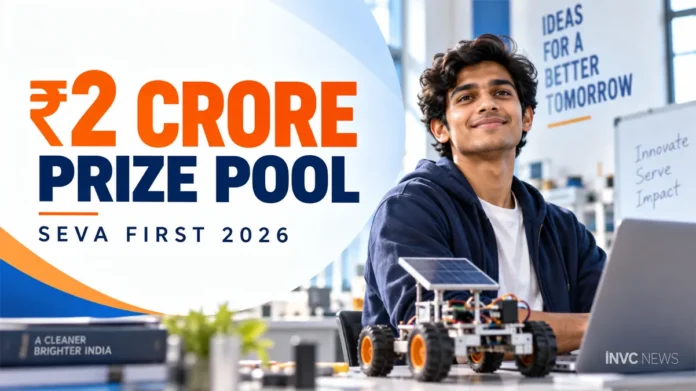
NEW DELHI, India | September 21, 2026 — Young innovators across India have a new opportunity to turn ideas into working solutions as the SEVA FIRST Innovation Challenge 2026 opens a national platform backed by a total prize pool of ₹2 crore.
Launched at Delhi Technological University, the initiative aims to bring students, researchers, educational institutions, startups and innovators together to solve practical problems affecting communities, industries and public systems.
Unlike competitions that stop at presentations and ideas, SEVA FIRST places strong emphasis on building solutions that can actually work on the ground.
Participants will move through problem identification, ideation, design, prototype development, testing and validation.
What is SEVA FIRST Innovation Challenge 2026?
SEVA FIRST is a youth-focused innovation programme designed to encourage practical problem-solving.
The challenge asks participants to observe problems around them and create affordable, sustainable and scalable solutions.
The programme focuses on turning ideas into functional prototypes rather than limiting participants to theoretical proposals.
That gives young innovators an opportunity to demonstrate not only creativity but also whether their solution could work in real-world conditions.
₹2 Crore Prize Pool Draws Attention
One of the biggest attractions is the ₹2 crore total prize pool announced for the challenge.
The money represents the overall awards pool and should not be interpreted as a ₹2 crore individual prize for every participant or winner.
Successful participants can also gain exposure to mentors, experts, industry representatives and the wider startup ecosystem.
For students hoping to turn a college project into something bigger, that exposure could prove just as important as the prize money.
Who Can Participate?
The initiative targets India’s young innovation ecosystem.
Students, researchers and innovators can explore participation, while educational institutions and startup-linked teams also form part of the wider programme.
DTU is serving as an important anchor institution for the initiative in northern India.
The challenge seeks participation from people capable of identifying a genuine problem and then developing a practical solution around it.
That means entrants should think beyond flashy presentations.
A strong entry will need to answer a simple question: Does this idea solve a real problem, and can it actually be implemented?
What Kind of Ideas Are They Looking For?
The programme covers areas where technology and innovation can create measurable impact.
Focus areas include challenges involving agriculture, clean energy, infrastructure, sustainability, waste management, rural development and other public-interest problems.
Artificial intelligence, automation, robotics and advanced technologies may also play a role where they offer a practical solution.
However, technology alone will not make an idea valuable.
Affordability, usability, sustainability and the ability to scale will matter heavily.
For example, a simple low-cost solution that helps farmers or improves waste management could potentially carry more real-world value than an expensive prototype with little practical application.
Ideas Need to Become Working Prototypes
This is where SEVA FIRST becomes particularly interesting.
Participants are expected to move through a complete innovation journey.
They must first understand the problem. Next comes solution design. Teams then need to develop a prototype, test it and collect feedback.
Finally, promising innovations should demonstrate how the solution could be expanded or deployed.
The programme therefore pushes young innovators to think more like entrepreneurs and problem-solvers rather than competitors preparing only for a presentation.
Mentorship Could Be a Major Advantage
Money is only one part of the programme.
Participants can also gain access to faculty members, mentors, industry professionals and government-linked innovation networks.
For first-time founders and students, such connections can help answer difficult questions about product development, funding, market demand and implementation.
A successful prototype could also provide a foundation for future entrepreneurship.
Before Applying, Prepare These Things
Young people interested in the challenge should begin by identifying one clearly defined problem rather than starting with technology.
First, understand who faces the problem.
Next, determine how serious and widespread it is.
Then explain why existing solutions do not solve it effectively.
Only after that should a team decide what technology or approach could provide a better answer.
Participants should also think about cost.
A prototype may work brilliantly inside a laboratory but still fail if its final price makes it inaccessible to the people who actually need it.
Why Students and Startups Should Watch This Challenge
India produces thousands of engineering, technology and research projects every year.
Many disappear after examinations, exhibitions or college evaluations.
Programmes such as SEVA FIRST attempt to create a bridge between those ideas and real implementation.
That makes this competition potentially relevant not only for students chasing prize money but also for people looking to build a startup, develop a portfolio, find mentors or test an idea outside the classroom.
One Important Point Before Registration
Applicants should rely on the official SEVA FIRST and DTU information for eligibility, registration windows, problem statements and submission requirements.
Competition schedules and participation instructions can change as different stages open.
Candidates should therefore verify the latest official instructions before submitting documents or sharing personal information.
For India’s young innovators, however, the message is already clear: a problem you see every day could become the starting point for your next serious innovation.