By Team INVC | INVC NEWS
MUMBAI, India | September 15, 2026 —
Stock Market Today September 15 2026 begins with Indian equities preparing to return after the Ganesh Chaturthi holiday, and early signals point to a positive start for the Sensex and Nifty despite an increasingly difficult global backdrop.
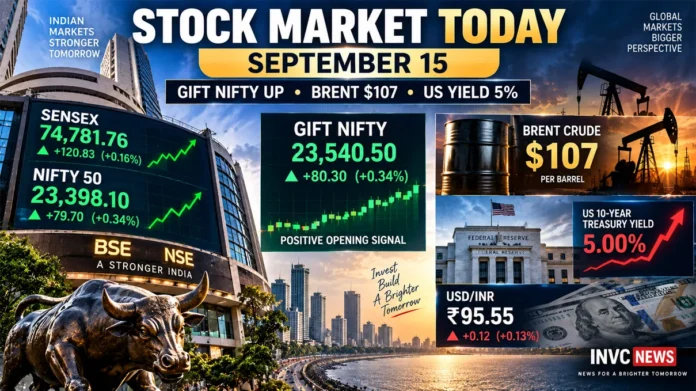
GIFT Nifty traded around 80 points higher in early deals, indicating that the Nifty 50 could open above the 23,500 zone. However, investors return to Dalal Street with Brent crude near $107 a barrel, the US 10-year Treasury yield around the psychologically important 5% level, a weak rupee and the Federal Reserve beginning a crucial two-day policy meeting.
That combination makes Tuesday far more complicated than the positive GIFT Nifty signal alone suggests.
The market may open higher, but holding those gains could prove to be the real test.
Sensex and Nifty Return After Ganesh Chaturthi Holiday
The NSE and BSE were closed on Monday, September 14, for Ganesh Chaturthi.
Indian equities will therefore react today to nearly four days of accumulated global developments, including another jump in crude oil, weakness on Wall Street, higher US bond yields and fresh concerns over inflation.
The Sensex had closed Friday at 74,781.76, down 120.83 points or 0.16%.
The Nifty 50 ended at 23,398.10, losing 79.70 points or 0.34%.
Despite recovering significantly from their intraday lows, both benchmarks completed another difficult week.
The Nifty has now suffered five consecutive weekly losses, reflecting pressure from expensive crude oil, Middle East tensions, global interest-rate fears and continued foreign selling.
GIFT Nifty Signals a Positive Opening
The strongest positive cue before Tuesday’s opening comes from GIFT Nifty.
GIFT Nifty traded roughly 80 points, or 0.34%, higher, pointing toward a positive opening for the Nifty 50.
That could push the domestic benchmark back above the important 23,500 zone if the indication holds through the opening bell.
However, traders should treat the early signal with caution.
GIFT Nifty indicates the likely direction at the opening but does not guarantee where the market will trade later in the session.
Oil prices, the rupee, foreign flows and international bond yields could quickly influence sentiment after trading begins.
Brent Crude Near $107 Becomes India’s Biggest Market Risk
Crude oil remains the single biggest macroeconomic threat hanging over Indian equities.
Brent crude traded around $106.98 per barrel, up more than 1% as supply concerns intensified.
For India, expensive oil creates a much broader problem than simply higher energy prices.
India imports most of the crude oil it consumes. Therefore, a sustained rise in international prices can widen the import bill, increase pressure on the rupee and revive inflation concerns.
Higher inflation can then restrict the Reserve Bank of India’s room to support economic growth through easier monetary policy.
Oil-sensitive sectors could remain particularly volatile.
Aviation companies, paint manufacturers, tyre companies, logistics businesses and other industries that use crude-linked inputs can face margin pressure when energy prices remain elevated.
Oil producers, meanwhile, may find support from higher realizations.
US 10-Year Treasury Yield Hits the 5% Barrier
The bond market has produced another major warning sign for global equities.
The US 10-year Treasury yield briefly moved above 5%, reaching its highest level since 2023.
That matters enormously for stock markets around the world.
When US government bonds offer yields near 5%, global investors gain a relatively attractive alternative to riskier equity investments.
High Treasury yields can therefore pull capital away from emerging markets and increase pressure on foreign portfolio flows.
They also increase borrowing costs across the global economy.
For Indian markets, that combination can hurt high-valuation growth stocks and intensify pressure on the rupee.
Technology shares could remain particularly sensitive because higher global yields reduce the present value investors assign to future earnings.
Federal Reserve Meeting Begins Today
The Federal Reserve begins its two-day policy meeting on September 15, with the interest-rate decision scheduled for September 16.
Markets increasingly expect the Fed to take a tougher stance after renewed inflation concerns and the surge in global energy prices.
A rate increase would strengthen the higher-for-longer interest-rate narrative and potentially keep Treasury yields elevated.
However, the rate decision itself will represent only part of the story.
Investors will closely examine the Federal Reserve’s economic projections and guidance about future rate moves.
A hawkish signal could create another wave of volatility across equities, bonds, currencies and commodities.
A less aggressive message could provide some relief.
Rupee Near 95.55 Keeps Currency Risk in Focus
The Indian rupee remains another major concern.
The currency recently closed near ₹95.55 against the US dollar after losing more than 1% over the previous week.
High crude prices put direct pressure on the rupee because Indian importers require more dollars to pay for oil.
Elevated US bond yields can add another layer of pressure by making dollar-denominated assets more attractive.
A weaker rupee can help export-oriented companies, particularly some IT and pharmaceutical businesses.
However, it also makes imports more expensive and can increase inflationary pressure.
Currency movement will therefore remain one of Tuesday’s most important market indicators.
FIIs Sell, DIIs Provide Support
Institutional flows continue to tell two different stories.
Foreign institutional investors sold approximately ₹930.9 crore worth of Indian equities in the latest available cash-market session.
Domestic institutional investors, however, purchased around ₹1,968.2 crore.
That domestic buying helped absorb a portion of the foreign selling pressure.
This pattern has become increasingly important for Indian equities.
Strong flows from mutual funds, insurance companies and other domestic institutions have repeatedly provided support during periods when overseas investors reduced exposure.
Yet sustained FII selling can still pressure large-cap benchmarks, particularly financial and technology stocks.
Wall Street Ends Lower Before India Reopens
US equities closed lower on Monday.
The S&P 500 lost about 0.5%, while the Nasdaq Composite fell roughly 0.6% and the Dow Jones Industrial Average declined around 0.3%.
Higher oil prices and elevated bond yields weighed on risk sentiment.
Asian markets also opened on a weak footing Tuesday, creating a mixed global setup for Dalal Street.
The contrast is notable.
India’s GIFT Nifty indicates a positive opening even as several major overseas markets flash caution.
That divergence could make the opening hour particularly volatile.
Nifty 23,500 Becomes the First Big Test
For the Nifty 50, the 23,500 level could become the first important sentiment test.
A sustained move above this zone could improve short-term momentum and potentially open the path toward the 23,600–23,650 region.
Failure to sustain the recovery could return attention to the 23,300 area and Friday’s intraday low near 23,230.
These are reference levels rather than guaranteed targets.
In a market dominated by crude oil, geopolitics and global bond yields, international developments can override technical signals quickly.
Banking Stocks Could Decide the Sensex Direction
Banking and financial stocks will remain crucial for the broader market.
Heavyweight private banks carry substantial weight in both the Sensex and Nifty.
Any recovery in these counters can provide powerful support to the benchmark indices.
However, rising global bond yields and domestic rate expectations can complicate sentiment.
Investors will therefore watch HDFC Bank, ICICI Bank, State Bank of India, Axis Bank and Kotak Mahindra Bank closely after the opening.
IT Stocks Face a Different Battle
Technology stocks enter Tuesday with conflicting forces.
A weaker rupee can help companies that earn significant revenue in dollars.
At the same time, rising US Treasury yields and concerns over global technology valuations create pressure.
The US economy also remains a crucial source of revenue for Indian IT exporters.
Any indication that high interest rates could weaken corporate spending may influence sentiment toward Infosys, TCS, HCLTech, Wipro and Tech Mahindra.
Oil and Gas Stocks Could Stay in Focus
Elevated crude prices put energy companies at the center of the market.
Upstream producers can benefit from stronger international crude prices.
However, refiners, fuel retailers and industries dependent on imported oil face a more complicated environment.
Reliance Industries will also remain important because of its heavyweight status and its exposure across energy and consumer businesses.
Movements in Reliance alone can meaningfully influence the Sensex and Nifty.
Auto, Aviation and Paint Stocks Face Higher Input-Cost Risk
Persistently expensive crude oil can create pressure across several sectors.
Airlines face higher aviation turbine fuel costs.
Paint manufacturers depend on crude-linked raw materials.
Tyre makers, chemical producers and logistics companies can also experience cost pressure.
Automakers face an indirect challenge if expensive fuel affects consumer demand or contributes to broader inflation.
Investors should therefore watch sector-level moves rather than relying only on headline index performance.
Five Things Investors Should Watch Today
1. Nifty above or below 23,500:
A sustained move above this zone could strengthen the recovery attempt.
2. Brent crude around $107:
Another move toward $110 could increase pressure on Indian risk assets.
3. US Treasury yields:
The 5% level remains a major global market signal.
4. Rupee movement:
Further weakness could increase inflation and foreign-flow concerns.
5. FII activity:
A return of strong foreign selling could challenge the positive opening signal.
Can Sensex and Nifty Hold a Positive Opening?
That is the central question for Tuesday.
GIFT Nifty provides a constructive opening signal, but almost every major external variable argues for caution.
Crude remains expensive.
US bond yields remain elevated.
The rupee is weak.
Foreign investors have remained net sellers.
The Federal Reserve begins a crucial policy meeting today.
Middle East tensions continue to threaten global energy supplies.
Therefore, the first 15 minutes of trade may tell only part of the story.
A more meaningful signal will emerge if the Nifty holds above 23,500 after the initial volatility settles.
If domestic institutional buying remains strong and oil prices stabilize, Indian equities could attempt a relief recovery.
However, another jump in crude or US bond yields could quickly erase early gains.
For investors, Tuesday’s market is less about chasing the opening move and more about watching whether that move survives.
Market Disclaimer: Stock-market information is provided for general news and educational purposes. It does not constitute investment advice. Investors should assess their financial circumstances and consult a qualified professional before making investment decisions.