
By Team INVC | INVC NEWS
NEW DELHI, India | September 14, 2026 —
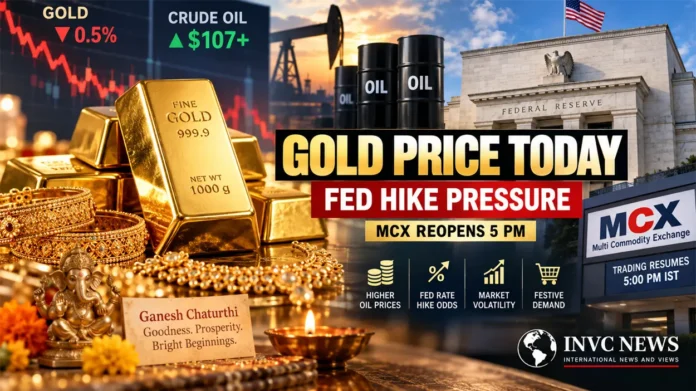
Gold Price Today moved lower on Monday as surging crude oil prices revived inflation fears and pushed traders toward expectations that the US Federal Reserve could raise interest rates this week.
Spot gold slipped about 0.3% to around $4,334 per ounce during early global trading, while US gold futures fell roughly 0.8% to around $4,375 per ounce.
The pressure arrived at an important time for Indian buyers.
Ganesh Chaturthi celebrations have increased interest in physical gold and jewelry, while Indian commodity traders are also waiting for the Multi Commodity Exchange to reopen its evening session after the holiday closure.
The biggest question now is whether gold prices could fall further if the Federal Reserve raises rates — or whether geopolitical uncertainty and elevated oil prices will bring safe-haven buyers back.
Gold Price Today: What Is Happening?
Gold entered Monday under pressure after posting its third consecutive weekly decline.
The immediate trigger came from crude oil.
Brent crude surged to around $107.82 a barrel, while US crude moved above $100 as fresh attacks on Middle East energy and shipping infrastructure increased concerns over global supply.
Normally, investors often turn to gold when geopolitical tensions escalate.
This time, however, oil’s inflationary impact is creating a competing force.
Higher energy prices can keep inflation elevated.
Persistent inflation can force central banks to keep interest rates high or raise them further.
That combination hurts gold because the precious metal does not pay interest.
Fed Rate Hike Odds Jump Above 86%
The Federal Reserve will announce its next policy decision after its September 15–16 meeting.
Markets have dramatically changed their expectations.
Traders now price in roughly an 86.5% chance of a US rate increase this week, up from around 67% before the latest inflation data.
US consumer prices accelerated in August, while a key underlying inflation measure recorded its largest increase in four months.
Goldman Sachs and JPMorgan have also moved toward expectations of a September rate hike.
That shift has become the biggest near-term challenge for bullion.
If the Federal Reserve raises rates and signals that additional tightening remains possible, gold could face renewed pressure from higher bond yields and a stronger US dollar.
On the other hand, any unexpectedly cautious message from the Fed could quickly revive buying.
Why Rising Oil Prices Are Hurting Gold
At first glance, expensive oil and weaker gold may appear unusual.
Both can rise during geopolitical crises.
However, markets currently see oil through the inflation lens.
Higher crude prices increase transportation, manufacturing and energy costs across economies.
Those costs can eventually flow into consumer prices.
Central banks may then respond by maintaining restrictive monetary policy.
That raises the opportunity cost of owning gold.
Investors can earn interest from bonds, deposits and other yield-bearing assets, while physical gold produces no regular income.
As a result, bullion can struggle even when geopolitical uncertainty remains high.
Middle East Crisis Keeps a Floor Under Gold
Gold still has significant support from geopolitical risk.
Fresh attacks have intensified concerns surrounding Saudi energy infrastructure, the Strait of Hormuz and shipping routes near the Red Sea.
Oil supply disruptions have already pushed crude prices sharply higher.
Diplomatic uncertainty has also increased after planned talks involving Iran and Gulf countries were postponed.
These developments may prevent gold from falling as sharply as it otherwise might during a rate-hike cycle.
Safe-haven demand tends to return quickly when investors fear a wider military or financial shock.
That leaves gold caught between two powerful forces: higher interest rates on one side and geopolitical risk on the other.
MCX Gold Market Closed in Morning, Reopens at 5 PM
Indian commodity traders need to keep today’s holiday schedule in mind.
The Multi Commodity Exchange has closed its morning session from 9:00 AM to 5:00 PM for Ganesh Chaturthi.
However, MCX will reopen for the evening session at 5:00 PM IST.
That evening reopening could produce significant movement because Indian futures will have to absorb several hours of international gold, crude oil, dollar and bond-market action at once.
The October MCX gold contract ended Friday at approximately ₹1,52,655 per 10 grams.
Domestic spot gold was around ₹1,51,549 per 10 grams in the previous session.
Silver futures were near ₹2,34,886 per kilogram.
Those levels provide the reference point for traders ahead of Monday evening’s reopening.
Gold Rates in India on September 14
Physical gold prices vary by city, jeweler, purity, local demand, taxes and making charges.
A morning retail-market snapshot in major Maharashtra cities showed 24-karat gold around ₹1,52,990 per 10 grams and 22-karat gold around ₹1,40,241 per 10 grams in Mumbai, Pune, Nagpur and Nashik.
Silver was quoted around ₹2,34,260 per kilogram in the same snapshot.
Actual jewelry purchase prices can be higher because making charges and applicable taxes are added separately.
Buyers should therefore confirm the final per-gram rate and total charges directly with the jeweler before making a purchase.
Silver Price Also Falls
Gold is not the only precious metal facing pressure.
Spot silver slipped about 0.7% to $64.02 per ounce in international trading.
Platinum hovered near $1,797 per ounce, while palladium remained close to $1,299.
Silver faces an additional complication because it behaves both as a precious metal and an industrial commodity.
Higher interest rates can pressure investment demand, while changes in global manufacturing activity can affect industrial consumption.
For Indian buyers, silver prices remain elevated despite Monday’s decline.
Should You Buy Gold Today?
There is no single answer that fits every buyer.
Someone purchasing jewelry for a festival, wedding or family requirement faces a different decision from an investor trying to time the market.
Short-term gold prices could remain volatile until the Federal Reserve announces its policy decision.
A rate hike accompanied by aggressive guidance could place further downward pressure on bullion.
However, continued escalation in the Middle East could quickly strengthen safe-haven demand.
That means buyers trying to predict the exact lowest price face considerable uncertainty.
For jewelry buyers, checking purity, hallmarking, making charges and the final invoice can matter just as much as a small intraday movement in the base gold rate.
Investment buyers should also distinguish between physical gold, ETFs, sovereign-style instruments where available and commodity futures because each carries different risks and costs.
What Could Push Gold Lower?
The clearest bearish trigger would be a stronger-than-expected Federal Reserve message.
Higher US rates generally support Treasury yields and the dollar.
Both can reduce demand for gold.
A cooling of Middle East tensions could add another source of pressure because some safe-haven demand would fade.
Profit-taking may also continue after gold’s enormous long-term rise.
Bullion remains at historically elevated levels even after recent weekly declines.
What Could Send Gold Higher Again?
Gold could rebound if the Federal Reserve surprises markets by keeping rates unchanged or signals that further increases are unlikely.
A weaker dollar would also help.
Escalating geopolitical tensions represent another major upside risk.
Any further disruption to the Strait of Hormuz, Saudi energy infrastructure or global shipping routes could trigger a renewed flight toward traditional safe-haven assets.
Central-bank purchases and long-term investment demand also remain important structural supports for bullion.
Goldman Sachs Still Sees Long-Term Upside
Despite short-term pressure, some major financial institutions remain constructive on gold over the longer term.
Goldman Sachs continues to see upside risk to its forecast of gold reaching around $4,900 per ounce by the end of 2026, while warning that volatility could remain high.
That forecast does not mean prices will move straight upward.
Gold can experience sharp corrections even during a longer-term bullish cycle.
For buyers, the next several days could therefore matter more than usual.
Three Things Gold Buyers Should Watch Now
The immediate direction of gold will depend heavily on three developments:
- Federal Reserve decision: Markets expect a rate hike, making the Fed’s guidance critical.
- Crude oil and Middle East tensions: Higher oil can increase both inflation fears and safe-haven demand.
- US dollar and Treasury yields: A stronger dollar and higher yields generally create pressure on bullion.
These forces can pull gold in opposite directions, which explains the current volatility.
Gold Price Outlook: Volatility May Stay High
Gold’s next major move may become clearer after the Federal Reserve meeting.
Until then, investors are likely to react quickly to oil prices, inflation signals, geopolitical developments and changes in rate expectations.
For Indian traders, Monday evening could become particularly important when MCX reopens at 5:00 PM after the Ganesh Chaturthi morning-session holiday.
For physical buyers, today’s modest decline offers some relief from recent elevated prices.
However, anyone buying gold should remember that retail jewelry costs include more than the headline bullion rate.
The next decisive move could come from Washington.
If the Fed raises rates and remains hawkish, gold may face another test.
If policymakers surprise markets — or geopolitical tensions intensify — the yellow metal could rapidly regain its safe-haven appeal.