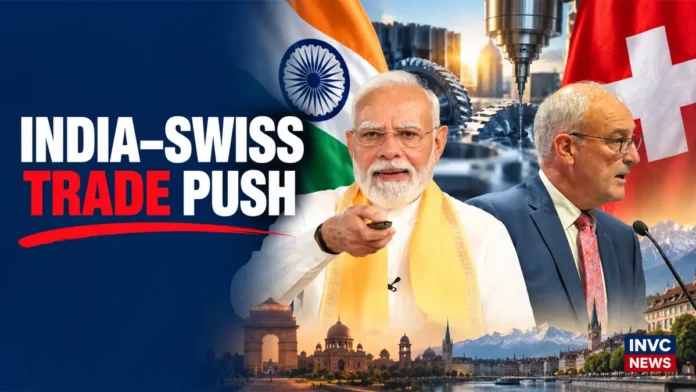
Guy Parmelin’s October 5–7 state visit brings business leaders to India as the two countries review their partnership and mark one year of the India–EFTA trade agreement.
By Team INVC | INVC NEWS
NEW DELHI, India | October 5, 2026 — Swiss President Guy Parmelin’s India visit brings a practical question into focus: how can closer diplomatic ties translate into investment, technology partnerships and business opportunities? His three-day state visit, scheduled for October 5–7 at Prime Minister Narendra Modi’s invitation, comes as India and the European Free Trade Association review the first year of their trade agreement.
Senior officials and business leaders will accompany Parmelin, according to India’s Ministry of External Affairs. Their participation gives the visit a commercial dimension alongside its diplomatic agenda.
Modi–Parmelin Talks Set for October 5
Prime Minister Narendra Modi and President Parmelin are scheduled to hold bilateral talks on Monday.
The Ministry of External Affairs said the discussions will cover trade and investment, science, technology and innovation, mobility, culture, and people-to-people relations. The leaders will also exchange views on regional and global developments and cooperation at international forums.
This will be Parmelin’s first state visit to India, although he visited New Delhi in February for the AI Impact Summit.
That distinction matters: the October visit provides a broader setting for reviewing the relationship, beyond his earlier participation in a technology event.
Why the EFTA Agreement Matters
The economic backdrop is the India–EFTA Trade and Economic Partnership Agreement, known as TEPA.
The agreement entered into force on October 1, 2025, according to EFTA’s official joint communiqué. Its four European members are Switzerland, Norway, Iceland and Liechtenstein.
Parmelin is scheduled to participate in the second India–EFTA Prosperity Summit on October 7, which will mark the agreement’s first anniversary.
The summit takes place six days after the anniversary date. It offers a platform to examine implementation and explore further business cooperation.
India’s foreign ministry identifies Switzerland as the country’s largest trade and investment partner within EFTA. Consequently, Swiss business participation carries particular importance for the partnership’s next phase.
The $100 Billion Goal: What It Actually Means
TEPA includes a shared objective to increase investment from EFTA investors into India by $100 billion over 15 years and facilitate one million direct jobs linked to that investment.
The agreement’s investment chapter divides the objective into two stages: $50 billion within the first 10 years and an additional $50 billion over the following five years.
These figures describe long-term objectives across the EFTA partnership. They do not represent a new $100 billion Swiss investment announcement for this visit, money already received, or jobs already created.
For businesses and workers, the meaningful evidence will come through actual investment decisions, operating projects and attributable employment.
Technology Cooperation Adds Another Dimension
Trade is only part of the agenda. The planned discussions also place science, technology and innovation alongside commercial cooperation.
That combination creates scope for partnerships involving businesses, researchers and institutions. However, the announced agenda does not establish that the leaders have already agreed to specific new projects.
From an economic perspective, the opportunity extends beyond selling more products. Companies can also explore production partnerships, technical expertise and stronger links between suppliers and markets.
EFTA’s implementation communiqué identifies precision manufacturing and clean technologies among potential areas for business cooperation.
What Mobility Talks Could Mean
Mobility and people-to-people relations also feature in the planned review.
These topics matter to professionals, researchers and businesses whose work depends on international collaboration. Nevertheless, an agenda item does not automatically establish new visa rules, employment rights or unrestricted movement.
Any specific change would require its own announcement and implementation details.
Readers should therefore distinguish the intention to deepen cooperation from an approved measure that individuals can immediately use.
Meetings With Murmu and Jaishankar
Parmelin’s program also includes a meeting with President Droupadi Murmu, who will host an official banquet in his honor. External Affairs Minister S. Jaishankar is scheduled to meet the Swiss president during the visit.
These engagements place the economic discussions within a wider diplomatic relationship.
The Ministry of External Affairs said the visit would build on regular high-level exchanges and help expand cooperation in areas of mutual interest.
INVC NEWS | BEYOND THE HEADLINE
The most useful measure of this visit will be the progress it helps produce after the meetings.
For companies, that could mean clearer opportunities to invest or build partnerships. For researchers and professionals, it could mean more concrete channels for collaboration. For policymakers, it means assessing how the trade agreement’s implementation supports its longer-term objectives.
The October 5 talks and October 7 summit provide opportunities to advance that work. Any agreements, investment announcements or mobility measures that emerge will need assessment on their own terms.