By Team INVC | INVC NEWSWASHINGTON, D.C., United States | September 15, 2026 —
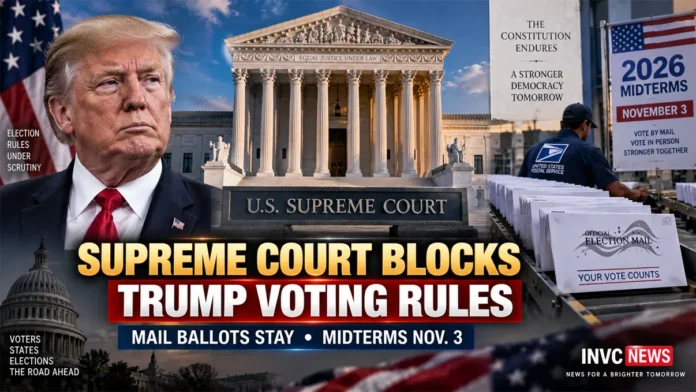
Trump Mail Ballot Restrictions will not take effect before the 2026 midterm elections after the U.S. Supreme Court rejected the administration’s emergency attempt to impose sweeping new Postal Service requirements on states just weeks before voters decide control of Congress.
The decision leaves existing state mail-voting procedures in place for the November 3 elections and removes a major source of uncertainty for election officials who have already begun sending ballots in several states.
President Donald Trump’s administration wanted states to provide lists of eligible mail-ballot recipients to the U.S. Postal Service and use specially approved ballot envelopes carrying unique barcodes.
Under the disputed rule, the Postal Service could refuse to process or deliver ballots if states failed to meet the new requirements.
Lower courts blocked the plan.
The Supreme Court has now refused to let the administration enforce it while the legal challenges continue.
The ruling does not permanently settle every question surrounding presidential authority, the Postal Service or future mail-voting rules.
However, for the 2026 midterms, its immediate effect is clear:
States can continue running mail voting under the procedures they already use.
Supreme Court Rejects Trump’s Emergency Request
The Justice Department had asked the Supreme Court to lift an injunction issued by a federal judge in Boston.
The justices declined.
In a brief order, the court said the government was unlikely to succeed on the merits of its challenge to the lower-court injunction.
That language is significant.
Emergency Supreme Court orders often focus narrowly on whether a policy should temporarily take effect.
This time, the majority went further by signaling skepticism about the administration’s underlying legal position.
That does not amount to a final judgment.
Still, it creates a substantial obstacle for the White House if it continues defending the current rule.
What Trump Wanted to Change
The disputed Postal Service regulations would have dramatically changed how states interact with the federal mail system during elections.
States would have been required to submit lists identifying voters eligible to receive mailed ballots.
Ballot envelopes would have needed Postal Service approval.
Outbound and return envelopes would also have carried unique barcodes.
If a voter did not appear on an approved list, or if a state did not comply with the prescribed envelope standards, the Postal Service could refuse to handle the ballot under the administration’s plan.
Supporters described the requirements as election-security safeguards.
Opponents argued that they would place the Postal Service in a role traditionally reserved for state election authorities.
Why Timing Became So Important
The legal battle reached the Supreme Court with the election calendar already moving.
Some states have begun sending mail ballots.
Election officials argued that redesigning envelopes, building data systems, uploading voter lists and testing new procedures so close to Election Day would create enormous logistical problems.
The United States does not operate one centralized election system.
Thousands of local election offices administer voting under state-specific laws.
That means a last-minute national change can require thousands of jurisdictions to alter procedures simultaneously.
Courts were particularly concerned about the possibility that otherwise eligible voters could lose access to ballots because election offices could not implement the new federal requirements in time.
Election Day Is November 3
The 2026 midterm elections will take place on November 3.
All 435 seats in the House of Representatives are on the ballot, along with roughly one-third of the Senate.
Republicans are fighting to preserve congressional control.
Democrats hope to capture at least one chamber and restrict the White House’s ability to advance its agenda during the final two years of Trump’s term.
That gives every major election-law ruling unusually high political stakes.
Mail voting could prove especially important in competitive states and congressional districts where narrow margins may decide control of Washington.
Nearly One-Third of Americans Use Mail Ballots
Mail voting has become a major component of U.S. elections.
All 50 states allow some form of absentee or mail voting.
Twenty-nine states allow eligible voters to request a mail ballot without providing a specific excuse.
Eight states conduct elections almost entirely through the mail.
Across the country, mailed ballots have accounted for close to one-third of votes cast in recent elections.
That scale explains why election administrators reacted so strongly to the proposed changes.
Even a relatively small technical failure could potentially affect large numbers of voters.
Eight States Faced Especially Serious Disruption
The stakes were highest in states where mail voting forms the backbone of the election system.
California, Colorado, Hawaii, Nevada, Oregon, Utah, Vermont and Washington conduct elections predominantly by mail.
These states do not necessarily maintain enough traditional polling infrastructure to replace mail voting at short notice.
Election administrators warned that imposing a new nationwide envelope and voter-list system immediately before the midterms could force them to rebuild core election processes while voting was already beginning.
The Supreme Court’s ruling removes that immediate requirement.
Trump Administration Says Rules Would Protect Elections
The White House has consistently presented stronger mail-voting rules as an election-security measure.
The administration argued that federal control over the Postal Service gives it significant authority over how election mail moves through the system.
Justice Department lawyers also maintained that the rule would not replace state election laws or determine voter eligibility.
Under that argument, states would still decide who can vote.
The Postal Service would regulate only how ballots enter and move through the mail network.
The administration also argued that stronger verification systems could reduce opportunities for fraud.
Courts Question Postal Service Authority
Opponents made a fundamentally different argument.
They said election administration belongs primarily to the states, subject to authority granted to Congress under the Constitution.
Two federal judges blocked the Postal Service rule.
One judge concluded that major portions of the rule exceeded the agency’s statutory authority.
Another found serious constitutional concerns and questioned whether states could realistically comply before the election.
The dispute therefore became about more than mail ballots.
It raised a larger constitutional question:
How much power can a president use through a federal agency to influence rules governing elections administered by states?
Trump-Appointed Judge Also Blocked the Rule
One of the lower-court setbacks came from U.S. District Judge Carl Nichols in Washington.
Nichols was appointed by Trump during his first presidential term.
He nevertheless concluded that the Postal Service lacked statutory authority for key parts of the regulation.
That fact makes the legal battle harder to reduce to a simple partisan divide.
The Boston-based federal court had already issued a separate injunction.
An appeals court then refused to pause that order.
The administration ultimately turned to the Supreme Court.
Alito and Thomas Dissented
Justice Samuel Alito disagreed with the Supreme Court’s decision.
Justice Clarence Thomas joined his dissent.
Alito argued that the Postal Service possesses broad authority to regulate the mail and questioned whether challengers were likely to prevail.
However, no other justice publicly joined the dissent.
The result is particularly notable because the Supreme Court currently has a 6-3 conservative majority.
The administration therefore failed to win enough support even from a court whose ideological composition has frequently benefited conservative legal arguments.
Kavanaugh Leaves the Door Open for Future Elections
Justice Brett Kavanaugh took a more nuanced position.
He agreed that the restrictions should not take effect for the 2026 midterms.
However, he indicated that the administration may have a stronger argument about Postal Service authority in a future case.
His central concern was timing.
State and local election administrators, he concluded, did not have enough time to implement the regulations reasonably before this year’s voting.
That distinction matters.
The court has effectively blocked the rule for 2026.
It has not necessarily declared that every similar federal election-mail regulation would always be unlawful.
Why the Ruling Is a Political Setback for Trump
Trump has made election rules a central part of his political agenda.
He has repeatedly argued that mail voting requires tighter safeguards and has pressed for greater federal involvement in election administration.
The Supreme Court ruling prevents one of the administration’s most consequential proposed changes from taking effect before an election that could reshape the rest of his presidency.
If Democrats capture the House, the administration could face intensified investigations, committee scrutiny and legislative resistance.
If Republicans retain both chambers, Trump would preserve a much stronger path for advancing his domestic agenda.
That makes the midterms critical to both parties.
Does Mail Voting Favor Democrats?
Political behavior surrounding mail ballots has changed sharply over the past decade.
Democratic voters have generally used mail voting at higher rates than Republicans in recent federal elections.
Trump’s repeated criticism of mail voting has contributed to that partisan divide.
However, Republican campaigns have also increasingly encouraged supporters to use early and absentee voting where permitted.
The electoral impact therefore varies significantly from state to state.
The Supreme Court ruling does not favor or prohibit any political party from using mail voting.
It simply prevents the new federal Postal Service restrictions from taking effect before the November election.
Fraud Claims Remain Central to the Political Debate
Trump has repeatedly questioned the security of mail voting.
The administration argues that tighter systems can strengthen public confidence and prevent abuse.
Election officials and voting-rights advocates counter that documented fraud involving mail ballots remains rare.
That disagreement has become one of the defining political battles surrounding American election administration.
Republicans often emphasize verification, voter eligibility and security.
Democrats and voting-rights groups emphasize access and warn that overly restrictive procedures can prevent eligible citizens from voting.
Both concerns will remain part of the political debate even after this Supreme Court decision.
Voting Has Already Started in Some States
The timing of the ruling gives it immediate practical importance.
Mail ballots have already begun moving in parts of the country.
Alabama, North Carolina and Wisconsin were among the states that began sending ballots while the legal battle remained unresolved.
Election officials had faced the possibility of changing procedures after ballot preparation had already begun.
The Supreme Court’s order largely eliminates that uncertainty for the current election.
Existing procedures can continue.
This Is Not the Final End of the Legal Fight
The Supreme Court did not issue a full final opinion resolving every constitutional and statutory question.
Instead, it rejected the administration’s emergency attempt to lift the injunction.
The underlying litigation can continue through lower courts.
Future appeals remain possible.
Congress could also address aspects of election-mail policy through legislation.
A future administration could pursue different regulations with more preparation time.
Therefore, the broader battle over federal power and mail voting is not finished.
But for 2026 Midterms, the Answer Is Clear
Whatever happens later, election officials now have far greater certainty about November.
States will not have to redesign mail-ballot systems around the administration’s new Postal Service rules.
Voters who planned to cast ballots by mail can continue following the procedures established by their states.
Election offices can continue printing and mailing ballots without waiting for a new federal system.
Politically, that represents a significant defeat for the White House.
Legally, it represents another limit on the administration’s effort to expand federal influence over election procedures.
And electorally, it removes a potentially enormous source of disruption less than two months before voters decide control of Congress.
The battle over American election rules is far from over.
But one major question surrounding November 3 has now been answered.
Trump’s new mail-ballot restrictions will not govern the 2026 midterm elections.