By Team INVC | INVC NEWS
NEW DELHI, India | October 4, 2026 — Consumers may want to take a closer look at their spice shelves after India’s food regulator ordered the immediate recall of a specific batch of Everest pre-packed cumin powder, while separately suspending the food license of Creative Bakers and Confectioners Pvt. Ltd. over what it described as severe hygiene deficiencies.
The two actions announced by the Food Safety and Standards Authority of India, or FSSAI, involve very different food-safety failures.
At Creative Bakers, inspectors reported dirt, grease, dust, cobwebs, flies, pest-control failures, open storage of perishable ingredients and rusted containers.
In the Everest case, laboratory testing found residues of two pesticides — azoxystrobin and thiamethoxam — above the prescribed maximum limits in a sampled batch of cumin powder. A referral laboratory later confirmed the sample as unsafe.
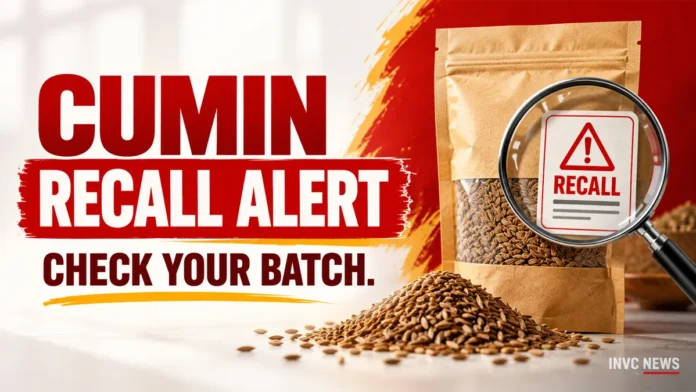
For consumers, the most important detail is the batch number:
Everest Pre-Packed Cumin Powder — Batch No. E080668761
FSSAI has directed that the entire implicated batch be withdrawn from the market.
THE 60-SECOND BRIEF
What happened to Creative Bakers?
FSSAI suspended the West Bengal-based company’s food license with immediate effect after inspectors found serious hygiene and sanitation problems.
What happened to Everest cumin powder?
One batch was ordered recalled after testing found pesticide residues above permitted limits.
Which pesticides were detected?
Azoxystrobin and thiamethoxam.
Which batch should consumers check?
Batch No. E080668761.
Was this based on only one laboratory result?
The original sample was declared unsafe, and after an appeal process, a Referral Food Laboratory also confirmed that the pesticide residues exceeded permitted limits.
Why FSSAI Suspended Creative Bakers’ License
The Creative Bakers case goes far beyond a minor housekeeping violation.
According to FSSAI’s findings cited in reports on the regulatory action, inspectors found dirt, grease, dust, cobwebs and flies in food production and handling areas.
Perishable raw materials were being stored in open conditions.
Inspectors also found rusted or inadequately cleaned containers being used for raw ingredients and semi-finished products.
The inspection reportedly identified broader pest-control problems as well.
FSSAI flagged ineffective fly-control measures, inadequate rodent control and openings or windows that lacked proper insect-proof mesh.
Those findings matter because food-safety controls do not stop at the ingredients themselves. The entire production environment — storage, equipment, surfaces, pest barriers, temperature controls and sanitation — plays a role in preventing contamination.
Waste, Rejected Stock and Rusting Equipment Also Flagged
The list of deficiencies continued.
Inspectors found waste material, old stock, rejected lots and scrap accumulated in food-handling areas.
They also noted:
- Rusting equipment
- Flaking paint
- Damp conditions
- Damaged floor tiles
- Poorly maintained food-handling areas
FSSAI also said mandatory food-safety records and monitoring systems had not been properly maintained. These included records for water testing, finished-product testing, temperature monitoring, equipment calibration, preventive maintenance, mock recalls, consumer complaints, staff training and audits.
Given the seriousness of the findings, the regulator suspended the company’s license with immediate effect and directed it to stop food-business operations during the suspension period.
Everest Cumin Powder Recall: What Exactly Did the Test Find?
The second case is likely to draw even greater consumer attention because cumin powder is an everyday kitchen staple.
FSSAI said a regulatory sample of pre-packed cumin powder manufactured by Everest Food Products Pvt. Ltd. was taken from the premises of Riverside Resorts & Holiday Homes in Goa.
A food analyst subsequently declared the sample unsafe.
The laboratory identified residues of two pesticides:
Azoxystrobin
Thiamethoxam
Both were reported above the prescribed maximum residue limits.
What Are Azoxystrobin and Thiamethoxam?
Azoxystrobin is used as a fungicide, while thiamethoxam is an insecticide.
FSSAI’s pesticide database lists specific maximum residue limits for pesticides in different food commodities, including cumin.
The regulator’s current data portal classifies azoxystrobin as a fungicide and lists an MRL for cumin, while thiamethoxam is classified as an insecticide with its own permitted residue level for cumin.
The issue in this recall is therefore not simply the detection of a pesticide.
The regulatory concern is that the tested residues were reported above the permitted maximum levels.
That distinction is crucial.
Everest Was Given an Opportunity to Appeal
The initial laboratory finding was not the final step.
According to FSSAI-linked reporting, the food business operator was given an opportunity to appeal the analyst’s result.
Following that process, the sample went to a Referral Food Laboratory.
That laboratory also confirmed that the product was unsafe because both pesticide residues exceeded permitted limits.
After the confirmation, FSSAI ordered the entire implicated batch to be recalled immediately.
The Batch Number Every Consumer Should Check
If you have Everest cumin powder at home, do not assume that every pack is covered by this action.
The order identified a specific implicated batch:
Batch No. E080668761
The recall action reported so far applies to that batch.
Consumers should therefore check the batch or lot information printed on their pack rather than treating the recall as applying automatically to every Everest cumin product.
FSSAI directed the company to maintain complete records of recalled stock, submit recall status information within prescribed timelines and take corrective steps aimed at preventing a recurrence.
What Should You Do If Your Pack Matches the Recalled Batch?
If the batch number on your pack matches E080668761, the safest practical response is to stop using that pack while the recall is being implemented and follow the retailer or manufacturer’s recall instructions as they become available.
Do not throw away the packaging immediately if you may need the batch number, purchase details or product information for a return or complaint.
Consumers can also use FSSAI’s recall and consumer-support systems to check official recall information and food-safety updates.
Why These Two FSSAI Actions Matter
These cases highlight two different points in the food-safety chain.
The Creative Bakers action concerns the conditions under which food is produced and handled.
The Everest action concerns what laboratory analysis found inside a finished packaged food product.
Both ultimately come back to the same principle: food that reaches consumers must comply with safety standards not just on paper, but in the factory, in storage and in the final product.
The cases also demonstrate why inspection records, pest controls, laboratory testing and recall systems matter.
A food recall is not simply a public-relations warning.
Under India’s food-safety framework, recalls are designed to remove food from the supply chain when it may pose a public-health concern or does not comply with applicable food-safety requirements.
Is Every Everest Cumin Pack Unsafe?
Based on the regulatory information available, no such conclusion should be made.
FSSAI’s recall direction identifies a specific batch.
That is an important distinction for consumers and retailers.
Similarly, the findings involving Creative Bakers relate to the facility inspected and the regulatory action taken against that food business operator.
Consumers should avoid expanding a batch-specific recall into claims about products that the regulator has not identified in its order.
INVC NEWS Bottom Line
FSSAI’s latest enforcement action sends two clear messages to consumers and food companies.
At Creative Bakers, the regulator found what it described as severe hygiene and sanitation failures — from flies, dust and grease to pest-control problems, rusting equipment and poorly maintained food-safety records.
In the separate Everest case, laboratory testing found azoxystrobin and thiamethoxam above permitted limits in a cumin powder sample, and a referral laboratory confirmed the unsafe finding.
The most important information for households is straightforward:
Check your Everest cumin powder pack for Batch No. E080668761.
The regulatory order reported so far targets that specific batch.
For consumers, this is exactly why a food recall should never be treated as just another corporate headline.
Sometimes the most important detail in the entire story is printed in tiny letters on the packet already sitting in your kitchen.