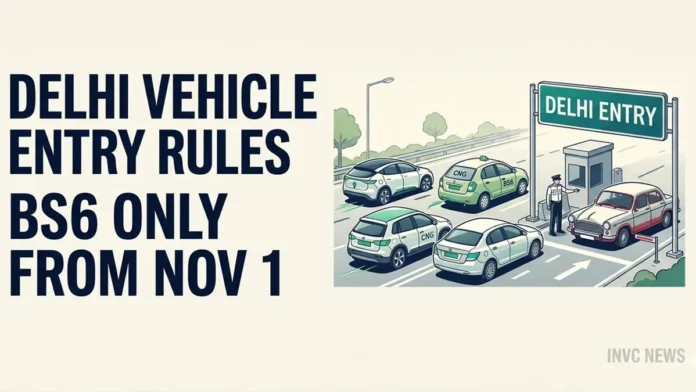
New Delhi, October 31, 2026: Motorists travelling to Delhi from neighbouring NCR cities and other states will face tighter vehicle-entry restrictions from November 1, as the capital steps up its winter air-pollution control measures. Under the new restrictions, vehicles registered outside Delhi that do not meet BS-VI emission standards will be barred from entering the city between November 1, 2026, and January 31, 2027.
The restrictions are particularly important for commuters travelling from Noida, Gurugram, Ghaziabad, Faridabad and other parts of the National Capital Region. Owners of older petrol and diesel vehicles should check their vehicle’s emission category before setting out for Delhi.
BS-VI-compliant petrol and diesel vehicles, CNG vehicles and electric vehicles will be allowed, subject to applicable rules. However, meeting the emission standard alone will not be enough: vehicles must also have a valid Pollution Under Control Certificate (PUCC).
Here is a practical guide to the new restrictions, exemptions and ways to check whether your vehicle meets the required emission standard.
When Will the Delhi Vehicle Entry Restrictions Apply?
The restrictions will come into force on November 1, 2026, and remain in effect until January 31, 2027.
The measure is part of Delhi’s winter pollution-control framework, when falling temperatures, stagnant air and local emissions can contribute to a deterioration in air quality.
The new entry restriction specifically targets non-Delhi-registered vehicles that do not meet BS-VI emission standards. This means petrol and diesel vehicles registered in other states or NCR cities and classified below BS-VI—including BS-III and BS-IV vehicles—will not be permitted to enter Delhi during the specified period.
The restriction is not a blanket exemption for every vehicle registered in Delhi. Delhi-registered vehicles remain subject to other applicable pollution-control rules, court directions and restrictions on overage or non-compliant vehicles.
Which Vehicles Will Be Allowed to Enter Delhi?
The following categories are permitted under the announced winter restrictions, subject to the applicable notification and document requirements:
- BS-VI petrol vehicles: Petrol cars and other vehicles registered outside Delhi that comply with BS-VI emission norms.
- BS-VI diesel vehicles: Diesel vehicles meeting the prescribed BS-VI standard.
- CNG vehicles: Vehicles running on compressed natural gas.
- Electric vehicles: Battery-powered electric vehicles.
- Specifically exempted vehicles: Vehicles covered by notified exemptions, including eligible emergency and essential-service categories.
Commercial goods vehicles may also be governed by separate CAQM directions covering BS-VI, CNG, LNG and electric vehicles. Motorists and transport operators should check the rules applicable to their vehicle category rather than assume that every exemption applies to every type of vehicle.
Which Vehicles Will Be Restricted?
The principal categories facing restrictions include:
- Petrol and diesel vehicles registered outside Delhi that fall below BS-VI emission standards.
- Non-BS-VI interstate buses, subject to the applicable bus and public-transport rules.
- Non-compliant commercial goods vehicles covered by separate CAQM directions.
- Vehicles without a valid PUCC, where the applicable rules require a valid certificate.
- Trucks passing through Delhi without the capital as their destination, which must follow designated peripheral routes instead of entering the city.
The Eastern Peripheral Expressway and Western Peripheral Expressway are among the designated routes for through-traffic that is not destined for Delhi.
Important: Will Vehicles Carrying Essential Goods Get an Exemption?
Transporters should pay particular attention to this provision. A previous CAQM direction allowed certain non-BS-VI commercial goods vehicles carrying essential commodities or providing essential services to enter Delhi only up to October 31, 2026.
That limited transition period ends on October 31. From November 1, transporters should not assume that a non-BS-VI goods vehicle will be permitted entry simply because it is carrying milk, vegetables, fruits, medicines or other essential supplies. The applicable commercial-vehicle requirements must be checked before dispatch.
This distinction is important because the rules for private passenger vehicles, commercial goods carriers and emergency-service vehicles are not necessarily identical.
How to Check Whether Your Vehicle Is BS6-Compliant
If you are unsure about your vehicle’s emission category, there are four practical ways to check it.
1. Check Your Registration Certificate (RC)
Your vehicle’s Registration Certificate is one of the most reliable documents for confirming its emission category.
Look for a field labelled Emission Norms, Emission Standard or a similar description on your RC or digital registration certificate.
- If it says BS-VI or BS6, the vehicle meets the BS-VI emission standard.
- If it says BS-IV, BS4, BS-III or an older category, it is below BS-VI.
Do not rely only on the vehicle’s model name or appearance. Check the emission-standard entry recorded in the registration documents.
2. Use the mParivahan App or Official VAHAN Services
You can also check your vehicle details online without carrying a physical copy of the RC.
Follow these steps:
- Open the mParivahan app or visit the official Parivahan/VAHAN services portal.
- Enter your vehicle registration number in the relevant vehicle-information section.
- Complete any required verification.
- Open the vehicle details displayed on the screen.
- Look for the Emission Norms field and check whether it says BS-VI or an older standard.
The Ministry of Road Transport and Highways’ vehicle information system includes an emission-norms field in the vehicle registration data available through its services.
3. Check the Vehicle’s Manufacturing and Registration Date
India moved to BS-VI emission standards nationwide from April 1, 2020. As a result, vehicles manufactured and sold under the new regime generally comply with BS-VI norms.
However, the manufacturing or registration year should only be treated as an initial indication—not final proof.
Some vehicles manufactured or registered around the transition period may require a closer check. The RC or official VAHAN record is a more dependable way to confirm the exact emission category.
4. Look for the Manufacturer’s Emission Label
You can also inspect the vehicle for its manufacturer’s emission-compliance information.
Depending on the model, the relevant label may be located in the engine compartment or on another designated part of the vehicle. It may mention the applicable Bharat Stage emission standard.
If the label is missing, unclear or difficult to interpret, confirm the information through the RC or the official vehicle database rather than relying on a visual guess.
A Valid PUCC Is Also Essential
Even if your vehicle meets BS-VI standards, you should not travel to Delhi without checking the validity of its Pollution Under Control Certificate.
The certificate records whether the vehicle meets the applicable pollution-emission requirements at the time of testing. Keep the valid certificate available in physical or accepted digital form.
Delhi’s winter pollution framework also includes a wider No PUC, No Fuel measure. Under this arrangement, vehicles without a valid PUCC can face restrictions on fuel purchases at fuel stations in the capital.
What Should NCR Commuters Do Before Travelling?
If you regularly travel between Delhi and Noida, Gurugram, Ghaziabad or Faridabad, check your vehicle documents before November 1.
A quick checklist can help avoid problems at Delhi’s entry points:
- Confirm the vehicle’s registration state.
- Check the emission standard on the RC or mParivahan.
- Ensure that the PUCC is valid.
- Check whether your vehicle category is covered by a specific exemption.
- If you operate a commercial goods vehicle, verify the separate CAQM requirements.
- If your vehicle is not eligible, consider public transport or another compliant vehicle.
The Bigger Picture
Delhi’s winter vehicle restrictions are intended to reduce emissions from vehicles entering and operating in the capital during the months when air quality often deteriorates.
For commuters, the immediate question is whether their vehicle meets the required emission standard. For transport businesses, the change also has operational implications: fleets carrying goods into Delhi may need to rely on compliant BS-VI diesel, CNG, LNG or electric vehicles, depending on the category and applicable directions.
The key takeaway is simple: check your RC, verify the emission category through official vehicle records and keep your PUCC valid before travelling to Delhi. Do not assume that an older vehicle will be allowed entry merely because it is carrying essential goods or is registered in an NCR city.