By Team INVC | INVC NEWS
RIYADH, Saudi Arabia | September 15, 2026 —
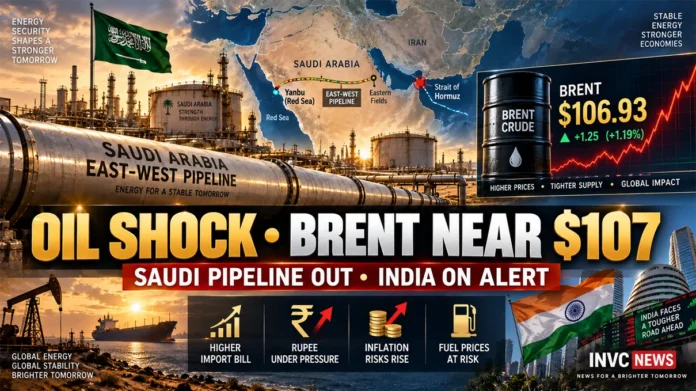
Saudi Oil Pipeline Outage has pushed global energy markets into a fresh danger zone, sending Brent crude above $106 a barrel as damage to Saudi Arabia’s critical East-West Pipeline threatens one of the world’s most important alternative oil-export routes.
Brent crude futures climbed to around $106.93 a barrel in early Tuesday trading, while US West Texas Intermediate rose to approximately $102.65.
The immediate problem goes far beyond the rise in oil prices.
Saudi Arabia built the East-West Pipeline to move crude from its eastern producing regions across the Arabian Peninsula to the Red Sea port of Yanbu. During the current Middle East crisis, the route became especially important because it allows Saudi crude to bypass the Strait of Hormuz.
Now that alternative route itself is damaged.
For India, one of the world’s largest crude-oil importers, the outage creates another threat to the rupee, inflation, corporate costs and potentially household fuel expenses if elevated oil prices persist.
Saudi East-West Pipeline Could Remain Disrupted for Weeks
The 1,200-kilometer East-West Pipeline was shut after attacks damaged infrastructure along the route.
Saudi authorities said the pipeline was closed as a precaution while technical teams assessed the damage and secured affected facilities.
Regional officials familiar with the repair operation estimate that significant restoration work could take roughly three to five weeks.
Partial operations may become possible before the entire system returns to normal.
However, Saudi Arabia has not publicly confirmed a precise date for full restoration.
That uncertainty matters enormously to oil markets.
The pipeline can transport up to roughly 7 million barrels per day at maximum capacity.
During the current regional crisis, Saudi Arabia had been using it to reroute around 4 million barrels per day toward the Red Sea.
That volume represents roughly 4% of global oil supply.
Why This Pipeline Matters So Much
Under normal conditions, much of Saudi Arabia’s crude reaches international customers through terminals connected to the Persian Gulf.
Tankers then move through the Strait of Hormuz.
That route has become increasingly risky amid months of Middle East conflict, attacks on commercial shipping and sharply reduced vessel traffic.
The East-West Pipeline offered Saudi Arabia an escape route.
Instead of sending crude through Hormuz, Saudi Arabia could move oil overland to Yanbu on the Red Sea coast.
The pipeline therefore acted as an energy-market safety valve.
Damage to that safety valve leaves traders asking a much more uncomfortable question: what happens if both the Gulf route and the Red Sea alternative face serious disruption at the same time?
That concern is now being priced into crude.
Brent Crude Climbs Back Toward $107
Brent crude rose more than 1% Tuesday morning to approximately $106.93 per barrel.
WTI climbed to about $102.65.
Oil had already experienced sharp swings in recent sessions as traders reacted to attacks on Saudi energy assets, instability around key shipping corridors and uncertainty over regional diplomacy.
The latest rise shows that markets remain highly sensitive to any development involving Saudi infrastructure.
A prolonged pipeline shutdown could push traders to demand an even larger geopolitical risk premium.
Oil prices could also remain volatile even if some pipeline capacity returns because markets will want evidence that supply routes can operate reliably.
Saudi Export Stocks Become Another Key Watchpoint
Saudi Arabia can use stored oil around its Red Sea export facilities to cushion the immediate disruption.
However, those inventories cannot replace normal pipeline flows indefinitely.
Industry estimates indicate that available stocks around Yanbu may sustain exports for only a limited period if fresh pipeline supplies remain constrained.
That makes the repair timeline critical.
A relatively quick partial restart could ease market anxiety.
A prolonged outage, combined with continued difficulty moving tankers through Hormuz or the Red Sea, could create a significantly tighter global supply environment.
Why India Should Be Worried About $107 Oil
India has exceptional exposure to international crude prices because it imports the overwhelming majority of the oil it consumes.
That means every sustained increase in global crude prices can affect the country through several channels.
The first is India’s import bill.
Buying crude at $107 costs substantially more than buying the same quantity at $70 or $80.
Higher import costs increase demand for US dollars and can put additional pressure on the rupee.
The second channel is inflation.
Oil does not affect only petrol and diesel.
Energy costs influence transportation, aviation, manufacturing, chemicals, plastics, paints, fertilizers, logistics and thousands of goods moving across India.
That allows an oil shock to spread gradually through the wider economy.
Rupee Near ₹95.55 Faces Another Test
The Indian rupee recently closed around ₹95.55 against the US dollar after losing more than 1% over the previous week.
Expensive oil creates an additional challenge for the currency.
Indian refiners need dollars to pay international suppliers.
When the oil bill rises, demand for foreign currency can increase.
At the same time, high US interest rates and elevated Treasury yields can attract international capital toward dollar assets.
That combination can pressure emerging-market currencies.
The Reserve Bank of India has substantial foreign-exchange resources available to manage extreme volatility, but persistent $100-plus oil can keep the rupee under pressure even when short-term intervention limits sudden moves.
India’s Inflation Problem Could Get Harder
India entered this latest oil shock with inflation already moving higher.
Annual consumer inflation reached 4.82% in August, up from 4.45% in July.
Wholesale inflation accelerated to approximately 9.92%.
Fuel and power costs have become an increasingly important component of wholesale price pressure.
That creates a difficult policy environment.
If oil remains around $105-$110 for an extended period, businesses could face higher transport and production expenses.
Some companies may absorb those costs temporarily.
Others may eventually pass part of them to consumers.
That is how an oil-price shock can move from commodity screens to supermarket shelves, airline tickets, freight rates and household budgets.
Will Petrol and Diesel Prices Rise in India?
Not necessarily immediately.
Global crude prices are a major component of India’s fuel economics, but retail petrol and diesel prices do not move automatically in lockstep with Brent every morning.
Pump prices also depend on refinery economics, marketing margins, central and state taxes, currency movements and government or oil-marketing-company pricing decisions.
Therefore, a jump in Brent to $107 does not mean consumers should assume an immediate equivalent increase at petrol pumps.
The risk grows if crude stays elevated for weeks rather than days.
A sustained period above $100 can squeeze the margins of fuel retailers and increase pressure for some combination of price adjustments, tax changes, subsidies or government intervention.
The duration of the Saudi pipeline outage will therefore matter as much as today’s headline oil price.
Airlines, Paints and Tyre Companies Face Margin Pressure
Several Indian industries are particularly sensitive to expensive crude.
Airlines face higher aviation fuel costs.
Paint companies depend heavily on crude-derived raw materials.
Tyre manufacturers, chemical producers, packaging businesses and logistics companies also face higher input or transportation costs.
Oil-marketing companies must balance international crude costs against domestic retail prices.
Meanwhile, upstream oil producers can sometimes benefit from stronger crude realizations.
That means the Saudi pipeline disruption will not affect every Indian stock in the same direction.
Sensex and Nifty Investors Have Another Risk to Price In
The timing is particularly important because Indian stock markets reopen Tuesday after the Ganesh Chaturthi holiday.
Investors already face a difficult mix of high US bond yields, a weak rupee, foreign institutional selling and uncertainty surrounding the Federal Reserve.
Brent near $107 adds another layer.
If oil continues rising after the market opens, aviation, paints, chemicals, tyres and other energy-sensitive sectors could face additional selling pressure.
Energy producers could move differently.
The overall market will also watch whether rising crude pushes inflation expectations higher.
RBI Faces a More Complicated Equation
Persistently high energy prices can complicate monetary policy.
A central bank normally prefers to support growth when economic conditions weaken.
However, an oil-driven inflation shock can limit that flexibility.
If fuel costs keep pushing broader prices higher, the Reserve Bank of India may need to place greater weight on inflation and currency stability.
That does not automatically mean an immediate interest-rate increase.
It does mean oil prices have become an increasingly important variable in future policy decisions.
Global Central Banks Are Watching Oil Too
India is not alone.
The Federal Reserve begins its two-day policy meeting on September 15 amid renewed inflation concerns in the United States.
European policymakers are also watching energy prices closely.
Oil therefore sits at the center of a global policy problem.
Higher energy prices can slow economic growth while simultaneously increasing inflation.
Economists call that combination particularly difficult because the normal tools used to support growth can worsen inflation, while policies designed to reduce inflation can further weaken activity.
Could Brent Reach $110 Again?
The next major psychological level is $110.
Oil already traded above that region briefly during earlier phases of the conflict.
Whether it returns there will depend largely on physical supply rather than headlines alone.
Markets will watch four factors especially closely:
First, Saudi pipeline repairs. A partial restart could quickly calm fears.
Second, Strait of Hormuz shipping. Any further decline in vessel traffic would increase pressure.
Third, Red Sea security. Disruptions around Bab el-Mandeb could weaken the usefulness of Saudi Arabia’s western export route.
Fourth, regional escalation. Additional attacks on producing fields, pumping stations, ports or tankers could send another shock through crude markets.
The Biggest Risk Is No Longer Just Hormuz
For months, global energy markets focused primarily on the Strait of Hormuz.
The Saudi pipeline outage has changed that calculation.
The East-West Pipeline was one of the world’s most important insurance policies against a Hormuz disruption.
When the insurance route itself becomes vulnerable, the market has fewer comfortable alternatives.
That is why Tuesday’s rise in crude deserves attention far beyond Saudi Arabia.
For India, the consequences could travel through the rupee, inflation, corporate margins, interest-rate expectations and eventually household expenses.
The crucial question is no longer whether oil briefly touches $107.
It is how long the world’s most important crude benchmark stays above $100 — and whether Saudi Arabia can restore its critical bypass route before inventories and markets come under much greater pressure.