By Team INVC | INVC NEWS
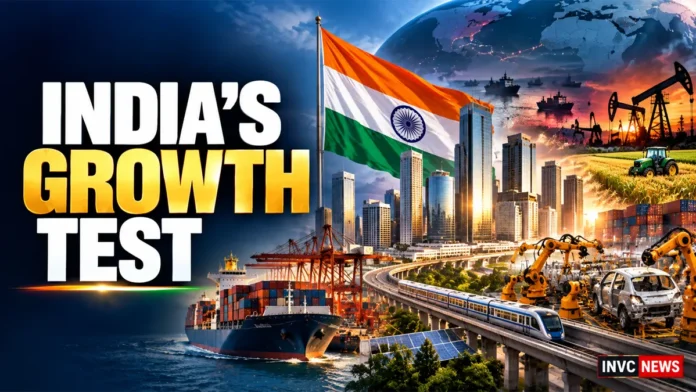
NEW DELHI, India | October 4, 2026 — India may be one of the world’s strongest major growth stories, but economists and policy experts are warning that rapid expansion alone will not be enough to protect the economy from the next global shock. With wars disrupting trade routes, energy markets vulnerable to geopolitical tension, supply chains increasingly exposed to political risk, and climate pressures threatening agriculture, the bigger question is no longer simply how fast India can grow. It is how well the economy can keep growing when conditions suddenly turn hostile.
That concern has emerged as a central theme at the 5th Kautilya Economic Conclave 2026, being held in New Delhi from October 3 to 5 under the theme “Resilience in an Age of Flux.” Economists, policymakers, researchers and industry experts attending the conclave are examining how governments and businesses can prepare for an economic environment in which disruption is increasingly becoming the rule rather than the exception.
Washington, D.C.-based economist and business expert Prof. Pravin Krishna said the conclave had come at an especially important moment because the global economy is facing an unusual combination of geopolitical and economic uncertainties. Tensions in the Middle East, the continuing Russia-Ukraine conflict and shifts in U.S. policy are all influencing trade, investment, energy and business decisions around the world.
Krishna said India’s economic progress in recent years had been impressive and reflected the strength of the country’s economic management. At the same time, he cautioned that strong growth should not create complacency. Existing vulnerabilities have not disappeared, and new risks could emerge quickly in a world where political developments can reshape economic conditions almost overnight.
India’s Next Economic Challenge Is Not Just Growth — It Is Resilience
The debate at the conclave suggests that economic resilience is becoming just as important as economic growth. For governments and companies, the challenge is to build systems that can continue functioning even when a major supplier fails, an energy route is disrupted, a conflict affects commodity prices or an important export market suddenly changes its trade policy.
Krishna said one encouraging feature of the discussions was the awareness among government officials, business leaders and policymakers about these risks. Instead of assuming that existing systems will continue working indefinitely, participants are examining how vulnerabilities can be reduced, alternative arrangements created and economic security strengthened before a major disruption occurs.
This is a significant shift in economic thinking. For decades, companies designed supply chains primarily to reduce costs and maximize efficiency. Today, governments and businesses increasingly have to ask a second question: what happens when the cheapest supplier is suddenly unavailable?
A supply chain can look extremely efficient when global conditions are stable. The same system can become a serious vulnerability when a war closes a trade route, sanctions interrupt access to a supplier, a natural disaster disrupts production or geopolitical tensions make a critical import unreliable.
Dependence on One Market or Energy Source Can Become a Strategic Risk
Krishna argued that countries can no longer afford excessive dependence on only one or two major markets or energy suppliers. Diversification, he said, is becoming essential to reducing economic risk.
That means building relationships with more trading partners, developing alternative energy sources and creating supply chains capable of shifting when disruption occurs. It may also require companies to maintain more inventory or source the same critical component from multiple countries rather than choosing only the cheapest producer.
Such arrangements can appear less efficient during normal times because they may increase costs. However, the calculation changes completely during a crisis. Paying slightly more for multiple suppliers can look expensive until the primary supplier suddenly stops delivering.
This is why the concept of de-risking has become increasingly important in global economic policy. Countries are not necessarily abandoning globalization, but they are changing the way they participate in it. The focus is shifting from simply finding the lowest-cost supplier to determining which supply networks are dependable enough to survive geopolitical or economic disruption.
Supply Chains Are Becoming a National Security Issue
The change is particularly visible in strategic sectors such as energy, semiconductors, critical minerals, pharmaceuticals, food, telecommunications and advanced technology. Dependence in these sectors can quickly become a national vulnerability because governments may not have enough time to find replacements after a crisis begins.
For India, the issue has added significance because the country is simultaneously trying to expand manufacturing, attract global investment and position itself as an alternative production base as multinational companies diversify their supply chains.
That creates a major opportunity. Businesses looking to reduce excessive dependence on one country may increasingly consider India as part of a broader supply-chain strategy. However, India must also make sure that its own expanding industrial system does not simply replace one form of dependence with another.
Reliable energy, secure access to raw materials, efficient transportation networks, diversified trade relationships and strong domestic manufacturing capacity will therefore become increasingly important to sustaining long-term growth.
India Has Momentum, but It Is Not Immune to Global Shocks
India enters this uncertain period with several advantages. Its large domestic market provides a level of protection that many heavily export-dependent economies do not enjoy. Its expanding manufacturing sector creates opportunities to capture investment moving across global supply chains. New Delhi also maintains economic relationships with the United States, Europe, the Gulf, Asia and other major regions, giving it more room to diversify partnerships.
Yet those advantages do not make India immune to external shocks. The economy remains sensitive to global energy prices, while manufacturing depends on secure access to a range of imported materials and components. A sharp rise in crude oil prices can affect transportation costs, inflation, the trade balance and household spending. Similarly, a major global supply disruption can increase costs for Indian businesses even when domestic demand remains strong.
This is why the central economic challenge is changing. India must continue pursuing high growth, but it must also make that growth harder to disrupt.
The Risk Does Not End at Ports and Oil Tankers — It Also Begins on Indian Farms
The resilience debate at the Kautilya Economic Conclave also extends far beyond international trade and financial markets. Agricultural risks remain a crucial part of India’s economic vulnerability, particularly as extreme weather conditions increasingly affect crop production and rural incomes.
Prof. Parmod Kumar, head of the Centre for Agricultural Development and Rural Transformation at the Institute for Social and Economic Change, highlighted the challenges facing agriculture and rural communities. He pointed to drought-like conditions affecting kharif crops in parts of Maharashtra and weather-related pressures in southern states, including Karnataka.
Kumar also referred to strong fertilizer demand during the sowing period in parts of Karnataka, where farmers were reported to have faced long queues. Such disruptions may appear to be localized agricultural problems, but their economic impact can travel much further.
Lower crop production can raise food prices. Higher food prices can push up inflation. Persistent inflation can affect household purchasing power and influence monetary policy decisions. What begins as insufficient rainfall or a fertilizer shortage in a farming district can therefore eventually become a national economic issue.
Agriculture Needs Its Own Economic Shock Absorbers
The same resilience principles being discussed for international supply chains also apply to farming. Agricultural production depends on rainfall, irrigation, fertilizers, seeds, credit, storage, transportation and market access. A serious breakdown at any point can hurt production and farmer incomes.
That means better planning must go beyond responding after a shortage emerges. Stronger fertilizer inventories, diversified supply sources, improved irrigation systems, better weather forecasting, efficient local distribution networks and more resilient crop planning can all reduce the impact of future disruptions.
Climate volatility makes this increasingly urgent. Farming decisions are made months before the final crop reaches the market, leaving farmers exposed when rainfall patterns suddenly change. Building resilience into agriculture is therefore not simply an agricultural policy objective; it is part of protecting inflation, food security and the wider economy.
The Most Efficient Economy Is Not Always the Most Resilient One
One of the most important lessons emerging from recent global crises is that maximum efficiency can sometimes create maximum vulnerability. An economy that has eliminated every backup supplier, reduced inventories to the minimum and concentrated production in a single location may perform extremely well when everything goes according to plan.
The problem appears when something does not.
A slightly more expensive system with multiple suppliers, greater storage capacity and alternative transport routes may appear inefficient in normal conditions. During a crisis, however, that redundancy can determine whether factories remain open, essential goods continue reaching consumers and prices remain under control.
The policy challenge is therefore not to abandon efficiency but to find the right balance between efficiency and security.
Businesses Will Have to Build Their Own Plan B
Governments alone cannot create economic resilience. Private companies determine where factories are located, which suppliers they use, how much inventory they maintain and how dependent they become on individual markets.
Companies that optimize only for short-term cost savings may find themselves exposed when geopolitical conditions change. Those that invest in alternative suppliers, multiple transport options and geographically diversified markets may carry higher costs during stable periods but could recover faster during disruption.
For corporate India, this means risk management is moving from the finance department into the center of business strategy.
The question for companies is no longer simply whether a supply chain works today. It is whether that supply chain would still work tomorrow if a war, tariff, sanction, natural disaster or political dispute suddenly changed the rules.
Why the Kautilya Economic Conclave Matters
Prof. Parmod Kumar said the Kautilya Economic Conclave has importance beyond conventional economic discussions because it provides a platform for examining national and international challenges from multiple perspectives.
The participation of researchers, PhD scholars, academics, bureaucrats, policymakers and international experts also gives younger researchers an opportunity to understand how major policy issues are being debated by people directly involved in shaping economic decisions.
That broader exchange becomes increasingly valuable when problems no longer fit neatly into separate categories. Energy security affects inflation. Geopolitics affects trade. Climate change affects agriculture. Technology affects employment and productivity. Supply chains affect national security.
Modern economic policy therefore requires governments to connect issues that were once treated separately.
What This Means for India’s Growth Story
India’s economic debate has understandably focused on growth, investment, manufacturing, infrastructure and the ambition to become one of the world’s largest economies. Those goals remain important, but the next phase may require a different measurement of success.
The strongest economy may not simply be the one that records the fastest growth during a favorable year. It may be the one that loses the least momentum when conditions deteriorate.
For India, that means diversifying energy supplies, strengthening domestic manufacturing, expanding trade relationships, securing access to critical materials, improving agricultural resilience and building alternative supply chains before they are urgently needed.
None of these measures will generate the same immediate excitement as a strong GDP number. Yet they may determine whether strong GDP growth can survive the next major global disruption.
INVC NEWS Bottom Line
India currently has what many economies want: growth momentum, a large domestic market and an increasingly important position in global trade and investment. But the world around that growth story is becoming more unpredictable.
The message emerging from the Kautilya Economic Conclave is therefore not that India’s economic outlook is weak. It is that strong economies must prepare when they are strong rather than waiting for a crisis to expose their vulnerabilities.
The next oil shock, trade dispute, supply-chain disruption, climate event or geopolitical crisis may be impossible to predict. What India can control is how dependent it remains on any single market, supplier, energy source or production network when that shock finally arrives.
That may become the defining economic test of the coming years: not simply how fast India can grow, but how difficult it becomes to knock that growth off course.