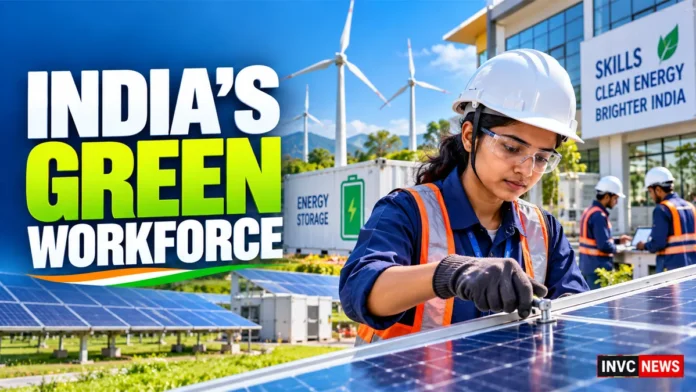
By Team INVC | INVC NEWS
BHUJ, India | October 4, 2026 — India is building solar parks, wind farms, battery-storage systems and smart grids at an unprecedented scale. But behind every new gigawatt lies a less visible challenge that could determine how smoothly the clean-energy transition actually works: finding enough people with the technical skills to build, operate and maintain the infrastructure.
Adani Skills & Education, the Adani Group’s skill-development and capability-building arm, has moved to address that challenge by opening a Green Energy Center of Excellence at Kachchh University in Bhuj, Gujarat. The facility, inaugurated Sunday by Gujarat Governor Acharya Devvrat, is expected to provide specialized training to more than 10,000 students every year in renewable-energy technologies and industrial automation.
The center arrives at a critical moment for India’s energy transition. Huge investments are flowing into solar, wind, battery storage and grid infrastructure, while demand is rising for technicians, engineers and operators who understand not only traditional electrical systems but also emerging technologies such as battery energy storage, microgrids, SCADA, IoT-based energy applications and smart grids.
For students in Kutch, that could turn one of India’s biggest clean-energy investment zones into something more immediate: a potential employment market close to home.
Why the Green-Energy Skills Gap Is Becoming a Big Business Issue
India’s renewable-energy push is increasingly creating a mismatch between infrastructure growth and the availability of specialized talent. Building a solar or wind project requires more than engineers at the design stage. Projects need trained workers to install equipment, monitor output, troubleshoot failures, manage automation systems, maintain storage facilities and safely operate increasingly sophisticated power infrastructure.
Adani Skills & Education CEO Robin Bhowmik said the renewable-energy industry has been expanding quickly, but the supply of specialized talent has not kept pace. The partnership with Kachchh University is designed to take industry requirements directly into the classroom and provide students with practical exposure to the technologies they could eventually use at work.
That industry connection could become particularly important because clean-energy skills are changing rapidly. A worker trained only in conventional electrical systems may not automatically be prepared to manage a modern battery-storage installation, smart grid or digitally controlled hybrid renewable-energy plant.
The new center is therefore being positioned not simply as another classroom facility, but as a bridge between academic education and the actual technical requirements of energy companies.
What Students Will Learn at the New Center
Training at the Green Energy Center of Excellence will cover solar photovoltaic technology, wind-energy systems, hybrid renewable-energy systems, battery energy storage systems and digital and industrial automation.
The curriculum will extend into areas that are becoming increasingly important as renewable energy takes a larger share of India’s electricity system. Students are expected to study renewable-energy integration, microgrids, SCADA systems, IoT-based energy applications and smart-grid technologies.
The teaching model will combine classroom instruction with simulation-based training and practical experience. That matters because renewable-energy employers increasingly need workers who can operate equipment rather than simply explain its theory.
The center will also support applied research and entrepreneurship, potentially giving students another route into the energy economy beyond conventional employment. As clean-energy deployment expands, opportunities are emerging not only in large power companies but also in equipment maintenance, software, monitoring systems, energy-management services and specialized contracting.
Kutch Is Becoming a Real-World Laboratory for Green-Energy Jobs
The choice of Kutch is significant.
The district has emerged as one of the most important locations in India’s renewable-energy expansion, with massive solar, wind and storage infrastructure under development. That means students trained in Bhuj will be studying in a region where many of the technologies in their curriculum are already being deployed at enormous scale.
According to the Adani Group, its green-energy activities in Kutch have generated more than 21,000 direct and indirect jobs over the past two years. That company estimate underlines the scale of workforce demand being created as projects move from construction into long-term operation and maintenance.
The employment opportunity is also changing in character. Large renewable projects initially require construction workers, equipment installers and project-management teams. Once operational, they create continuing demand for technicians, control-room operators, maintenance specialists, automation professionals and workers capable of handling complex electrical and digital systems.
That is where specialized training becomes economically important.
Khavda Shows Why the Workforce Question Is So Big
The scale of the transition becomes clearer at Khavda in Kutch, where Adani Green Energy is developing a renewable-energy project designed to reach 30 GW of capacity across roughly 538 square kilometers.
A project of that size is not merely an electricity-generation facility. It requires a vast technical ecosystem involving solar installations, wind generation, transmission infrastructure, digital monitoring, equipment maintenance and increasingly energy-storage technologies.
Adani has described Khavda as a long-term renewable-energy hub, with the full 30 GW project targeted for completion by 2029.
For Kutch, projects of this magnitude create an important economic question: will the region primarily import skilled workers from elsewhere, or can local students be trained to fill a larger share of those jobs?
The new Center of Excellence clearly aims at the second outcome.
Karan Adani: Training Must Prepare Students for Jobs That Are Still Emerging
Adani Group Director Karan Adani said renewable energy will play a critical role in shaping India’s future and argued that the center should prepare students not only for the jobs available today but also for emerging opportunities in India and overseas.
That distinction is important because the clean-energy industry is moving beyond basic solar and wind installations.
Battery storage is expanding rapidly. Grid-management technology is becoming more sophisticated. Industrial automation is increasing. Digital monitoring, artificial intelligence and IoT systems are becoming more deeply integrated into energy infrastructure.
The jobs created five years from now may therefore require a different skill set from many renewable-energy jobs available today.
Training institutions will have to evolve at roughly the same speed as the industry they serve.
India’s 500-GW Goal Makes the Skills Question Urgent
India has set a goal of achieving 500 GW of installed electricity capacity from non-fossil-fuel sources by 2030, a target that is driving enormous investment across the clean-energy value chain.
That expansion requires far more than panels, turbines and transmission lines. It also requires trained people at every level of the system.
As renewable capacity increases, India will need workers capable of managing generation variability, integrating storage, maintaining new equipment and operating increasingly digital power networks. Battery specialists, automation technicians and smart-grid professionals could therefore become just as important to the energy transition as conventional electrical engineers.
The scale of the national target turns skills development into an infrastructure requirement rather than simply an education policy.
The Bigger Opportunity: Train Locally, Employ Locally
There is another potential economic benefit.
If regions hosting massive infrastructure projects can also train workers locally, energy investment can produce a deeper impact on the surrounding economy.
Instead of young people leaving Kutch to search for employment elsewhere, large-scale energy projects could create career opportunities in their own region. Training linked directly to industry requirements may also reduce the gap employers often identify between academic qualifications and job-ready technical skills.
Adani Skills & Education has already been expanding industry-linked vocational training in Kutch, including collaboration with government Industrial Training Institutes. The university partnership takes that strategy further into advanced renewable-energy technology.
For students, this means the energy transition becomes more than a national climate target. It can become a career path.
Why Battery Storage Could Become One of the Most Valuable Skills
Among the subjects being taught at the center, Battery Energy Storage Systems, or BESS, deserve particular attention.
Solar panels produce the most electricity when sunlight is strongest, but electricity demand does not always peak at the same time. Wind generation also varies according to weather conditions.
Large-scale batteries help store electricity when generation is high and release it when the grid needs it.
As India installs more renewable energy, storage is therefore expected to become increasingly important for balancing the power system.
That creates demand for people who understand battery operations, energy-management software, safety systems, digital monitoring and grid integration.
A student entering this field today could be training for a segment of the energy industry that becomes substantially larger by the end of the decade.
From Degrees to Employability
The larger significance of the Bhuj center may ultimately be measured by what happens after students finish their courses.
India already produces large numbers of engineering and technical graduates. The challenge for industry is often finding candidates with the specific practical skills needed to become productive quickly.
The Center of Excellence model attempts to narrow that gap by putting industry technologies, simulations and practical training into the education process.
If successful, students should leave with more than a qualification. They should understand the equipment and systems employers actually use.
That is the difference between education and employability — and in a rapidly expanding industry, the distinction can be worth thousands of jobs.
INVC NEWS Bottom Line
India’s renewable-energy race is usually measured in gigawatts, solar modules, wind turbines and investment dollars. The Adani-Kachchh University initiative highlights another number that may become equally important: the number of people trained to make all that infrastructure work.
With more than 10,000 students expected to receive training each year, the Bhuj center is attempting to connect three things that India increasingly needs to bring together — education, industry and employment.
The timing matters. India is pushing toward 500 GW of non-fossil-fuel capacity by 2030, while Kutch is already emerging as one of the country’s most important clean-energy hubs.
Building the power plants is one challenge.
Building the workforce capable of running them could be the next one.
And for thousands of young people in Kutch, the green-energy revolution may no longer be something happening somewhere on the horizon. It could become their next job.