By Team INVC | INVC NEWS
BRUSSELS, Belgium | September 14, 2026 —
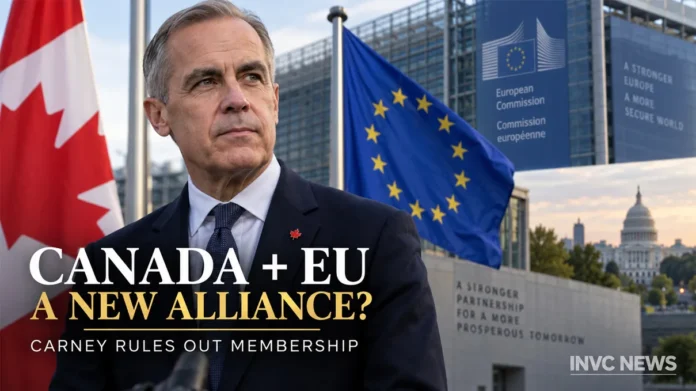
Canada EU unique alliance talks are emerging as one of the most consequential shifts in Ottawa’s foreign and trade policy as Prime Minister Mark Carney moves to deepen ties with Europe while relations with the United States remain under severe strain.
Carney has made one point clear: Canada is not seeking membership in the European Union.
Instead, the Canadian prime minister says Ottawa will begin discussions with Brussels over a new and unusually close partnership that could extend far beyond the existing Canada-EU trade relationship.
The proposal comes as Canada looks to diversify trade, investment, security and technology partnerships away from its overwhelming dependence on the United States.
At the same time, renewed tariff tensions with US President Donald Trump have increased pressure on Ottawa to find alternative markets and strategic partners.
Carney Says Canada Is Not Joining the European Union
Speculation intensified after reports suggested Canada and European officials had discussed whether Ottawa could receive some form of “associate member” relationship with the EU.
Carney moved quickly to clarify Canada’s position.
He said Canada does not intend to become an EU member.
Instead, Ottawa wants to explore what he described as a unique alliance built around shared values, common priorities and complementary economic strengths.
That distinction matters.
Traditional EU membership involves extensive legal, political and economic obligations that Canada is not currently seeking.
The emerging proposal appears focused instead on creating deeper economic and strategic integration without formal membership.
What Could the Canada-EU Alliance Include?
The most ambitious ideas reportedly under discussion involve reducing barriers between Canada and Europe in strategically important industries.
Those sectors could include:
- Artificial intelligence
- Defence
- Energy
- Critical minerals
- Technology infrastructure
- Data centers and cloud computing
- Satellite networks
- Strategic supply chains
Discussions reported by international media also include ways to make it easier for goods, services and specialized workers involved in those sectors to move between Canada and European countries.
However, these remain areas of discussion.
No final agreement on free movement, visas or an associate-membership framework has been announced.
That distinction should remain central as negotiations develop.
AI, Energy and Critical Minerals Could Drive New Partnership
The economic logic behind closer ties is significant.
Europe wants secure supplies of energy, critical minerals and advanced technology.
Canada has large natural-resource reserves, a growing artificial-intelligence ecosystem and close security links with European NATO members.
Ottawa, meanwhile, wants more destinations for Canadian exports and investment.
That creates natural overlap.
Critical minerals could become particularly important because Western governments increasingly view supplies of lithium, rare earths and other strategic materials as national-security issues.
AI and defence technology offer another major area of potential cooperation.
Canada has already strengthened its participation in European security initiatives, including becoming the first non-European country to join the EU’s Security Action for Europe framework.
That existing relationship gives Ottawa and Brussels a foundation for something deeper.
Underwater Cables and Data Centers Enter the Discussion
The talks may eventually extend well beyond conventional trade.
Reported ideas include new underwater cables linking Canada and Europe, shared data infrastructure, cloud-storage capacity and satellite networks.
Energy infrastructure that could help move Canadian resources toward European markets has also entered the broader discussion.
Such projects would serve both economic and security goals.
Governments increasingly treat digital networks, energy systems and computing infrastructure as strategic assets rather than ordinary commercial projects.
A deeper Canada-EU partnership could therefore combine trade policy with technological and national-security planning.
Trump Trade Tensions Add Urgency
Canada’s pivot toward Europe does not happen in a vacuum.
Relations with Washington have deteriorated sharply amid tariff disputes and disagreements over trade.
Trump renewed criticism of Canada over the weekend and signaled further tariffs affecting Canadian vehicles, trucks and auto parts.
The dispute matters enormously because the United States has historically been Canada’s dominant trading partner.
For Ottawa, reducing that dependence has therefore become a strategic priority.
Carney’s government has repeatedly emphasized diversification as Canada builds relationships with Europe and other major economies.
The proposed EU alliance could become the largest expression of that strategy yet.
Could Canadians Live and Work Freely in Europe?
One of the most attention-grabbing possibilities concerns mobility.
Reports suggest Canadian and European officials have explored whether certain Canadians could gain easier access to European labour markets.
Carney has also held regular discussions with European leaders, including French President Emmanuel Macron, as Canada seeks deeper integration.
However, Canadians should not interpret those discussions as an announcement of visa-free employment rights.
No such system has been finalized.
Any major mobility agreement would require complex negotiations involving European institutions and individual EU governments.
For now, it remains a potential component of a broader partnership.
Canada Already Has a Major EU Trade Agreement
Canada and the European Union are not starting from zero.
The two sides already operate under the Comprehensive Economic and Trade Agreement, widely known as CETA.
The agreement has significantly reduced trade barriers.
Yet CETA also shows how difficult deeper European integration can become.
Several EU member states have still not completed full ratification years after the agreement began provisional application.
That experience highlights one of the biggest obstacles facing Carney’s more ambitious plan.
A unique alliance may sound strategically attractive, but converting political momentum into legally enforceable arrangements could take years.
Carney Heading to Europe
The timing of the announcement is significant.
Carney is scheduled to travel to Strasbourg and Liverpool from September 15 to 17 as Canada seeks to strengthen relationships with European partners.
He will address the European Parliament in Strasbourg.
Canada’s government says its European strategy focuses on greater certainty, security and prosperity while diversifying partnerships abroad.
The trip gives Carney an immediate opportunity to explain his vision directly to European political leaders.
It could also provide the first clearer indication of how far Brussels is willing to go.
Why Europe May Be Interested in Canada
Europe also has reasons to deepen the relationship.
Canada offers energy resources, critical minerals, advanced technology expertise and political stability.
Its NATO membership further strengthens security links.
European policymakers are simultaneously looking for reliable partners as geopolitical competition intensifies.
Canada could fit that requirement particularly well.
The country maintains deep historic ties with Europe while occupying a strategically important position across the Atlantic and Arctic.
That combination makes Canada different from most other potential EU partners.
Canada-EU Alliance Could Reshape Transatlantic Trade
The biggest question is how far the negotiations eventually go.
A modest outcome could involve expanded cooperation in defence, energy and technology.
A more ambitious model could create easier movement of investment, skilled workers and strategic goods between Canada and Europe.
Either scenario would represent another major step in Canada’s attempt to reduce its economic dependence on the United States.
For now, Carney is carefully drawing one boundary.
Canada is not asking to join the European Union.
But Ottawa is clearly looking for something much deeper than a conventional trade relationship.
If Canada and Brussels can turn the idea into a workable framework, the proposed alliance could reshape economic and strategic ties across the Atlantic.