By Team INVC | INVC NEWS
MIAMI, United States | September 14, 2026 —
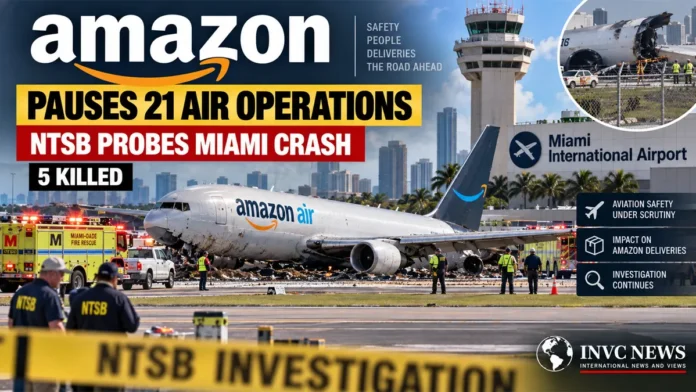
Amazon Suspends 21 Air Operations after the cargo carrier operated an Amazon Air Boeing 767 that overran a runway at Miami International Airport, struck vehicles beyond the airport perimeter and killed five people on the ground.
Amazon confirmed that it has paused operations with Miami-based 21 Air while federal investigators examine the September 6 accident involving Flight 7598.
The Boeing 767-33A freighter was arriving in Miami from San Juan, Puerto Rico, when it overran Runway 30.
Five people died and five others suffered injuries.
Both pilots survived the crash and later left the hospital.
Amazon said it reached the decision after spending time supporting the investigation and reviewing circumstances surrounding the accident.
The company said safety remains a central priority and that it will continue supporting investigators and people affected by the tragedy.
The suspension creates a fresh operational question for Amazon Air while the National Transportation Safety Board continues one of the most closely watched US aviation investigations of the year.
What Happened to Amazon Air Flight 7598?
21 Air Flight 7598 operated as part of Amazon’s cargo network.
The Boeing 767 was flying from San Juan to Miami on September 6 when the aircraft approached Runway 30 at Miami International Airport.
According to preliminary NTSB information, cockpit recordings captured concerns about the aircraft’s speed during the final approach.
One pilot cautioned that the aircraft was too fast.
The cockpit also received several automated warnings during the descent, including “sink rate” and “too low terrain” alerts.
Despite those warnings, the aircraft continued toward the runway.
The NTSB has stressed that its findings remain preliminary.
Investigators have not yet announced the probable cause of the accident.
Boeing 767 Touched Down at 158 Knots
Flight-data information released by the NTSB provides a detailed picture of the final seconds.
The nose gear and right main landing gear touched down at a groundspeed of approximately 158 knots.
Brakes were applied when the aircraft was moving at around 146 knots.
The left main landing gear touched down later, at approximately 134 knots.
Then came one of the most important moments investigators are examining.
With the aircraft still moving at around 120 knots, the brakes were released and the throttles increased to a level consistent with go-around thrust.
Seconds later, the throttles returned to idle and the brakes were applied again.
The aircraft then left the paved surface.
Investigators are working to understand why the crew attempted the maneuver after touchdown and why it was subsequently discontinued.
Pilots Considered Go-Around After Touchdown
Cockpit voice recordings indicate that one pilot called for a go-around roughly 15 seconds before the recording ended.
By that point, the aircraft had already touched down.
A go-around normally involves abandoning a landing and climbing away for another approach.
The maneuver can play a critical safety role when pilots determine that an approach or landing cannot continue safely.
In this case, flight-data information indicates that thrust briefly increased before the crew returned the engines to idle.
The aircraft continued beyond the runway and struck vehicles outside the airport area.
Investigators have not determined why the attempted go-around began so late or why it ended almost immediately.
NTSB Finds No Recorded Deployment of Speed Brakes or Thrust Reversers
Another key area of investigation concerns the aircraft’s deceleration systems.
The NTSB said the recorded data showed no indication that the speed brakes or thrust reversers deployed during the final portion of the landing.
Speed brakes help reduce lift and increase braking effectiveness after touchdown.
Thrust reversers redirect engine thrust to help slow an aircraft.
Their absence from the recorded data has become an important factual element of the investigation.
However, investigators have not yet said why the systems did not deploy or whether their status directly caused the runway overrun.
The distinction matters.
Preliminary data can identify what happened without establishing why it happened.
Plane Overran Runway by About 1,300 Feet
The Boeing 767 traveled approximately 1,300 feet beyond the runway before the accident sequence ended.
The aircraft struck ground vehicles, including a cleaning crew van and a Toyota SUV.
Five people on the ground died.
Five others suffered injuries.
The scale of destruction prompted the NTSB to send a large investigative team to Miami.
Officials recovered both the cockpit voice recorder and flight data recorder and transported them to the agency’s laboratory in Washington.
Investigators successfully downloaded both devices.
The cockpit recorder contained more than two hours of good-quality audio.
The flight-data recorder contained approximately 54 hours of information across more than 400 parameters.
Amazon Pauses 21 Air Operations
Amazon’s latest decision significantly expands the commercial consequences of the crash.
21 Air operated cargo flights for the Amazon Air network.
Amazon has now paused that relationship while authorities continue investigating Flight 7598.
The company has not announced how long the suspension will last.
It also has not said whether it will permanently terminate its relationship with the carrier.
For now, the move should be described as an operational pause rather than a permanent separation.
That distinction is important because the NTSB investigation could take months before reaching final conclusions.
What Is 21 Air?
21 Air is a US cargo airline based in Miami.
The carrier operates freight aircraft for logistics customers, including operations connected with Amazon Air.
Cargo airlines play an important role in Amazon’s logistics system by moving packages quickly between major distribution hubs.
Amazon has built a large air-freight network to reduce its dependence on traditional shipping providers and accelerate deliveries.
Contract carriers operate part of that network.
The accident therefore raises questions not only about 21 Air but also about the safety oversight, training and operational standards surrounding contracted cargo operations.
Aircraft Had Flown Twice Earlier That Day
The accident aircraft was on its third flight of the day.
It had flown earlier sectors before beginning the San Juan-to-Miami trip.
The Boeing 767 was more than three decades old.
It originally entered service as a passenger aircraft and later transitioned into cargo operations.
Aircraft age alone does not establish an accident cause.
Commercial jets can safely operate for decades when airlines maintain them according to regulatory and manufacturer requirements.
Investigators will therefore examine the aircraft’s maintenance records, systems, crew actions, operational procedures and environmental conditions before reaching conclusions.
NTSB Examines Crew Experience and Decision-Making
Investigators are also studying the pilots’ backgrounds and actions during the final approach.
The two pilots had thousands of hours of total flight experience, although they were relatively new to the Boeing 767 type.
The captain had approximately 7,145 flight hours, while the first officer had around 2,655 hours.
Their overall flying experience does not automatically determine how they responded to this specific approach.
The NTSB investigation will examine training, crew coordination, airline procedures and cockpit decision-making.
It will also study why repeated speed concerns did not immediately result in an earlier go-around.
What Is an Unstable Approach?
The Miami crash has drawn attention to the aviation concept of a stabilized approach.
Airlines generally establish criteria covering an aircraft’s speed, descent rate, configuration and position during the final stages of landing.
If a flight does not meet the required conditions by a certain altitude, standard procedures may require pilots to discontinue the approach.
A go-around is not considered a failure.
It is a normal safety procedure pilots use when landing conditions do not meet established criteria.
Investigators will examine whether Flight 7598 met 21 Air’s stabilized-approach requirements and how the crew responded when concerns emerged.
Why Cargo Aviation Safety Matters
Cargo airlines operate under demanding schedules.
Aircraft may fly several sectors in a single day, often during nighttime or early-morning hours.
Crews also work within complex logistics networks that depend on precise delivery schedules.
US aviation regulations still require operators to maintain strict safety standards regardless of commercial pressure.
The Miami investigation could therefore examine fatigue, scheduling, training, maintenance and corporate procedures along with cockpit actions.
Investigators have not yet determined whether any of those factors contributed to Flight 7598.
What Happens Next?
The NTSB will continue analyzing cockpit audio, flight-data information, aircraft systems, maintenance records and operational procedures.
Investigators will also interview crew members and other relevant personnel.
A preliminary factual update does not provide a probable cause.
The agency’s final report could take considerably longer and may include safety recommendations aimed at airlines, regulators, airports or aircraft operators.
Until that process is complete, conclusions about responsibility would be premature.
Amazon Air Faces a Critical Safety Test
For Amazon, the accident creates a different challenge.
The company depends on a broad logistics system involving aircraft, trucks, fulfillment centers and delivery networks.
Pausing operations with 21 Air shows that Amazon is reassessing at least part of that network while the investigation continues.
The decision also puts pressure on other cargo operators to demonstrate strong training, safety and operational controls.
Five people lost their lives in the Miami accident.
The central question now is not only what went wrong on Flight 7598, but whether the investigation identifies lessons that can prevent another runway overrun.
For the moment, Amazon has made its first major operational move.
21 Air flights for the company are paused.
The NTSB now has the harder task: determining exactly why the Boeing 767 failed to stop safely in Miami.