NEW DELHI, India | September 7, 2026 —
Alternative Fuel Car Sales India 2026 have crossed a historic threshold as CNG, hybrid and electric passenger vehicles collectively overtook petrol-powered models for the first time in India’s retail market, according to fresh automobile registration data released on Monday.
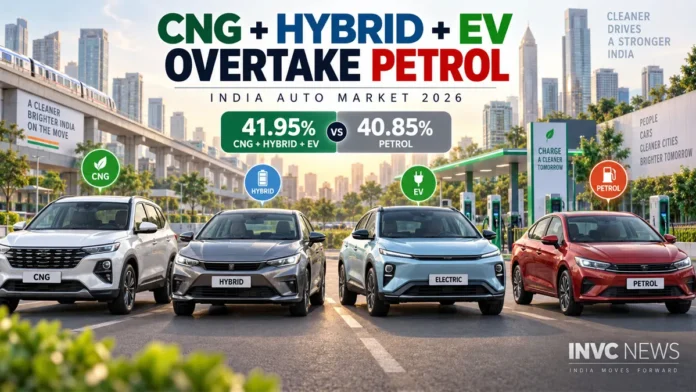
Alternative-fuel vehicles captured 41.95% of passenger vehicle retail sales in August 2026, narrowly beating the 40.85% share held by petrol and ethanol-powered vehicles.
The shift marks a major change in how Indian consumers are choosing new cars.
CNG and LPG vehicles accounted for the biggest portion of the alternative-fuel market, while hybrids and electric vehicles added enough volume to push the combined category ahead of petrol.
Lower running costs and continuing consumer questions surrounding E20 petrol have contributed to the changing fuel mix, according to the Federation of Automobile Dealers Associations.
Alternative-Fuel Cars Beat Petrol for First Time
The August numbers represent a major turning point for India’s car market.
Alternative fuels accounted for:
CNG/LPG: 25.28%
Hybrid: 9.04%
Electric Vehicles: 7.63%
Combined Alternative Fuels: 41.95%
Petrol and ethanol-powered passenger vehicles held a 40.85% share.
Diesel accounted for another 17.21%.
Petrol still remains the largest individual fuel category. However, when CNG, hybrid and EV sales are combined, alternative powertrains have now moved ahead.
That had never happened before in India’s passenger vehicle retail market.
Petrol’s Lead Has Disappeared Rapidly
The speed of the change makes the August milestone even more significant.
A little over a year ago, petrol vehicles held a lead of nearly 11 percentage points over the combined alternative-fuel category.
That advantage has now disappeared.
In July 2026, alternative fuels had already come close to petrol.
Their combined share stood at 40.59%, while petrol remained slightly ahead at 41.68%.
August finally reversed that order.
The trend suggests that Indian car buyers are increasingly willing to consider more than conventional petrol models when choosing a new vehicle.
E20 Petrol Concerns Influence Buying Decisions
India’s transition to E20 petrol has become an important part of the consumer discussion.
E20 contains 20% ethanol blended with petrol.
The policy aims to reduce India’s dependence on imported crude oil, support domestic ethanol production and lower certain emissions.
However, motorists have raised questions about fuel economy, vehicle compatibility and potential long-term effects on older vehicles.
FADA has linked some of the changing buyer preference to continued uncertainty around the E20 transition.
Importantly, this does not mean E20 alone caused the shift.
Lower operating costs, wider CNG availability, improving electric vehicles, stronger hybrid choices and new model launches also influence buying decisions.
Government Has Rejected Exaggerated E20 Claims
The central government has previously rejected claims suggesting that E20 petrol automatically damages vehicles or creates widespread mechanical problems.
Authorities have argued that many concerns circulating online overstate the risks.
Vehicle compatibility also depends on model year, engine design and manufacturer specifications.
Owners of older vehicles should therefore rely on their vehicle manufacturer or authorised service network for compatibility information instead of social-media claims.
For buyers considering a new car, however, the E20 debate has clearly become part of the purchase conversation.
CNG Remains the Biggest Alternative-Fuel Winner
CNG/LPG vehicles accounted for 25.28% of passenger vehicle retail sales in August.
That makes CNG by far the largest component of India’s alternative-fuel market.
Running cost remains one of its strongest selling points.
For consumers who drive long distances, particularly in cities with reliable CNG infrastructure, the lower fuel cost can materially reduce monthly vehicle expenses.
Automakers have responded by offering factory-fitted CNG versions across an increasingly broad range of hatchbacks, sedans and SUVs.
That wider choice has helped CNG move beyond the entry-level car market.
Hybrid Cars Take More Than 9% Share
Hybrid passenger vehicles accounted for 9.04% of August retail sales.
Hybrids combine an internal-combustion engine with electric assistance.
Depending on the technology, they can reduce fuel consumption without requiring drivers to depend entirely on public charging infrastructure.
That positioning makes hybrids particularly attractive to consumers who want better fuel efficiency but are not yet ready to switch fully to an EV.
Strong-hybrid SUVs and premium models have helped expand this segment.
However, pricing remains an important consideration.
EVs Capture 7.63% of Passenger Vehicle Market
Electric vehicles accounted for 7.63% of August passenger vehicle retail registrations.
India’s electric-car market remains smaller than CNG, but its share has expanded as manufacturers launch more models across different price points.
Charging infrastructure has also continued to grow.
Consumers can now choose electric vehicles ranging from compact urban models to premium SUVs.
Running costs can remain significantly lower than petrol cars for consumers who can charge conveniently at home or work.
However, vehicle price, charging availability, battery range and resale value remain important considerations.
Passenger Vehicle Sales Cross 4 Lakh in August
The fuel-market shift came during a record August for India’s passenger vehicle industry.
Passenger vehicle retail sales reached approximately 4.02 lakh units.
That represented a 16.14% year-on-year increase and marked the first time August passenger vehicle registrations crossed four lakh units.
The performance shows that the change in fuel preference occurred while the overall market itself continued to expand.
However, August passenger vehicle sales remained about 3.4% below July levels.
Seasonal monsoon conditions and changes in the festival calendar contributed to the month-on-month decline.
Total Auto Retail Sales Reach 24.23 Lakh Units
India’s overall automobile retail market recorded 24,23,201 vehicles in August 2026.
That represented growth of 17.51% from a year earlier.
The number includes two-wheelers, passenger vehicles, commercial vehicles, three-wheelers and tractors.
Retail sales nevertheless fell 6.48% from July, which had set a record.
FADA linked part of that sequential decline to seasonal factors and the timing of festive demand.
September could therefore become another important month as dealerships prepare for the festival-buying season.
Rural India Drives Strong Passenger Vehicle Growth
Rural demand delivered particularly strong growth in August.
Passenger vehicle registrations in rural markets rose 24.99% year-on-year.
Urban passenger vehicle retail increased 10.93%.
The stronger rural performance matters because automakers increasingly view smaller cities and rural markets as important growth engines.
Better road infrastructure, rising incomes and broader financing access have helped expand vehicle ownership beyond India’s largest cities.
Car Dealers Carry Higher Inventory
Despite strong August sales, dealership inventory increased.
Passenger vehicle inventory moved to approximately 38 to 40 days.
FADA considers that level higher than ideal and has urged manufacturers to align wholesale dispatches more closely with actual retail demand.
Excess inventory can put financial pressure on dealers because unsold vehicles require working capital and storage.
However, companies also tend to increase stock ahead of major festive periods.
The coming months will show whether festive demand absorbs those inventories quickly.
What the Shift Means for Maruti, Tata, Hyundai and Other Carmakers
The change in fuel preference could influence automakers’ future product strategies.
Companies with strong CNG portfolios may continue expanding factory-fitted options.
Manufacturers investing heavily in EVs could accelerate launches as electric share grows.
Meanwhile, brands with hybrid technology may see fresh opportunities among consumers looking for better fuel efficiency without relying entirely on charging.
Petrol vehicles will not disappear.
Instead, India’s market increasingly looks like a multi-powertrain industry where petrol, diesel, CNG, hybrids and EVs compete simultaneously.
Does This Mean Petrol Cars Are Finished?
No.
Petrol remains the largest single passenger vehicle fuel category in India.
Its 40.85% market share still represents a substantial number of vehicles.
Petrol models also offer several advantages.
They generally have widespread fuel availability, established servicing networks and a broad selection across price segments.
For buyers with relatively low annual driving distances, petrol vehicles can still make financial sense.
The August data therefore signals a shift in consumer preference, not the end of petrol cars.
Should Buyers Choose CNG, Hybrid, EV or Petrol?
There is no single fuel choice that works best for every driver.
CNG may suit high-mileage users with convenient filling stations.
Hybrid vehicles can appeal to buyers seeking improved efficiency without charging dependence.
EVs may work particularly well for consumers with predictable daily travel and easy access to charging.
Petrol vehicles remain practical for buyers who prioritize purchase price, widespread fuel availability and conventional ownership.
Diesel can still appeal in selected high-mileage or larger-vehicle use cases.
Buyers should compare the total ownership cost rather than only the showroom price.
India’s Car Market Has Entered a New Phase
The August data shows that India’s transition away from an overwhelmingly petrol-led passenger vehicle market is accelerating.
Just months ago, alternative fuels were chasing petrol.
They have now moved ahead collectively.
Whether this becomes a permanent lead will depend on fuel prices, E20 consumer confidence, CNG availability, EV charging infrastructure, hybrid pricing and the models automakers launch over the coming years.
Still, the August 2026 milestone is significant.
For the first time, Indian consumers collectively bought a greater share of CNG, hybrid and electric passenger vehicles than petrol-powered cars.
That shift could reshape product planning across India’s entire automobile industry.