MUMBAI, India | September 7, 2026 —
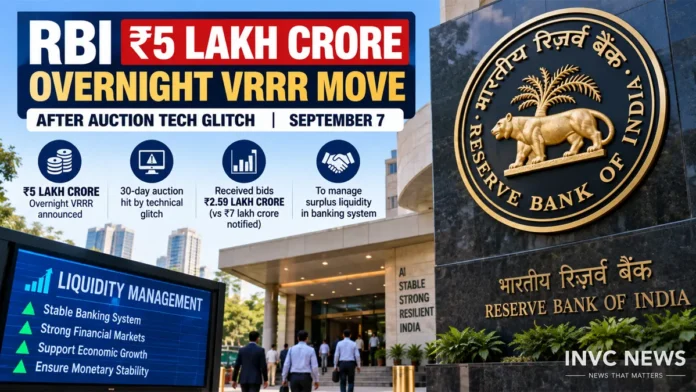
RBI ₹5 Lakh Crore Overnight VRRR became a key banking-market development on Monday after the Reserve Bank of India announced an additional overnight liquidity-absorption operation following technical problems that disrupted participation in its longer 30-day auction.
The central bank will conduct an overnight Variable Rate Reverse Repo, or VRRR, operation for ₹5 lakh crore, after the earlier 30-day auction attracted bids worth only about ₹2.59 lakh crore.
The move is aimed at managing the large amount of surplus cash currently sitting in India’s banking system.
Importantly for consumers, the operation does not represent a change in the RBI repo rate and does not directly alter home-loan, fixed-deposit or savings-account rates.
What Happened in RBI’s 30-Day VRRR Auction?
RBI had scheduled a large 30-day VRRR operation as part of its effort to absorb excess liquidity from banks.
However, participation came in much lower than expected.
The auction received offers worth around ₹2.59 lakh crore.
Market participants linked the weak bidding to technical problems affecting the normal bidding process.
According to traders, some banks were unable to participate as expected after the bidding process moved away from the usual E-Kuber platform because of technical issues.
That left the central bank needing another short-term operation to absorb liquidity.
RBI Announces ₹5 Lakh Crore Overnight Operation
Following the disrupted auction, RBI announced an overnight VRRR with a notified amount of ₹5 lakh crore.
An overnight VRRR allows banks with surplus cash to temporarily place money with RBI through an auction mechanism.
The money is returned after the specified tenor along with the applicable interest determined through the auction.
The operation gives RBI a flexible way to remove excess liquidity from the banking system without changing its policy interest rate.
What Is VRRR?
VRRR stands for Variable Rate Reverse Repo.
Under this mechanism, banks lend surplus funds to the Reserve Bank of India for a specified period.
Unlike a fixed-rate facility, banks submit bids indicating the rate at which they are willing to park their money.
RBI then accepts bids according to the auction rules.
The tool helps the central bank manage short-term liquidity and keep money-market interest rates aligned with its monetary policy framework.
Why Does RBI Want to Remove Surplus Liquidity?
India’s banking system currently holds a large liquidity surplus.
When banks have far more cash than they need for normal lending and regulatory requirements, short-term market interest rates can move away from the levels RBI wants to maintain.
The central bank can therefore use reverse repo operations to temporarily absorb part of that excess money.
This does not mean RBI is permanently removing funds from the economy.
The operation has a defined maturity, after which the funds return to participating banks.
Earlier Auction Was Originally Much Larger
The 30-day VRRR operation had been designed as a much larger liquidity-management exercise.
RBI had announced a notified amount of ₹7 lakh crore for the 30-day auction.
That came against a banking-system liquidity surplus estimated at more than ₹10 lakh crore earlier in September.
The central bank was therefore attempting to move a significant portion of excess liquidity into a longer-duration absorption facility.
But the technical disruption prevented participation from reaching the level market participants might otherwise have expected.
Why Technical Problems Matter in RBI Auctions
Central bank liquidity auctions involve major financial institutions and very large sums of money.
Banks normally prepare their treasury operations around RBI’s announced auction timetable.
Even a temporary bidding-platform problem can therefore affect how much money banks successfully place in an operation.
Low bidding does not necessarily mean banks rejected RBI’s liquidity-management strategy.
In this case, market participants specifically pointed to technical and platform-related difficulties as an important factor behind the limited participation.
What Is RBI E-Kuber?
E-Kuber is RBI’s electronic banking and transaction platform used by banks and financial institutions for several central-bank operations.
It supports transactions involving government securities, liquidity operations and other financial-market activities.
Banks are familiar with the system and structure their treasury operations around established procedures.
A change in the bidding environment can therefore create operational challenges, particularly when an auction window is relatively short.
Does the ₹5 Lakh Crore Operation Mean RBI Changed Interest Rates?
No.
The overnight VRRR should not be confused with a repo-rate decision.
The repo rate is RBI’s main policy rate and influences borrowing costs throughout the financial system.
A VRRR is primarily a liquidity-management operation.
RBI can conduct multiple VRRR auctions without changing the repo rate.
Therefore, Monday’s announcement does not automatically make home loans, car loans or other retail borrowing more expensive.
Will Bank FD Rates Change Because of This?
There is no automatic direct change.
Fixed-deposit rates depend on several factors, including banking-system liquidity, credit demand, RBI’s policy stance and competition among banks.
Removing excess liquidity can influence short-term money-market conditions.
However, one overnight auction alone does not determine retail deposit rates.
Consumers should therefore avoid interpreting the ₹5 lakh crore figure as a direct signal that their FD interest rate will immediately rise or fall.
Will Home Loan EMIs Change?
The same principle applies to home loans.
Monday’s VRRR operation does not change the RBI repo rate.
Therefore, borrowers with loans directly linked to policy benchmarks should not expect an automatic EMI revision merely because RBI conducted this auction.
Loan rates can change when banks revise their benchmarks, funding costs or spreads, but those are separate decisions.
Why Is There So Much Extra Cash in the Banking System?
Liquidity conditions can change because of several factors.
These include foreign-currency inflows, government spending, tax payments, RBI foreign-exchange operations and movements in currency circulation.
Recent foreign-currency inflows have contributed to substantial surplus liquidity in India’s banking system.
RBI has therefore increased its use of liquidity-absorption tools to keep financial conditions orderly.
What Does This Mean for Bond Markets?
Liquidity operations matter closely to bond traders because surplus cash affects short-term interest rates and demand for government securities.
Large RBI absorption operations can influence expectations about money-market conditions.
Government bond yields were already in focus on Monday as traders assessed RBI’s liquidity strategy alongside rising crude oil prices and expectations surrounding US interest rates.
However, bond-market movements also depend on inflation, government borrowing, global yields and monetary policy expectations.
RBI Can Conduct More Liquidity Operations
Monday’s overnight VRRR may not necessarily be the final liquidity action.
RBI regularly reviews the amount of cash in the banking system and can announce additional short-term or longer-tenor operations when required.
The size, duration and frequency of these auctions can change according to prevailing liquidity conditions.
That flexibility allows the central bank to respond quickly when market conditions or operational issues alter the outcome of an earlier auction.
Why Today’s RBI Action Matters
The significance of today’s announcement lies mainly in its timing.
RBI had attempted a longer-duration liquidity operation, but technical difficulties reduced participation.
Instead of leaving the surplus unaddressed, the central bank quickly announced another ₹5 lakh crore overnight operation.
That response shows RBI actively managing liquidity conditions rather than waiting for the next scheduled long-term auction.
RBI ₹5 Lakh Crore VRRR: Key Facts
Central Bank: Reserve Bank of India
Date: September 7, 2026
New Operation: Overnight Variable Rate Reverse Repo
Notified Amount: ₹5 lakh crore
Earlier Operation: 30-day VRRR
Bids Received in 30-Day Auction: Around ₹2.59 lakh crore
Original 30-Day Notified Amount: ₹7 lakh crore
Reason for Low Participation: Technical/bidding-platform problems reported by market participants
Repo Rate Changed: No
Direct Immediate Change to Home Loans or FDs: No
What Happens Next?
Banks and bond-market participants will now watch the result of the overnight VRRR and RBI’s subsequent liquidity operations.
If banking-system surplus remains high, the central bank could continue using variable-rate reverse repos or other liquidity-management tools.
The key point for ordinary bank customers is that today’s ₹5 lakh crore announcement is primarily a banking-system liquidity operation, not a new monetary-policy decision.
For financial markets, however, the scale of the operation makes it an important signal of how aggressively RBI is managing India’s unusually large liquidity surplus.