CAIRO | September 6, 2026 —
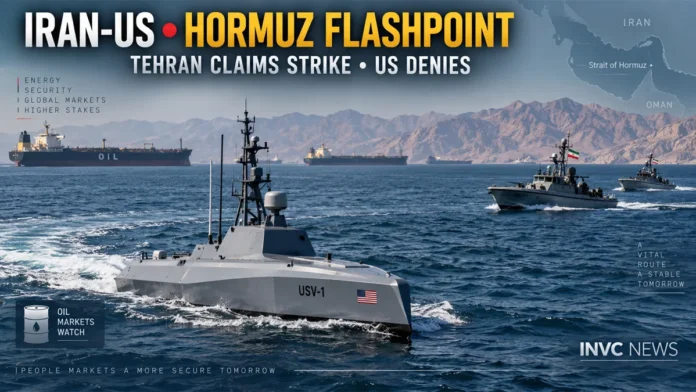
Iran US Strait of Hormuz tensions surged again Sunday after Tehran claimed its forces struck an unmanned American military vessel attempting to enter an area Iran considers restricted, while the United States flatly rejected the account and accused Iranian state media of spreading a false report.
The competing claims mark another dangerous escalation around one of the world’s most important energy corridors.
Iranian state media said the unmanned U.S. military vessel was moving toward a restricted section of the Strait of Hormuz when Iranian forces targeted it.
U.S. Central Command rejected that claim.
Capt. Tim Hawkins, a CENTCOM spokesman, said the report originated with Iranian state media and called it completely false.
Neither side has produced publicly verified evidence establishing that an American unmanned vessel suffered damage in the reported incident.
That distinction matters because tensions around Hormuz have already intensified after direct attacks involving Iranian forces, U.S. warships and oil tankers.
Iran-US Military Confrontation Moves Back to Hormuz
The latest dispute comes only a day after U.S. forces struck three Iranian crude oil tankers.
Washington said it carried out those attacks after Iran’s Islamic Revolutionary Guard Corps launched ballistic missiles toward U.S. Navy warships.
The American military said its ships avoided the incoming missiles and reported no U.S. casualties.
Iran, meanwhile, has framed its actions as retaliation for American military pressure and attacks on Iranian assets.
The result is an increasingly dangerous cycle.
Iran carries out or claims attacks against American or U.S.-linked assets.
Washington responds with military force.
Tehran then threatens stronger retaliation.
That pattern has pushed the Strait of Hormuz back to the center of the Iran-US confrontation.
Why the Unmanned Vessel Claim Matters
An unmanned surface vessel differs from a conventional warship because it can operate remotely without a crew onboard.
Militaries increasingly use such systems for surveillance, reconnaissance and maritime operations.
Iran’s claim is politically significant even without independent confirmation because it suggests Tehran wants to demonstrate that U.S. military activity inside or near Hormuz remains vulnerable.
For Washington, rejecting the report quickly serves a different purpose.
The United States does not want an unverified Iranian claim to create the impression that Tehran successfully damaged an American military asset.
That information battle now runs alongside the physical military confrontation.
Strait of Hormuz Remains Critical to Global Energy
The location makes every new incident economically important.
The Strait of Hormuz connects Gulf energy exporters with international markets and remains one of the world’s most strategically important oil and gas routes.
Any prolonged disruption can affect:
- Global crude oil supplies
- LNG shipments
- Tanker insurance costs
- Freight rates
- Asian energy imports
- Refinery margins
- Petrol and diesel price expectations
That makes an incident involving a military vessel much more than a regional security story.
It also becomes an energy-market story almost immediately.
US Says Millions of Barrels Still Cross Hormuz
U.S. Energy Secretary Chris Wright said Sunday that an average of around nine million barrels of oil per day continues to move through the Strait of Hormuz.
He argued that regional pipeline flows lift total effective supply movements to roughly two-thirds or more of pre-conflict levels.
However, those flows depend heavily on security conditions.
The U.S. Navy has played a major role in escorting or protecting shipping around the waterway as commercial operators remain cautious about Iranian attacks.
Persistent military incidents could make shipping companies and insurers reassess risk again.
Iran Uses Hormuz as Strategic Pressure Point
For Iran, geography gives the Strait enormous strategic importance.
Tehran has long understood that instability in Hormuz can create international economic pressure far beyond the Middle East.
Even limited attacks or threats can increase insurance premiums, disrupt tanker schedules and force energy importers to reconsider supply routes.
That leverage becomes particularly important as Iran faces intense U.S. economic pressure and restrictions on its oil exports.
Washington, however, has responded by combining military operations with financial and economic measures.
The confrontation now spans military, commercial and financial fronts simultaneously.
US-Iran Fighting Resumed After Period of Relative Calm
The latest incidents followed several weeks of reduced military activity.
The conflict began with U.S. and Israeli attacks on Iran on February 28.
A fragile ceasefire announced in June briefly raised expectations that both sides could move toward negotiations.
Those hopes did not last.
Intermittent clashes continued and diplomatic negotiations eventually stalled.
The United States and Iran resumed more visible military exchanges last week after roughly a month of comparative calm.
The renewed confrontation has once again placed southern Iran, Gulf shipping lanes and Hormuz in the danger zone.
Iranian Leadership Warns of Tougher Retaliation
Iran’s political leadership has also hardened its public message.
Parliament Speaker Mohammad Bagher Qalibaf has warned that Iran may move beyond what Tehran previously described as proportionate retaliation.
Iranian officials have said future responses could become faster and more painful if attacks continue.
Such rhetoric raises the possibility that future confrontations could involve larger military targets or strategically important energy infrastructure.
At the same time, rhetoric does not necessarily reveal what Iran will actually do.
Military developments therefore require careful verification rather than treating every threat as an inevitable next step.
Oil Market Faces Another Risk Premium
Energy markets are particularly sensitive to Hormuz because the risk does not need to shut the waterway completely to matter.
Even partial disruption can raise costs.
Shipowners may demand higher freight rates.
Insurers may increase war-risk premiums.
Tankers may delay departures.
Some operators may seek alternative routes.
Those changes ultimately feed into the cost of moving oil and gas.
For major importing economies, including India, Japan, South Korea and several European markets, prolonged instability can therefore have direct economic consequences.
India has already faced higher LNG procurement costs during the wider Iran conflict.
India Has Major Stake in Hormuz Stability
India imports a large share of its crude oil and natural gas requirements.
That makes stability in the Gulf particularly important for Indian energy security.
Higher crude prices can increase India’s import bill, affect refining economics and place pressure on inflation.
Expensive LNG can also affect fertilizer producers, industrial users and gas-distribution companies.
However, one military incident does not automatically mean Indian petrol or diesel prices will rise.
Domestic fuel pricing depends on several additional factors, including international crude prices, refinery economics, taxes, exchange rates and government policy.
The greater concern is what happens if Hormuz disruption continues for weeks rather than days.
Iran Nuclear Dispute Remains Unresolved
The military escalation continues against the background of Iran’s unresolved nuclear dispute with Western governments.
Negotiations that were expected to address Tehran’s nuclear program lost momentum after earlier diplomatic agreements broke down.
Western governments continue to raise concerns over Iran’s compliance with international nuclear obligations.
That means Washington and Tehran remain divided across several issues at once:
Iran’s nuclear program.
Regional military activity.
Oil exports.
Economic sanctions.
Freedom of navigation.
And control over security conditions in the Strait of Hormuz.
Solving one dispute without addressing the others will remain difficult.
What Happens Next in Strait of Hormuz
The immediate question is whether Sunday’s disputed vessel incident triggers another direct military response.
Washington has denied that Iran successfully hit an American vessel.
That denial could reduce immediate pressure for retaliation over this specific claim.
However, the broader confrontation remains unresolved.
U.S. attacks on Iranian tankers and Iranian missile launches toward American warships have already demonstrated how quickly tensions can escalate.
Any confirmed attack that causes American casualties or seriously damages a U.S. military asset could dramatically change the situation.
The same applies to a major attack on oil infrastructure or commercial shipping.
For now, the Strait of Hormuz remains both a military flashpoint and one of the most important economic pressure points in the Iran-US conflict.
Tehran says it struck an American unmanned vessel.
Washington says that never happened.
But the larger danger does not depend on which side wins the information battle.
It comes from the fact that U.S. and Iranian forces are again operating, firing and retaliating in waters through which a vital share of the world’s energy supplies must pass.