TEHRAN, Iran | September 6, 2026 — Iran Economy Crisis 2026 entered a more serious phase Sunday as Tehran moved to confront mounting pressure from U.S. sanctions and restrictions on its oil trade while senior Iranian leaders acknowledged problems involving inflation, currency volatility, unemployment and household livelihoods.
Iran’s Economy Ministry has intensified work through what officials call an “Economic War Headquarters,” a mechanism aimed at tackling economic problems linked to the conflict and growing American pressure.
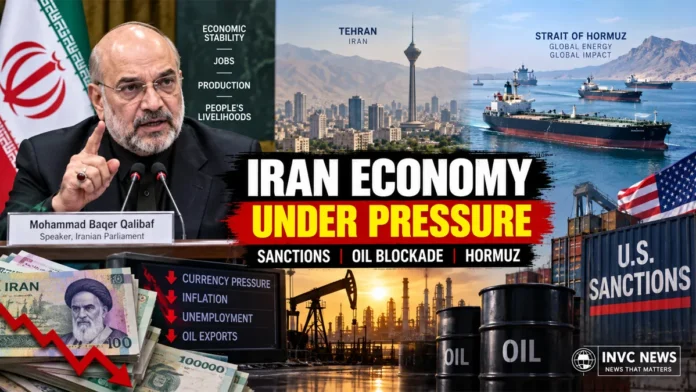
At the same time, Iranian Parliament Speaker Mohammad Baqer Qalibaf warned Washington that further attacks on Iranian interests would bring a “faster, heavier and more painful” response.
The developments show how the Iran-US confrontation has expanded beyond missiles, ships and the Strait of Hormuz.
The conflict is increasingly becoming an economic war as well.
Iran Says Economy Is Now a Major Battlefront
Qalibaf said Iran now faces a major struggle over domestic production and people’s livelihoods alongside the military confrontation.
He identified sharp currency movements, inflation, unemployment and market management as some of the most pressing challenges facing the country.
His comments amount to a rare public acknowledgment of the economic pressure confronting ordinary Iranians.
Tehran has endured sanctions for years, but the latest conflict has added a new layer of difficulty by disrupting oil exports, maritime trade and access to financial networks.
Iranian officials now face pressure not only to withstand Washington’s strategy but also to convince citizens that the government can manage the economic consequences.
‘Economic War Headquarters’ Steps Up Work
Iran’s Economy Ministry has expanded the activities of its Economic War Headquarters as officials try to manage problems caused by the conflict.
The body is expected to focus on economic stability, production, market management and other pressures arising from sanctions and disruptions to trade.
Economy Minister Ali Madanizadeh has argued that Iran should answer external pressure with domestic economic reforms.
Tehran rejects the idea that Washington can force political concessions simply by making economic conditions more difficult.
Iranian officials insist decisions about economic reform belong to Iran’s government and its people rather than the U.S. Treasury.
That position signals that Tehran plans to combine economic adaptation with continued resistance to American demands.
US Oil Blockade Puts Tehran Under Pressure
Oil remains at the center of the economic confrontation.
Iran is one of OPEC’s major producers and historically depended heavily on crude exports for foreign revenue.
Before the current conflict, around 90% of Iranian crude exports moved through the Kharg Island export hub.
American restrictions on Iranian oil exports intensified in mid-April.
Since then, Washington has sought to reduce Iran’s ability to move crude abroad while also targeting methods used to bypass sanctions.
The strategy aims to cut one of Tehran’s most important sources of hard currency.
That pressure becomes more difficult for Iran to absorb as the conflict continues.
Kharg Island Becomes Critical Economic Target
Kharg Island now sits at the heart of Iran’s economic vulnerability.
Iran’s Oil Minister Mohsen Paknejad said Sunday that the island had been hit around 550 times during previous months but had continued operating.
Kharg’s importance comes from the huge share of Iranian crude that traditionally leaves the country through the terminal.
Any sustained disruption there can affect Iran’s export revenue far more severely than an isolated attack on a tanker.
Iran has repeatedly warned that a major assault on Kharg Island would trigger a strong response.
That makes the facility both an economic asset and a strategic flashpoint.
US Says Blockade Enforcement Is Expanding
The United States says it is tightening enforcement around Iran’s maritime oil trade.
U.S. Central Command said that as of September 6 it had redirected 92 commercial vessels, disabled three and boarded two as part of enforcement of the blockade.
Washington argues that restricting Tehran’s oil revenues will reduce Iran’s ability to finance military operations and withstand broader economic pressure.
Iran sees the policy differently.
Tehran portrays the blockade as economic warfare and insists that pressure will not force it to abandon its strategic positions.
The competing views have pushed maritime commerce deeper into the military confrontation.
Iran Warns Rules of Conflict Have Changed
Qalibaf’s latest warning adds another layer of risk.
He said Iran would no longer necessarily limit itself to the type of proportional response that characterized earlier stages of the conflict.
His warning followed fresh U.S. strikes on Iranian tankers and renewed Iranian military activity involving American naval assets.
Washington said its forces struck three Iranian vessels after Iran’s Islamic Revolutionary Guard Corps launched ballistic missiles toward two U.S. Navy ships.
No American personnel were reported harmed in that exchange.
Iranian forces have since threatened stronger action against U.S. military vessels.
The result is an increasingly dangerous cycle in which economic pressure and military retaliation reinforce each other.
Inflation and Currency Pressure Hit Iranian Households
Economic pressure does not remain confined to oil companies or government budgets.
Currency weakness can raise the price of imported products.
Inflation reduces household purchasing power.
Unemployment increases political pressure on the government.
Supply disruptions can also affect businesses that depend on foreign components or financing.
Qalibaf’s emphasis on livelihoods therefore reflects one of Tehran’s biggest internal challenges.
Iranian leaders want to show that the country can withstand external pressure.
At the same time, they must prevent frustration over economic conditions from turning into broader public anger over government management.
Hormuz Remains Iran’s Biggest Economic Leverage
Iran retains one major strategic economic weapon: its position around the Strait of Hormuz.
Before the conflict, roughly one-fifth of global oil supplies passed through the waterway.
Iran has restricted traffic through the Strait, although oil continues moving through the region.
U.S. Energy Secretary Chris Wright said shipments through Hormuz were averaging more than nine million barrels per day.
When pipeline routes that bypass the Strait are included, Washington estimates that effective flows have recovered to roughly two-thirds or more of pre-conflict levels.
That means Iran can still disrupt global energy markets, but Washington believes its naval operations have reduced Tehran’s leverage.
Oil Markets Remain Exposed
The economic confrontation matters far beyond Iran and the United States.
When oil flows through the Gulf face disruption, global markets react.
Shipping insurance costs can rise.
Tanker freight rates can increase.
Energy importers may pay more for crude and liquefied natural gas.
Refiners can face tighter margins.
Consumers may eventually feel the effect through inflation and fuel costs if higher energy prices persist.
The risk becomes particularly important for major oil-importing economies such as India.
India depends heavily on imported crude, meaning prolonged disruption around Hormuz can increase the country’s energy import bill.
However, short-term military escalation does not automatically translate into an immediate change in Indian petrol or diesel prices.
Tehran Rejects US Strategy
Despite the mounting economic pressure, Tehran continues to reject Washington’s core assumption that sanctions will eventually force political concessions.
Iranian officials argue that domestic reforms can strengthen economic resilience.
They also believe the United States faces costs of its own.
Higher global energy prices can increase inflation in America and create political pressure ahead of elections.
Disruption in Hormuz also affects U.S. allies and other economies that depend on Gulf energy.
Iran therefore appears determined to use both economic resilience and strategic geography to resist Washington’s campaign.
Diplomacy Remains Stalled
The economic confrontation is unfolding while diplomatic efforts remain largely frozen.
A preliminary ceasefire arrangement reached in June has unraveled.
Efforts to restart a broader peace process have made little visible progress.
Military exchanges resumed after a period of relative calm.
That leaves both sides locked into a dangerous structure.
Washington applies sanctions, maritime pressure and military force.
Tehran responds with threats, strikes and restrictions around strategic shipping routes.
Neither side has yet demonstrated that it can force the other to accept its terms.
Iran Faces Its Toughest Test at Home
For Tehran, the most important battle may ultimately take place inside Iran’s economy.
Military retaliation can demonstrate strength abroad.
But managing inflation, currency instability, jobs, production and household living standards requires a different type of response.
The creation and expansion of the Economic War Headquarters suggests Iranian leaders understand that distinction.
The coming months will test whether Tehran can keep oil revenues flowing, stabilize domestic markets and protect household purchasing power while facing sustained American pressure.
Iran says it will not change course because of sanctions.
Washington believes continued economic pressure can make Tehran’s current position increasingly difficult to sustain.
That confrontation now sits alongside the military conflict as one of the defining battles of the Iran-US standoff.