MUMBAI, India | September 7, 2026 —
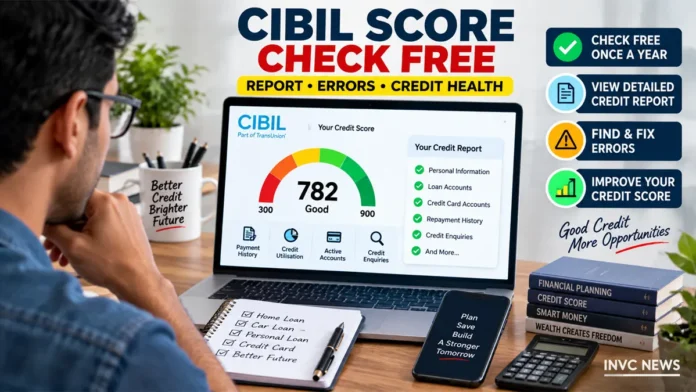
CIBIL Score Check Free is one of the most useful financial tools available to borrowers before they apply for a home loan, personal loan, car loan or credit card. Indian consumers can get one free CIBIL Score and Credit Information Report every calendar year without paying a fee.
The report does much more than show a three-digit score. It gives consumers a detailed view of loans, credit cards, repayment history, lender enquiries and information reported by banks and financial institutions.
Checking the report regularly can also help identify incorrect loans, delayed updates or possible identity misuse before those problems affect a major borrowing decision.
What Is a CIBIL Score?
A CIBIL Score is a three-digit number that summarises a consumer’s credit history.
The score ranges from 300 to 900.
A score closer to 900 generally indicates a stronger credit profile. However, a high score does not guarantee approval of a loan or credit card.
Banks and financial institutions also consider income, existing liabilities, repayment capacity, employment profile, loan-to-value ratio and their own credit policies.
The score therefore acts as one important part of a lender’s overall assessment.
Can You Check CIBIL Score for Free?
Yes.
Consumers whose credit history is available with TransUnion CIBIL can obtain one free CIBIL Score and Report in every calendar year.
For example, a person who has already used the free CIBIL report facility at any time during 2026 will become eligible for the next annual free report from January 1, 2027.
Consumers do not need to buy a subscription merely to obtain the annual free report.
Additional monitoring services or repeated reports during the same year may involve a paid plan.
How to Check CIBIL Score Free
Consumers can complete the process online.
First, visit the official TransUnion CIBIL platform and choose the free CIBIL Score and Report option.
Next, create an account or sign in if an account already exists.
The system may ask for identification and authentication details before showing the report.
After successful verification, users can access their latest score and detailed credit report.
Consumers should avoid websites that imitate credit-bureau pages and ask for unnecessary payments, OTPs or sensitive information.
What Does a CIBIL Report Show?
A credit report contains far more information than the score displayed at the top.
It may include:
- Current and closed loan accounts
- Credit-card accounts
- Repayment history
- Amounts reported as outstanding
- Credit limits
- Personal information linked with credit accounts
- Recent lender enquiries
- Dates on which lenders reported account information
Consumers should examine every section rather than looking only at the score.
An incorrect account entry can sometimes matter more than a small movement in the score itself.
Does Checking Your Own CIBIL Score Reduce It?
No.
Checking your own CIBIL Score does not lower the score.
A consumer checking their own report creates a different type of enquiry from a lender making a credit enquiry after a loan or credit-card application.
However, applying repeatedly for several loans or cards within a short period can lead to multiple lender enquiries.
Credit bureaus consider enquiry behaviour as one factor when assessing a credit profile.
Therefore, consumers should compare products carefully rather than submitting unnecessary applications to many lenders at once.
What Factors Can Affect Your CIBIL Score?
Several parts of a borrower’s credit behaviour influence the score.
Payment History
Late credit-card payments, missed EMIs and loan defaults can hurt a credit profile.
Paying dues on time remains one of the most important habits for maintaining healthy credit information.
Credit Utilisation
Using a very large portion of an available credit-card limit can indicate greater dependence on borrowed money.
Consumers who consistently use most of their available credit may present a different risk profile from those who maintain more comfortable limits.
Age of Credit
Longer credit histories can provide lenders and credit bureaus with more repayment information.
Closing an old account solely to change the score may therefore not always produce the result a consumer expects.
Credit Enquiries
Repeated applications can generate multiple lender enquiries.
Consumers should apply when they genuinely need credit and meet the lender’s basic eligibility criteria.
Credit Mix
The type and history of secured and unsecured credit can also form part of the overall assessment.
What If Your CIBIL Report Contains an Error?
Consumers should act quickly when they spot incorrect information.
Common problems can include a loan appearing after closure, incorrect outstanding balance, wrong personal details, duplicate accounts or a credit facility that the consumer never opened.
The consumer can raise a dispute through CIBIL and can also contact the bank or financial institution that supplied the information.
Credit bureaus generally cannot change lender-reported account data merely on a consumer’s assertion. The institution that supplied the information must verify the correction.
Consumers should keep account statements, closure letters, payment receipts and correspondence that support the dispute.
RBI Gives Consumers Protection Against Delayed Corrections
The Reserve Bank of India has introduced a compensation framework for delays in updating or correcting credit information.
Under the framework, a complaint involving inaccurate credit information should generally reach resolution within 30 calendar days.
Where the applicable conditions are met and the delay crosses that period, the complainant may become entitled to ₹100 for each calendar day of delay.
The exact responsibility can depend on whether the delay occurred at the credit institution or the credit information company.
Consumers should therefore keep the complaint reference number and the date on which they first filed the grievance.
Credit Reports Now Receive More Frequent Updates
Credit information reporting has also become faster.
From January 1, 2025, regulated lenders must report credit information on a fortnightly basis, generally reflecting positions as of the 15th and the last day of each month.
This system can reduce the long delays that consumers previously experienced after loan repayments or account closures.
However, an update may still take some time to move from the lender’s internal systems to the final credit report.
Consumers should not expect every payment to appear immediately.
How to Improve a CIBIL Score
No legitimate service can guarantee an instant increase in a credit score.
Consumers can instead build a stronger profile through consistent financial behaviour.
Pay EMIs and credit-card dues on time.
Avoid repeatedly exhausting credit limits.
Check reports for inaccuracies.
Limit unnecessary applications for new credit.
Repay overdue amounts according to an agreed plan.
Keep loan-closure documents safely.
Consumers should also remain cautious about businesses that promise to “repair” a score instantly in exchange for a large fee.
A genuine negative repayment history cannot simply disappear because a third party requests its removal.
Can You Have a CIBIL Score Without a Loan?
A person generally needs sufficient reported credit information before a bureau can calculate a meaningful credit score.
Someone who has never used a loan or credit card may have little or no conventional credit history.
That does not automatically mean the person has poor financial behaviour.
It simply means lenders may have less credit-history data to evaluate.
Is 900 Required for a Loan?
No.
A consumer does not need a perfect score of 900 to apply for credit.
Each lender sets its own approval policies and risk thresholds.
A stronger score can improve the overall credit profile, but lenders also evaluate income, existing debt, employment, property value and other criteria.
Consumers should therefore avoid treating any single score number as a guaranteed approval threshold.
Why You Should Check Your Credit Report Before a Major Loan
A home loan or large personal loan can involve years of repayments.
Checking a credit report before applying gives consumers time to detect errors, reduce outstanding balances and understand how lenders may see their credit history.
It can also prevent an avoidable rejection caused by incorrect information that the borrower could have disputed earlier.
The most useful approach is simple: use the annual CIBIL Score Check Free facility, read the entire report carefully and fix genuine inaccuracies before they become expensive problems.