BENGALURU, India | September 2, 2026 —
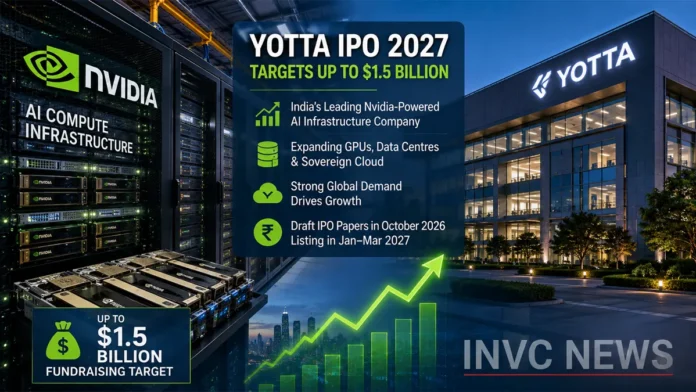
Yotta IPO 2027 has emerged as one of India’s biggest artificial-intelligence fundraising stories after Yotta Data Services revealed plans to enter the stock market in the January-March quarter of 2027 while targeting up to $1.5 billion to expand its rapidly growing AI and data-centre business.
CEO Sunil Gupta said the Hiranandani Group-backed company plans to file draft IPO documents as early as October.
Yotta wants to use the money to repay debt, buy more graphics processing units, expand sovereign cloud infrastructure and meet rapidly growing demand for artificial-intelligence computing.
The IPO plan arrives at a critical moment for India.
Global companies are pouring billions of dollars into AI infrastructure, while Nvidia GPUs have become some of the most valuable computing resources in the world.
Yotta now wants to position India as a major destination for that investment.
Yotta Targets January-March 2027 IPO
Yotta plans to launch its public offering during the January-March quarter of 2027.
The company aims to begin the formal process much earlier.
It expects to file its draft IPO papers in October 2026.
Yotta could seek total funding of up to $1.5 billion, although the final size of the public issue may become smaller.
That is because the company is already raising significant pre-IPO capital.
CEO Sunil Gupta said strong fundraising before the IPO could reduce the amount Yotta ultimately needs to collect from public-market investors.
Yotta Wants Money for Nvidia GPUs and AI Infrastructure
Artificial-intelligence computing requires enormous amounts of specialised hardware.
GPUs sit at the centre of that infrastructure.
Yotta plans to deploy part of its new capital toward acquiring more high-performance GPUs and expanding computing capacity.
The company describes itself as India’s largest provider of Nvidia-powered AI computing infrastructure.
Nvidia chips have become essential for training and running large AI models used in generative artificial intelligence, enterprise software and cloud computing.
Demand for those chips remains intense globally.
That gives Yotta a powerful growth opportunity but also creates a huge financing requirement.
AI Boom Is Turning Data Centres Into Mega Investments
Traditional data centres mainly hosted websites, corporate servers and cloud workloads.
AI has completely changed the scale of that business.
Modern AI systems require huge clusters of GPUs.
Those processors consume enormous amounts of electricity and generate substantial heat.
Operators therefore need:
Power infrastructure
Advanced cooling systems
High-speed networking
Secure cloud infrastructure
Large quantities of GPUs
and enormous capital investment.
That has transformed data centres from relatively conventional infrastructure projects into some of the biggest technology investments in the world.
Yotta Raised $150 Million Before IPO
Yotta has already attracted major capital before reaching the stock market.
Sunil Gupta said last month that the company raised $150 million in primary growth capital.
That fundraising valued Yotta at approximately ₹370 billion, or roughly $3.9 billion.
The company continues to seek pre-IPO funding.
If investor demand remains strong, Yotta may not need to raise the full $1.5 billion through the stock-market listing itself.
That could significantly alter the eventual IPO structure.
Nvidia Connection Gives Yotta Strong Search Value
The Nvidia connection makes Yotta especially important in India’s AI infrastructure race.
Nvidia dominates the global market for high-performance AI accelerators.
Companies around the world are competing to secure the latest Nvidia chips.
Yotta has been building a large GPU cloud platform that allows enterprises, startups and government-linked customers to access AI computing without purchasing expensive hardware themselves.
That model could become increasingly valuable as artificial-intelligence adoption expands across India.
India Becomes Global AI Data Centre Destination
Yotta believes India is entering a particularly favourable period.
Power constraints have slowed data-centre development in parts of the United States and Europe.
GPU supply also remains tight.
Meanwhile, geopolitical instability has complicated infrastructure expansion in parts of the Middle East.
Gupta argues that these pressures make India increasingly attractive to global companies looking for reliable AI computing capacity.
India offers:
A large digital economy
Growing electricity infrastructure
Skilled technology workers
Cloud demand
Government support
and rapidly expanding AI adoption.
These factors could make India a major global data-centre hub.
Global Customers Drive Most of Yotta’s Business
Yotta is not relying only on Indian customers.
Gupta said overseas clients account for approximately 75% to 80% of the company’s customer base.
That figure shows how quickly India’s data-centre market is becoming international.
Global companies increasingly want computing resources in multiple regions.
They also want alternatives to markets where energy availability, regulation or geopolitical risks may constrain expansion.
Yotta wants India to capture more of that demand.
Sovereign Cloud Becomes Major Growth Opportunity
The company also plans to expand its sovereign cloud infrastructure.
Sovereign cloud services keep sensitive data and computing workloads within a particular country or legal jurisdiction.
Governments, banks, defence organisations and regulated businesses increasingly care about where data resides.
AI has made the issue even more important.
Large models can process enormous amounts of corporate, government and personal information.
Countries therefore want greater control over data storage and computing infrastructure.
Yotta sees this trend as another major growth opportunity.
India’s Tax Policy Helps Data Centre Push
India has also introduced incentives designed to attract international cloud and data-centre investment.
The government announced a 20-year tax holiday for qualifying foreign companies using Indian data-centre infrastructure.
Yotta says this policy has increased confidence among overseas customers.
Tax incentives alone will not decide where companies build AI infrastructure.
Power availability, connectivity, regulatory stability and GPU access remain equally important.
However, a long-term tax benefit can improve India’s competitiveness against rival locations.
Google and Amazon Are Expanding in India
Yotta is not alone in betting heavily on India.
Global technology giants including Google and Amazon are expanding their Indian data-centre presence as demand for AI and cloud computing accelerates.
That competition could dramatically increase investment in:
Electricity generation
Transmission networks
Data-centre construction
Fibre infrastructure
Cooling equipment
Cloud software
and semiconductor-linked services.
India could therefore benefit far beyond individual data-centre companies.
GPU Costs Create New Financing Challenge
The AI boom also creates an unusual financial problem.
GPUs are extremely expensive.
Companies may need billions of dollars to build computing clusters before earning revenue from them.
Yotta is therefore exploring alternative financing structures.
Under one model, outside partners could purchase GPUs through special-purpose vehicles.
Yotta would use those processors to provide AI services and share revenue with the investors.
After four or five years, ownership of the GPUs could transfer to Yotta.
Such arrangements could allow the company to expand more quickly without funding every chip directly from its balance sheet.
Yotta Has Already Made Huge Nvidia Bets
The company has already demonstrated aggressive ambitions in AI hardware.
Yotta has previously outlined plans involving tens of thousands of next-generation Nvidia GPUs, including Nvidia’s newest computing architectures.
That scale puts the company directly into one of the world’s most capital-intensive technology races.
However, rapid GPU expansion also carries risks.
AI hardware improves extremely quickly.
A processor that commands a premium today can become less competitive when Nvidia introduces a new generation.
Operators therefore need enough customer demand to keep costly hardware highly utilised.
Why Investors Will Watch Yotta IPO Closely
A Yotta listing could become an important test of investor appetite for India’s AI infrastructure story.
Investors will examine:
Revenue growth
Debt
GPU utilisation
Electricity costs
Customer concentration
Capital expenditure
Cloud demand
and profitability.
The headline “AI boom” can attract attention.
But public-market investors will ultimately demand evidence that expensive infrastructure can generate sustainable returns.
India’s AI Race Moves From Software to Infrastructure
For years, much of India’s technology story revolved around software services.
Artificial intelligence is creating a different opportunity.
The next phase requires physical infrastructure.
India needs data centres.
It needs GPUs.
It needs reliable electricity.
It needs advanced cooling.
It needs fast networks.
And it needs cloud infrastructure capable of keeping sensitive data inside the country.
That shift could create an entirely new technology-investment cycle.
Yotta IPO Could Become One of 2027’s Biggest Tech Listings
The Yotta IPO 2027 plan brings several of the world’s hottest investment themes into one story:
Artificial intelligence.
Nvidia.
Cloud computing.
Data centres.
Sovereign AI.
And India’s IPO market.
Yotta now plans to file draft documents in October before targeting a January-March listing window.
The company could seek up to $1.5 billion across its fundraising programme, although strong pre-IPO investment may reduce the final public issue.
For investors, the bigger question is no longer whether AI requires massive infrastructure.
It clearly does.
The question is how much of that global infrastructure boom India can capture.
Yotta is betting that the answer could be enormous.