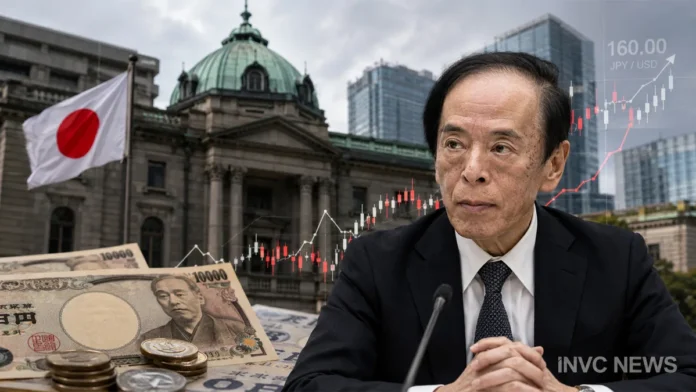
TOKYO, Japan | September 2, 2026 —
Bank of Japan rate hike expectations jumped sharply on Wednesday after Governor Kazuo Ueda signalled that policymakers will closely examine another interest-rate increase at their September meeting as a weak yen, rising oil prices and persistent inflation increase pressure on the Japanese economy.
The Bank of Japan will hold its next monetary-policy meeting on September 17 and 18, and markets are increasingly betting that policymakers could raise the current 1% policy rate.
Ueda stopped short of promising an increase.
However, he made clear that the central bank will assess whether inflation risks have intensified and whether economic conditions continue to follow the BOJ’s projections.
His comments immediately put the yen, Japanese government bonds and global interest-rate markets under closer scrutiny.
Ueda Opens Door to September Rate Hike
Governor Ueda said the Bank of Japan will carefully examine economic activity and price risks when policymakers meet later this month.
The central bank has already raised rates five times during its gradual exit from years of ultra-loose monetary policy.
Its latest increase came in June, when the BOJ lifted the policy rate to 1%, its highest level in more than three decades.
Officials left rates unchanged at their July meeting.
Now, September could bring another move.
Ueda stressed that policymakers will determine whether recent economic developments justify further adjustment rather than follow a predetermined path.
Yen Near 160 Adds Pressure on Bank of Japan
The Japanese yen remains one of the biggest reasons markets expect action.
The currency has traded around the psychologically important 160-per-dollar level, keeping pressure on Japanese households and businesses that depend on imported energy, food and raw materials.
A weak yen makes imports more expensive.
That can push inflation higher even when domestic demand remains relatively soft.
The currency’s weakness has also become an international issue.
Japanese and US officials have discussed the need for orderly exchange-rate movements as markets watch for signs of intervention or monetary-policy action.
US Presses Japan for ‘Decisive’ Monetary Steps
US Treasury Secretary Scott Bessent has added another layer of pressure.
Bessent urged Japanese policymakers to take decisive monetary steps that could help stabilise the yen.
The comments followed discussions with Governor Ueda and Japanese Finance Minister Satsuki Katayama.
Washington and Tokyo have also agreed to continue coordinating on currency-market stability.
Such public pressure from the United States is unusual and shows how the yen’s weakness has become more than a domestic Japanese issue.
Oil Near $95 Makes Japan’s Inflation Problem Harder
The renewed US-Iran conflict has complicated the Bank of Japan’s decision.
Brent crude has climbed to around $95 per barrel as markets worry about further military escalation and potential disruption around the Strait of Hormuz.
Japan imports most of its energy needs.
Higher crude prices therefore increase costs across the economy.
Businesses pay more for energy and transportation.
Consumers can eventually face higher fuel, electricity and product prices.
That creates exactly the kind of imported inflation the BOJ must now consider.
Japanese Bond Yields Jump to Multi-Decade Highs
Bond markets have already started pricing in tighter monetary policy.
Japan’s two-year government bond yield climbed to its highest level since 1995 as investors increased bets on another rate hike.
Longer-term yields have also moved higher.
Rising bond yields increase borrowing costs for governments, companies and households.
They can also pressure stock-market valuations.
Japan spent decades in an environment dominated by extremely low or even negative interest rates.
The current shift therefore represents one of the biggest structural changes in global financial markets.
Japan Has Already Left Negative Rates Behind
For years, the Bank of Japan stood apart from other major central banks.
While the Federal Reserve, European Central Bank and Bank of England raised rates aggressively during global inflation shocks, Japan maintained exceptionally loose monetary policy.
That era has now ended.
The BOJ abandoned negative interest rates in 2024 and has gradually increased borrowing costs since then.
Its current policy rate of around 1% remains low compared with many other economies.
However, for Japan, even a move toward 1.25% would mark another significant step away from decades of extraordinary monetary stimulus.
Inflation Keeps BOJ on Alert
The central bank wants inflation to remain near its 2% target in a sustainable way.
Japan has struggled for decades with weak inflation and deflationary pressure.
The current challenge looks very different.
Prices have increased.
Wages have also risen.
And a weak currency continues to raise import costs.
The BOJ must decide whether inflation has become strong enough to justify further tightening without damaging economic growth.
That balance will determine the September decision.
Rate Hike Could Strengthen Yen
A Bank of Japan rate hike could potentially support the yen.
Higher interest rates make yen-denominated assets relatively more attractive.
They also reduce the enormous interest-rate gap between Japan and other major economies.
That gap has encouraged investors to borrow cheaply in yen and invest in higher-yielding assets elsewhere — a strategy commonly known as the yen carry trade.
If Japanese rates rise further, part of that trade could unwind.
That could strengthen the yen but also create volatility across global markets.
Yen Carry Trade Makes BOJ Decision Global
The Bank of Japan’s decisions matter far beyond Tokyo.
For years, cheap Japanese money has flowed into bonds, stocks and other assets around the world.
Investors have used low-cost yen financing to buy higher-return investments.
A faster-than-expected rise in Japanese interest rates could force some investors to reverse those trades.
That creates risks for:
Global equities
Government bonds
Emerging-market currencies
Cryptocurrencies
High-yield investments
A sharp yen rally could therefore trigger market movements thousands of kilometres away from Japan.
Fed Rate Hike Bets Add Another Complication
Japan is not tightening policy in isolation.
Markets are also raising expectations that the US Federal Reserve could increase interest rates again.
US Treasury yields have climbed sharply, with the 10-year yield reaching its highest level in nearly three years.
Higher American yields can strengthen the dollar and weaken the yen.
That creates a difficult situation for the Bank of Japan.
Even if Tokyo raises rates, an equally hawkish Federal Reserve could keep the US-Japan yield gap wide.
September 17–18 Becomes Critical Date
Markets will now focus heavily on the BOJ’s two-day policy meeting.
The key questions will include:
Will the BOJ raise rates above 1%?
How worried is the central bank about the weak yen?
How much weight will policymakers give to higher oil prices?
Does the BOJ believe wage growth can sustain domestic inflation?
And how quickly can Japan normalise policy without damaging economic growth?
Ueda has deliberately kept his options open.
That gives policymakers flexibility if financial conditions change dramatically before the meeting.
What a Rate Hike Could Mean for Global Investors
A September increase could send several immediate signals through financial markets.
The yen could strengthen.
Japanese bond yields could rise further.
Bank shares could benefit from wider lending margins.
Rate-sensitive Japanese stocks could face pressure.
Global carry trades could become less attractive.
Investors could also reassess capital flows into Asian markets.
The size of the market reaction would depend heavily on whether investors see the hike as a one-time adjustment or the beginning of a faster tightening cycle.
Japan Enters New Monetary Era
The Bank of Japan rate hike debate highlights how dramatically Japan’s economic environment has changed.
For decades, policymakers fought weak demand, falling prices and near-zero inflation.
Today they face a weaker currency, rising import costs and stronger price pressures.
Governor Kazuo Ueda now has to manage the transition without triggering a recession or destabilising financial markets.
The next major decision comes on September 17–18.
Until then, every move in the yen, oil prices and Japanese bond yields could shift expectations.
For global investors, one message is already clear: the Bank of Japan is no longer the world’s permanently dovish central bank — and September could deliver another historic step in Japan’s return to conventional monetary policy.