NEW DELHI, India | September 22, 2026 —
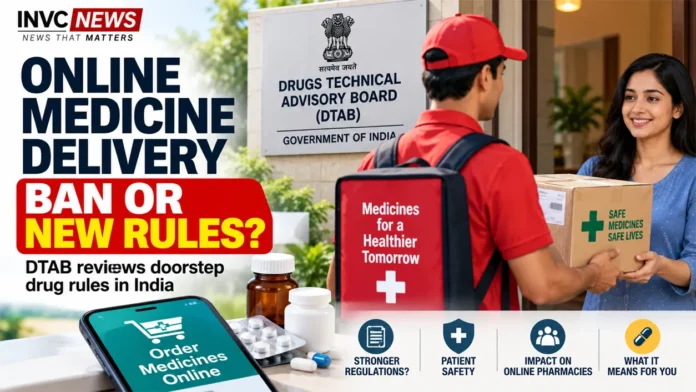
Millions of Indians who order medicines at home could eventually face tighter rules as the country’s top drug advisory body takes another look at the regulations governing doorstep medicine delivery.
However, online medicine delivery has not been banned in India.
The Drugs Technical Advisory Board, or DTAB, has reopened scrutiny of the 2020 notification that permits licensed pharmacies to deliver certain medicines to patients’ homes. The review follows a request from the All India Organisation of Chemists & Druggists seeking withdrawal of that notification.
That distinction matters. The government is examining the regulatory framework, but no final decision to stop home delivery has been announced.
Why is doorstep medicine delivery under review?
The government introduced G.S.R. 220(E) on March 26, 2020, during the COVID-19 emergency.
The notification allowed licensed retail pharmacies holding Form-20 or Form-21 licences to deliver permitted medicines directly to patients under specified conditions.
The measure proved particularly useful for people who could not easily visit pharmacies, including patients managing chronic conditions and people living far from convenient medical stores.
Over time, however, concerns emerged about how the framework was being used in an increasingly digital medicine market.
The All India Organisation of Chemists & Druggists subsequently asked authorities to withdraw the 2020 notification. DTAB first examined that request and constituted a sub-committee to study the issue in detail.
What did DTAB decide in its latest meeting?
This is where the current story becomes important.
At its 94th meeting on August 27, 2026, DTAB considered the sub-committee report on the proposed withdrawal of the doorstep-delivery notification.
But the Board did not approve an immediate ban.
Instead, DTAB asked the sub-committee to revisit the issue “in the present context” and, if necessary, hear relevant associations before finalising its position.
Therefore, doorstep medicine delivery continues under the existing regulatory framework unless and until the government issues a new legal notification or order.
What medicines can currently be delivered?
The 2020 notification does not provide an unrestricted right to deliver every drug.
Licensed retailers can deliver permitted medicines, including certain Schedule H prescription medicines, subject to conditions. Schedule H drugs require a prescription received physically or through email.
The notification excludes narcotics, psychotropic and controlled substances, as well as medicines covered under Schedule H1 and Schedule X from this doorstep-delivery permission.
The rules also require pharmacies to follow specific safeguards.
For example, the medicine must generally reach a patient within the same revenue district where the licensed seller operates.
For chronic conditions, the prescription must be presented within 30 days of issue. For acute conditions, the limit is seven days.
Pharmacies must also maintain transaction records and provide a bill or cash memo.
Could online pharmacies face tougher rules?
That is now one of the biggest questions.
The original 2020 notification specifically addresses licensed retail sellers and doorstep delivery. India’s digital medicine market has expanded substantially since then.
As a result, regulators now have to balance convenience against concerns involving prescription compliance, medicine storage, supply-chain accountability and possible misuse.
Recent reporting has also indicated that a government sub-committee saw value in retaining doorstep medicine delivery while strengthening safeguards rather than eliminating the facility altogether.
That makes a complete prohibition only one possible outcome—not the established government decision.
What happens to people ordering medicines today?
For consumers, nothing changes immediately.
Patients can continue using legally permitted home-delivery services under the existing rules.
People should still buy medicines from properly licensed sellers and provide a valid prescription whenever the medicine requires one.
Most importantly, consumers should not stop necessary medicines or alter treatment because of reports about a possible regulatory change.
Until authorities announce a final decision, the current system remains in force.
The next decision could reshape India’s medicine-delivery market
The eventual outcome will matter to pharmacies, digital health companies and millions of patients.
A withdrawal of the 2020 provision could significantly change the way medicines reach homes. On the other hand, retaining the rule with stronger checks could preserve convenience while increasing accountability.
For now, the headline is straightforward:
India is reviewing its doorstep medicine-delivery rules. It has not banned online or home delivery of medicines.