By Team INVC | INVC NEWS
NEW YORK, United States | September 2, 2026 —
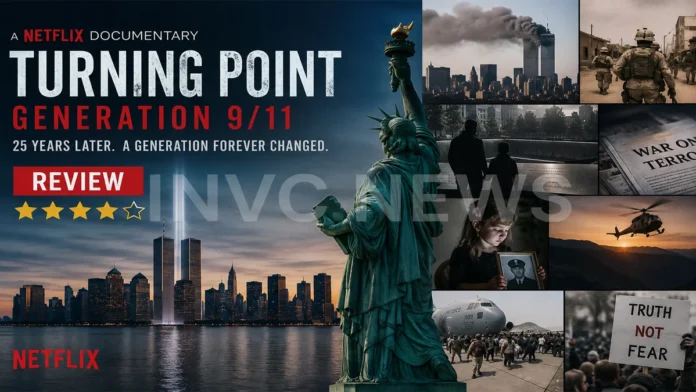
Turning Point Generation 9/11 review: Netflix’s new documentary does something far more difficult than simply replay the horror of September 11, 2001. It asks what happened after the smoke cleared, after America went to war, after children grew up without parents, and after fear became embedded in politics, surveillance, foreign policy and public life.
Director Brian Knappenberger resists turning the 25th anniversary of 9/11 into another conventional chronology of planes, towers and political speeches.
Instead, Turning Point: Generation 9/11 follows the human and political aftershocks of the attacks across a quarter-century.
That choice gives the 97-minute documentary its power.
The images of September 11 remain devastating, but the film’s strongest moments come when it moves beyond those familiar images and listens to people who had to build entire lives around what happened that morning.
INVC NEWS Rating: ★★★★☆ — 4/5
The Film Understands That 9/11 Is Now Becoming History
Perhaps the documentary’s smartest observation arrives before any political argument.
Time has changed the meaning of September 11.
Millions of adults alive today either were not born in 2001 or were too young to remember the attacks.
For one generation, 9/11 remains a vivid memory.
For another, it has become history.
Knappenberger understands that transition.
He does not assume viewers already carry the emotional weight of the event.
Instead, he reconstructs that weight through people who inherited its consequences.
That makes Generation 9/11 particularly effective as a documentary for younger viewers.
It does not lecture them about why September 11 mattered.
It shows them.
Children Who Lost Parents Give the Film Its Emotional Core
The documentary becomes most affecting when politics disappears and individual lives take over.
Children who lost parents in the attacks describe growing up with an absence that never became ordinary.
Among them is Laurel Homer, daughter of United Airlines Flight 93 co-pilot Leroy Homer Jr.
Flight 93 remains one of the most extraordinary stories of September 11.
Passengers and crew fought back against the hijackers before the plane crashed in Pennsylvania.
But Generation 9/11 does not reduce that story to heroism alone.
It asks what happens to a child after the world turns her father into part of national history.
That perspective cuts through the mythology surrounding major historical events.
Behind every monument stands a family that still had to go home without someone.
Those are the moments when the documentary lands hardest.
The War on Terror Becomes the Real Subject
Generation 9/11 gradually reveals that September 11 itself is only the beginning of the film.
Its true subject is the world America constructed afterward.
The United States invaded Afghanistan.
Washington launched the War on Terror.
The government expanded surveillance powers.
National security institutions grew.
America invaded Iraq.
Muslim and immigrant communities lived under greater suspicion.
Conspiracy theories flourished.
Two decades of war followed.
The documentary draws a straight line through those developments without pretending that every consequence came from a single decision.
That restraint matters.
It allows viewers to see how fear, policy and politics accumulated over time.
Afghanistan Gives the Documentary Its Most Painful Contradiction
The film becomes particularly strong when it looks at Afghanistan.
Young Afghans appear not as anonymous people living inside an American foreign-policy story, but as individuals whose childhoods unfolded during a war they did not start.
That shift in perspective gives the documentary important moral weight.
For Americans, Afghanistan became the country’s longest war.
For Afghans, it became everyday life.
The film eventually reaches the chaotic American withdrawal of 2021.
By then, the circle feels brutally complete.
A war launched after September 11 ends nearly 20 years later with desperate crowds at Kabul airport, the Taliban back in power and another generation wondering what all those years achieved.
The documentary does not need to shout its conclusion.
The images do enough.
Marines Bring the War Home
American Marines who experienced the Afghanistan withdrawal give the film another important perspective.
Their testimony prevents Generation 9/11 from reducing the War on Terror to decisions made by presidents, generals or Washington officials.
People carried out those decisions.
Some were teenagers when September 11 happened.
Years later, they found themselves inside the war that followed it.
The documentary handles those experiences with admirable seriousness.
It does not romanticise war.
It also does not dismiss the people who fought it.
Instead, it lets the contradiction sit there.
That makes the film more mature than a simple anti-war argument.
The Conspiracy-Theory Section Feels Uncomfortably Current
One of Generation 9/11’s most interesting sections examines conspiracy theories.
The so-called 9/11 “truther” movement emerged long before TikTok, algorithmic feeds and today’s deepfake culture.
Yet the documentary shows how familiar the mechanics now look.
Distrust institutions.
Reject official explanations.
Find communities that reinforce suspicion.
Transform unanswered questions into certainty.
Spread the theory faster than evidence can catch it.
Knappenberger connects that period to the misinformation ecosystem that defines much of modern political life.
The connection feels convincing.
In hindsight, 9/11 conspiracy culture looks less like an isolated phenomenon and more like an early warning of what the internet would eventually become.
Surveillance Legacy Deserves Attention
The documentary also reminds viewers how dramatically the attacks changed the relationship between citizens and the state.
National-security powers expanded.
Surveillance increased.
New government institutions emerged.
The balance between security and privacy shifted.
At the time, authorities justified many of those changes as necessary to prevent another catastrophic attack.
Twenty-five years later, that debate feels even more relevant.
Governments and technology companies now possess surveillance tools far more powerful than anything widely available in 2001.
Artificial intelligence, facial recognition and massive data collection have made old questions about privacy dramatically more complicated.
Generation 9/11 does not fully explore that modern technological layer, but it opens the door.
A longer documentary could have walked through it.
This Is Where the Film Sometimes Moves Too Fast
That leads to the documentary’s biggest weakness.
It wants to cover an enormous amount of history in only about 97 minutes.
September 11.
Afghanistan.
Iraq.
Surveillance.
Immigration.
Islamophobia.
Conspiracy theories.
American political culture.
Kabul.
A quarter-century of national trauma.
That is simply too much material for one feature-length documentary to investigate deeply.
As a result, some major themes arrive, make their point and disappear before the film can fully unpack them.
Viewers familiar with post-9/11 history may occasionally wish the documentary would slow down.
The film often works better as a powerful map of consequences than as a definitive examination of any single one of them.
Iraq Could Have Used More Space
The Iraq War particularly deserves a deeper treatment.
The invasion became one of the most consequential results of the political environment created after 9/11, even though Iraq did not carry responsibility for the September 11 attacks.
The war reshaped the Middle East, transformed American politics and left immense human costs.
Generation 9/11 recognises that wider history, but Afghanistan naturally receives more emotional space.
That makes sense structurally.
Still, the Iraq chapter feels somewhat compressed given its significance.
The Documentary Avoids Empty Anniversary Nostalgia
This is where the film deserves particular credit.
Anniversary documentaries often become ceremonial.
They repeat familiar footage.
They honour victims.
They ask viewers to remember.
Generation 9/11 does those things, but it refuses to stop there.
It asks uncomfortable questions.
What did America become after the attacks?
Which policies made the country safer?
Which ones created new damage?
How did grief become political power?
How did fear change public attitudes?
What did children inherit from decisions adults made in 2001?
Those questions prevent the documentary from becoming a memorial special.
It behaves like an investigation.
Brian Knappenberger Keeps the Human Story in Control
Knappenberger has made a smart directing choice by keeping individuals at the centre even when the documentary tackles enormous geopolitical issues.
Policy can become abstract quickly.
War statistics can become numbingly large.
Political arguments can turn into partisan noise.
A daughter discussing the father she never got to know cuts through all of that.
So does an Afghan describing a country shaped by war.
So does a Marine remembering Kabul.
These people give the documentary continuity.
History happens around them, but they carry its consequences.
The Film Does Not Offer Easy Villains and Heroes
Another strength comes from what the documentary avoids.
It does not reduce 25 years of history into a simple argument where one politician, one party or one institution explains everything.
That would have made for easier television.
It would also have made for weaker history.
Generation 9/11 instead portrays a country reacting to genuine trauma and then living with choices made under that trauma.
Some choices came from understandable fear.
Some produced consequences their architects did not anticipate.
Others created problems that still shape political life.
That complexity gives the film credibility.
Josh Brolin’s Narration Knows When to Step Aside
Josh Brolin provides narration, but the documentary wisely does not allow celebrity narration to overpower firsthand testimony.
His voice helps guide viewers through history without turning the film into a performance.
The actual witnesses remain more important.
That is exactly how a documentary like this should work.
The biggest emotional moments belong to people who lived the consequences, not the narrator explaining them.
Indian Viewers Will Find the Geopolitics Familiar
For viewers in India, Generation 9/11 carries additional significance.
September 11 transformed US-Pakistan relations.
It changed counterterrorism cooperation.
It reshaped Afghanistan.
It changed intelligence sharing.
It altered how the world discussed cross-border terrorism.
India had already experienced major terrorist violence before 2001, but September 11 forced Western governments to confront terrorism as a central global-security issue.
The wars and strategic alliances that followed directly affected South Asia.
That makes this documentary more than an American history lesson for Indian viewers.
Part of its story unfolded in India’s immediate neighbourhood.
Is Turning Point: Generation 9/11 Worth Watching?
Yes.
Especially if you expect something broader than another reconstruction of the World Trade Center attacks.
Viewers looking for minute-by-minute analysis of September 11 itself may find Netflix’s earlier Turning Point: 9/11 and the War on Terror more comprehensive.
Generation 9/11 has a different ambition.
It wants to examine inheritance.
The documentary asks what fear passes from one generation to another.
What wars leave behind.
What happens when emergency powers become normal.
And how societies remember tragedy after personal memory begins disappearing.
Those are bigger and messier questions.
The film does not answer all of them.
But it asks enough of the right ones.
Final Verdict
Turning Point: Generation 9/11 is moving without becoming manipulative, political without collapsing into party warfare, and historical without feeling trapped in the past.
Its greatest strength lies in refusing to treat September 11 as a story that ended when the towers fell.
For children who lost parents, it continued.
For soldiers, it continued.
For Afghans, it continued.
For Muslim and immigrant communities, it continued.
For American politics, surveillance and public trust, it continued.
Twenty-five years later, the documentary’s argument becomes difficult to dispute:
The legacy of 9/11 cannot be measured only by what happened on one morning.
It must also be measured by everything that morning set in motion.
Generation 9/11 occasionally tries to cover too much territory, and several subjects deserve more time than its 97-minute runtime allows.
But when it focuses on people rather than policy, the documentary becomes quietly devastating.
INVC NEWS Rating: ★★★★☆ — 4/5
Watch it for: The human stories, generational perspective, Afghanistan material and examination of conspiracy culture.
Could have been better: A deeper exploration of Iraq, surveillance and the long-term political consequences would have strengthened the film further.
Verdict: Powerful, thoughtful and disturbingly relevant. One of the more worthwhile documentaries to watch as the world approaches the 25th anniversary of 9/11.