
SINGAPORE, Singapore | September 2, 2026 —
Global Market Today September 2 2026 turned sharply risk-off on Wednesday as investors dumped stocks across Asia, pushed government bond yields higher and rushed toward the US dollar after renewed US-Iran fighting sent crude oil above $95 a barrel.
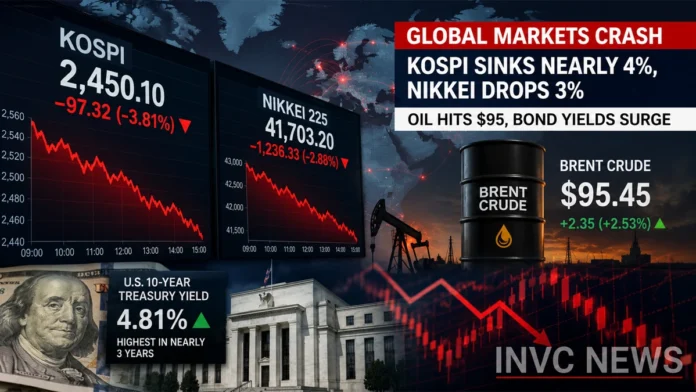
South Korea’s KOSPI suffered one of the steepest falls, dropping close to 4%.
Japan’s Nikkei 225 lost almost 3%.
The broader MSCI Asia-Pacific index outside Japan fell around 2%.
At the same time, the US 10-year Treasury yield climbed to its highest level in nearly three years, amplifying fears that central banks may have to keep interest rates higher — or raise them again — to contain a fresh inflation shock.
The combination of war, expensive oil, rising bond yields and renewed rate-hike expectations has created one of the most difficult market setups investors have faced this month.
KOSPI Crashes Nearly 4%
South Korea became one of the biggest casualties of Wednesday’s global selloff.
The KOSPI dropped almost 4% as investors sold technology and semiconductor shares.
South Korea’s market carries heavy exposure to major chipmakers, making it particularly sensitive to changes in global technology valuations and interest-rate expectations.
Higher bond yields reduce the present value investors assign to future corporate earnings.
That pressure often hits expensive growth and semiconductor stocks harder.
As investors reduced risk, major technology names across the region came under selling pressure.
Nikkei Falls Around 3%
Japanese shares also suffered a brutal session.
The Nikkei 225 fell roughly 2.9% to 3% during Wednesday trading.
Technology stocks and other rate-sensitive companies led much of the decline.
Japan faces an additional challenge because its domestic bond yields are also rising rapidly.
The country’s 10-year government bond yield has climbed above 3%, reaching levels not seen for decades.
That marks a dramatic change for an economy that spent years operating with exceptionally low interest rates.
Brent Crude Trades Above $95
Oil sits at the centre of Wednesday’s market turmoil.
Brent crude traded around $95.45 a barrel during Asian hours after the renewed confrontation between the United States and Iran raised fears about energy supplies.
Crude prices had already surged during the previous session.
Investors now worry that additional military escalation could threaten shipping through the Strait of Hormuz.
That waterway carries a substantial share of globally traded oil.
Even a limited disruption could tighten supplies and push prices higher.
Why $95 Oil Worries Investors
Higher oil prices do much more than increase fuel bills.
They can raise costs across:
Transport
Aviation
Manufacturing
Chemicals
Agriculture
Logistics
Consumer goods
Companies may eventually pass part of those higher costs to customers.
That creates inflation.
And rising inflation can force central banks to keep interest rates higher.
Markets therefore see $95 oil not only as an energy story but also as an interest-rate threat.
US 10-Year Treasury Yield Hits Nearly Three-Year High
Bond markets delivered another warning.
The benchmark US 10-year Treasury yield rose to around 4.81%, reaching its highest level in almost three years.
Bond prices move inversely to yields.
When investors sell government debt, yields rise.
The latest selloff reflects concerns about:
Higher inflation
US fiscal pressures
Expensive oil
Potential Federal Reserve tightening
and reduced demand for long-term government bonds.
The rise matters globally because the 10-year Treasury yield influences borrowing costs across mortgages, corporate debt and financial markets.
Fed Rate Hike Odds Jump
Investors have sharply increased bets that the US Federal Reserve could raise interest rates again.
Market pricing now puts the probability of a near-term Fed hike at roughly two-thirds.
That shift represents a major reversal from expectations that monetary policy might become easier.
Higher oil prices have changed the inflation equation.
If energy costs remain elevated, the Fed could worry that inflation will accelerate again.
Investors therefore face the possibility of high oil prices and high interest rates at the same time.
That combination typically creates pressure on stocks.
US Dollar Strengthens as Investors Seek Safety
The US dollar also benefited from Wednesday’s nervous mood.
The dollar index climbed toward a two-week high.
During periods of geopolitical uncertainty, investors frequently move toward dollar-denominated assets.
Higher US Treasury yields have added another reason to hold dollars.
The stronger currency puts additional pressure on several emerging-market currencies.
Countries that import large quantities of oil can face a double hit:
Oil becomes more expensive.
And the dollar needed to buy that oil also becomes stronger.
Wall Street Already Sent a Warning
US markets entered September under pressure before Asia opened.
The Dow Jones Industrial Average lost around 0.8% in the previous session.
The S&P 500 fell roughly 0.7%.
The Nasdaq Composite dropped about 1%.
Large technology stocks faced particular pressure as bond yields climbed.
That weakness then spilled into Asian trading on Wednesday.
Nvidia, Amazon and Tech Stocks Feel Yield Pressure
High-growth technology companies become vulnerable when long-term bond yields surge.
Investors often compare expected returns from stocks with relatively safer government bonds.
When government bonds offer significantly higher yields, expensive equities must work harder to justify their valuations.
That can pressure companies such as:
Nvidia
Amazon
major semiconductor manufacturers
cloud-computing companies
and other AI-related stocks.
The global AI boom remains intact as a long-term investment theme, but high interest rates can trigger sharp short-term corrections.
Bitcoin Fails to Become Clear Safe Haven
Cryptocurrency markets also showed mixed behaviour.
Bitcoin edged higher at points while Ether traded lower.
The moves showed that crypto assets did not attract the same uniform safe-haven demand as the US dollar.
Bitcoin supporters often describe the asset as digital gold.
However, during sudden risk-off events, cryptocurrencies can still trade more like speculative technology assets.
That keeps volatility high.
Gold Also Faces Higher-Yield Problem
Gold traditionally attracts buyers during geopolitical crises.
But rapidly rising Treasury yields can make the metal less attractive because gold does not pay interest.
That creates a tug-of-war.
War supports gold.
Higher real yields can pressure gold.
The result has been relatively restrained movement compared with the dramatic changes occurring in stocks, bonds and oil.
Asian Economies Face Oil Shock
The rise in crude prices presents a particular challenge for Asian economies that depend heavily on imported energy.
India, South Korea, Japan and several Southeast Asian countries import large amounts of crude oil.
Higher energy bills can:
Worsen trade balances
Pressure currencies
Increase inflation
Reduce household spending
Raise corporate costs
That explains why the market reaction has spread far beyond countries directly involved in the Middle East conflict.
Strait of Hormuz Becomes Market’s Biggest Geopolitical Risk
Investors now watch the Strait of Hormuz almost as closely as central-bank announcements.
Iran has repeatedly demonstrated that it can threaten maritime traffic around the waterway.
The United States has increased military operations aimed at protecting shipping and limiting Iranian capabilities.
Any escalation involving tankers or shipping infrastructure could cause another sharp move in oil.
That would immediately feed back into inflation expectations and bond yields.
Global Bond Selloff Deepens
The United States is not the only country experiencing rising yields.
Japan’s bond market has also suffered heavy selling.
Australian government borrowing costs have moved sharply higher.
European bond markets have faced similar pressure.
This synchronized move makes the situation more dangerous for global investors.
When yields rise across several major economies simultaneously, financing becomes more expensive everywhere.
That can slow investment, housing and consumer demand.
What Investors Are Watching Next
Markets will now focus on five major triggers.
US-Iran military developments
Brent crude around the $95-$100 zone
US Treasury yields
Federal Reserve rate-hike expectations
Strait of Hormuz shipping activity
Any meaningful easing in geopolitical tension could send oil lower and provide relief to stocks.
But another military escalation could produce the opposite result.
Could Oil Reach $100?
Brent now sits close enough to $100 that traders will inevitably watch that psychological level.
However, reaching $100 is not guaranteed.
Oil prices will depend on actual supply disruptions rather than headlines alone.
If shipments through the Gulf continue largely uninterrupted, the market could stabilise.
If disruptions intensify, prices could rise much faster.
That uncertainty keeps volatility elevated.
Global Market Today Sends Clear Warning
The most important message from Global Market Today September 2 2026 is that investors are no longer dealing with one isolated risk.
Several pressures have converged.
War has pushed oil higher.
Higher oil has revived inflation fears.
Inflation fears have pushed bond yields higher.
Higher yields have increased expectations of central-bank tightening.
And that entire chain has hit stock valuations.
South Korea’s near-4% plunge and Japan’s roughly 3% decline show how quickly the shock has travelled through global markets.
The next major move will depend on whether oil and bond yields stabilise.
Until they do, investors should expect volatility to remain high across stocks, currencies, commodities and cryptocurrencies.
Market Disclaimer
This report provides financial news and market information only. It does not constitute investment advice or a recommendation to buy or sell any security, currency, commodity or digital asset.











Comments are closed.