By Team INVC | INVC NEWS
Published: September 1, 2026 |11 : 28 AM IST
MUMBAI, India | September 1, 2026 —
India’s digital payments revolution has smashed another record. UPI transactions in August 2026 surged to an all-time high of 24.51 billion, while payments worth a staggering ₹29.82 lakh crore moved through the Unified Payments Interface during the month, according to the latest data released by the National Payments Corporation of India (NPCI).
The numbers show just how deeply UPI has become embedded in everyday payments across India. On average, the system processed nearly 790.6 million transactions every single day in August — covering everything from a cup of tea and grocery purchases to online shopping, utility bills and business payments.
Transaction volume increased from about 23.66 billion in July to 24.51 billion in August, marking another monthly record for India’s fast-growing real-time payment network.
UPI August 2026 Numbers at a Glance
The latest UPI data shows:
- Total transactions: 24.51 billion
- Total transaction value: ₹29.82 lakh crore
- Average daily transactions: Around 790.6 million
- Average daily value: Around ₹96,194 crore
- Year-on-year transaction volume growth: More than 22%
- Average transaction size: Around ₹1,217
Although transaction volume climbed sharply from July, the total value of payments eased marginally from about ₹29.88 lakh crore in July.
That combination tells an important story: Indians are increasingly using UPI for smaller and more frequent everyday purchases.
The average value of a UPI transaction fell to around ₹1,217 in August, compared with approximately ₹1,263 in July.
India Is Making Nearly 791 Million UPI Payments Every Day
The daily numbers are perhaps even more striking.
India averaged around 790.6 million UPI transactions per day in August 2026, up from roughly 763 million per day in July.
A year earlier, the daily average was substantially lower.
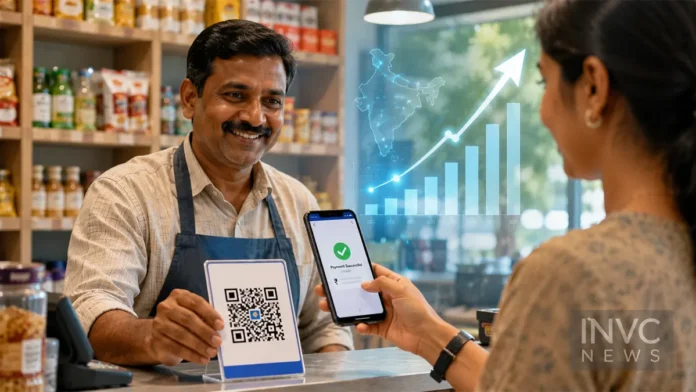
The jump underlines how QR-code payments and instant bank-to-bank transfers have moved beyond major cities and organised retail. UPI is now routinely used by neighbourhood stores, restaurants, delivery workers, street vendors, professionals and small businesses.
For millions of consumers, opening an app such as PhonePe, Google Pay, Paytm or another UPI-enabled application has effectively replaced carrying cash for many routine transactions.
Also Read : UPI Sets New Milestone: India Records 22.35 Billion Transactions in April 2026
UPI Volume Has Nearly Quadrupled in Four Years
The longer-term expansion is even more dramatic.
In August 2022, UPI processed roughly 6.58 billion monthly transactions. By August 2026, that figure had climbed to about 24.5 billion.
That means monthly transaction volumes have nearly quadrupled in just four years.
The value of UPI transactions has also surged from around ₹10.73 lakh crore in August 2022 to nearly ₹29.82 lakh crore in August 2026.
The expansion reflects greater smartphone access, wider QR-code acceptance, increasing bank connectivity and a major shift in consumer behaviour toward instant digital payments.
Why Smaller UPI Payments Matter
The falling average transaction size is not necessarily a sign of weakness.
Instead, it suggests UPI is being used more frequently for small-ticket purchases.
A consumer who might once have paid ₹30 or ₹50 in cash at a local shop can now scan a QR code within seconds. The same infrastructure can simultaneously support much larger permitted transactions across eligible categories.
This high-frequency usage is one reason UPI has become a critical part of India’s digital public infrastructure.
It also creates a huge ecosystem around payment processing, banking technology, fraud prevention, merchant services and financial products.
What the Record Means for PhonePe, Google Pay, Paytm and Banks
The continued expansion of UPI matters not just to consumers but also to banks, fintech companies and payment applications.
Apps such as PhonePe, Google Pay and Paytm compete for users and merchants while banks provide the underlying accounts and payment infrastructure required to complete transactions.
As volumes rise, the ecosystem must also handle greater demands around server capacity, fraud detection, transaction reliability and cybersecurity.
The sheer scale of UPI means even a small percentage increase in payments can translate into hundreds of millions of additional transactions every month.
Also Read – : Will UPI Payments Above ₹2,000 Face Charges? What India’s New Digital Payments Law Means
Will UPI Transactions Now Attract Charges?
For ordinary users, the latest record does not itself introduce any new UPI transaction charge.
Consumers can continue making routine UPI transfers and merchant payments under the prevailing framework.
However, the debate over how India’s rapidly expanding digital-payment infrastructure should be funded has intensified.
Recent legal changes give the government greater flexibility over the future framework for Merchant Discount Rate, or MDR, on electronic payment methods. Any actual new charge would require a separate policy decision or notification.
Users should therefore avoid social-media messages claiming that the latest UPI record automatically means every transaction above a certain amount will become chargeable.
Also Read – : UPI Payments Are Free — Here’s How Google Pay and PhonePe Still Make Money
UPI’s Next Challenge Is Scale, Security and Reliability
UPI’s rapid growth also creates a new challenge: keeping such a massive network reliable and secure.
Hundreds of millions of daily transactions require banks and payment service providers to continuously strengthen infrastructure while combating phishing, fake payment screenshots, malicious QR codes, remote-access scams and other forms of digital-payment fraud.
For users, basic precautions remain essential. A UPI PIN should only be entered when making a payment, never to receive money. Users should also verify the recipient before approving a transfer and avoid installing applications sent through suspicious links.
UPI Record Shows India’s Digital Payment Habit Is Still Growing
The August numbers suggest UPI has not yet reached a plateau.
Despite already operating at extraordinary scale, transaction volumes continue to set fresh records.
The most notable shift is no longer simply that Indians are adopting digital payments. It is that UPI is increasingly becoming the default payment method for millions of small everyday transactions.
With 24.51 billion payments in a single month and nearly 791 million transactions every day, India’s home-grown instant payment network has entered a new phase of scale.
The next test will be whether that growth can continue while maintaining speed, security, reliability, and affordability for consumers and merchants.