
NEW DELHI, India | August 23, 2026
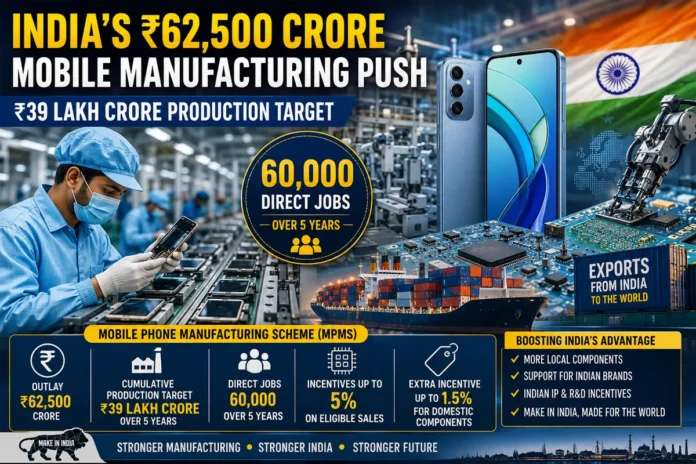
India Mobile Phone Manufacturing Scheme is set to accelerate the country’s electronics ambitions with a massive ₹62,500 crore incentive program targeting approximately ₹39 lakh crore in cumulative mobile phone production and around 60,000 direct jobs over five years.
The Mobile Phone Manufacturing Scheme, or MPMS, will run from FY2026-27 to FY2030-31. It is designed not only to increase smartphone production but also to deepen domestic value addition, strengthen local supply chains, boost exports and help build globally competitive Indian mobile phone brands.
The scheme represents the next phase of India’s effort to transform itself from a major smartphone assembly base into a deeper technology manufacturing hub with stronger capabilities in components, design, intellectual property and research and development.
₹62,500 Crore Scheme Targets ₹39 Lakh Crore Production
The government has approved a budgetary outlay of ₹62,500 crore for MPMS.
Over its five-year tenure, cumulative mobile phone production in India is expected to reach approximately ₹39 lakh crore, alongside a significant increase in exports.
The scheme is also expected to generate around 60,000 direct jobs.
The potential economic impact could extend beyond those direct jobs as larger manufacturing volumes create additional demand across component suppliers, logistics companies, industrial parks, engineering services and other parts of the electronics ecosystem.
India is simultaneously accelerating infrastructure around major manufacturing hubs. The government’s recent push to move India’s industrial corridors from project approvals toward factories, investment and actual production could complement schemes such as MPMS by providing manufacturers with more investment-ready industrial locations.
Mobile Manufacturers Can Receive Incentives of Up to 5%
MPMS provides incentive support on eligible sales of mobile phones manufactured in India.
Depending on the target segment and applicable conditions, incentive rates range from 2.25% to 5%.
The incentive structure is intended to encourage companies to substantially expand production rather than simply maintain existing manufacturing levels.
Large mobile phone manufacturers and Electronics Manufacturing Services companies registered in India can participate subject to the scheme’s eligibility requirements.
The approach builds on the Production Linked Incentive Scheme for Large Scale Electronics Manufacturing, or PLI-LSEM, whose tenure ended on March 31, 2026.
Extra Incentive for Domestic Components
One of the most important features of the India Mobile Phone Manufacturing Scheme is its focus on local sourcing.
Eligible manufacturers can receive an additional incentive of up to 1.5% linked to domestic sourcing of key components and sub-assemblies.
This is strategically significant because India’s next major challenge is not merely assembling more smartphones.
The country wants a larger portion of the components and economic value inside each phone to be produced domestically.
Displays, camera modules, printed circuit boards, memory, semiconductor components and other high-value electronics collectively account for a substantial portion of a smartphone’s manufacturing cost.
Increasing localization could therefore create new opportunities for Indian component makers as well as global suppliers establishing manufacturing facilities in the country.
Indian Smartphone Brands Get Special Incentives
MPMS also contains a major push for Indian-owned mobile phone brands.
Qualifying Indian brands can receive a 5% incentive on eligible sales, along with an additional 3% incentive for product design and R&D, subject to scheme conditions.
This is one of the most strategically interesting parts of the new program.
India has already established itself as a major manufacturing location for international smartphone companies. However, creating globally competitive Indian brands with their own technology, intellectual property and product-development capabilities is a much more ambitious goal.
The scheme therefore seeks to encourage companies to build products in India that are not merely assembled locally but are increasingly designed, developed and owned in India.
India Is World’s Second-Largest Mobile Phone Manufacturer by Volume
India’s smartphone manufacturing industry has undergone a dramatic transformation.
Government data show that India is now the world’s second-largest mobile phone manufacturer by volume, while approximately 99.2% of mobile phones used in the country are manufactured domestically.
Electronics manufacturing has expanded roughly seven-fold since FY2014-15, while electronics exports have increased approximately eleven-fold.
Smartphones have also emerged as one of India’s most important export success stories.
The next challenge is to capture a greater share of the value chain.
From Assembly to Components, Chips and Intellectual Property
India’s electronics strategy is increasingly moving beyond final assembly.
The government is simultaneously building semiconductor capacity, electronics component manufacturing, advanced packaging, supply chains and design capabilities.
That shift is closely connected with India’s international technology partnerships. Recent India-US semiconductor and AI talks focused on chip manufacturing, resilient supply chains and critical minerals, highlighting how semiconductor security is becoming central to India’s wider technology strategy.
This matters directly to smartphone manufacturing.
Modern smartphones depend on processors, memory, sensors, connectivity chips, power-management components and numerous other semiconductor products.
If India can combine large-scale smartphone production with a stronger domestic component and semiconductor ecosystem, local value addition could rise substantially.
₹39 Lakh Crore Target Could Strengthen India’s Export Position
MPMS is also designed to significantly increase mobile phone exports.
India’s expanding manufacturing capacity has already made smartphones an important export category, and the new scheme attempts to push the sector further into global markets.
The opportunity is considerable.
Global smartphone companies are increasingly looking to diversify their manufacturing footprints and create more resilient supply chains.
India offers a large domestic market, skilled labor, an expanding supplier ecosystem and government incentives.
However, competing with established Asian manufacturing hubs will require consistent quality, competitive logistics, reliable infrastructure, sophisticated component suppliers and faster product-development capabilities.
The ₹62,500 crore scheme is designed to strengthen several of those advantages simultaneously.
Smartphone Prices Make Local Manufacturing Even More Important
The new manufacturing push also comes at a challenging moment for consumers.
Memory and other component costs have been putting upward pressure on smartphone prices, particularly in affordable and mass-market categories.
INVC recently reported that smartphone prices in India are rising ahead of the crucial Diwali 2026 shopping season, with higher hardware costs creating difficult choices for buyers considering an upgrade.
Domestic manufacturing alone cannot completely insulate consumers from global memory, semiconductor or currency movements.
However, stronger local supply chains could improve resilience over the longer term and reduce dependence on imported components in selected categories.
Indian Buyers Still Prioritize Performance and Battery Life
The production push will also have to reflect what Indian consumers actually want from their smartphones.
Despite the enormous industry focus on artificial intelligence, a recent consumer survey found that practical features continue to dominate purchase decisions.
According to INVC’s report on what Indian smartphone buyers really prioritize over AI features, performance and speed were important to 87% of respondents, followed by battery life at 79% and camera quality at 77%.
AI features ranked considerably lower.
That consumer behavior matters for manufacturers participating in India’s expanding smartphone ecosystem.
Winning the domestic market will require competitive prices, dependable performance, long battery life, good cameras and extended software support—not simply manufacturing scale.
60,000 Direct Jobs Could Be Only Part of the Employment Impact
The government’s estimate of around 60,000 direct jobs under MPMS is another major element of the scheme.
Electronics manufacturing has already emerged as an important employment generator, including for young workers and women.
The broader electronics manufacturing ecosystem supports around 25 lakh jobs, according to government figures, while mobile manufacturing accounts for approximately 12 lakh employment opportunities.
If MPMS succeeds in encouraging deeper component manufacturing and R&D, the employment mix could also gradually change.
Alongside assembly-line positions, India could see greater demand for engineers, industrial designers, software specialists, semiconductor professionals, quality-control experts, supply-chain specialists and research personnel.
Can India Build a Global Smartphone Brand?
Perhaps the most ambitious objective of MPMS is the creation of globally competitive Indian brands.
Manufacturing smartphones for leading global companies is economically important, but owning the brand, patents, industrial design and underlying intellectual property allows companies and countries to capture a much larger share of the final product’s value.
India has a huge domestic smartphone market, an expanding electronics manufacturing ecosystem and a large pool of technology professionals.
MPMS attempts to connect those advantages.
Special incentives for Indian brands, design and R&D indicate that policymakers want the next phase of growth to produce not only more factories but also more Indian intellectual property.
Why the ₹62,500 Crore Mobile Manufacturing Scheme Matters
India has already demonstrated that it can manufacture smartphones at enormous scale.
The next test is harder: Can India capture more of the technology, components, intellectual property and profits behind those smartphones?
The ₹62,500 crore Mobile Phone Manufacturing Scheme is designed around that challenge.
It targets approximately ₹39 lakh crore in cumulative production, around 60,000 direct jobs, higher exports, greater domestic sourcing and stronger Indian-owned brands over its five-year tenure.
If those goals are achieved, the scheme could help move India’s smartphone industry from the era of “Made in India” toward a broader future of “Designed, Developed and Made in India for the World.”











Comments are closed.