BENGALURU, INDIA | AUGUST 23, 2026 —
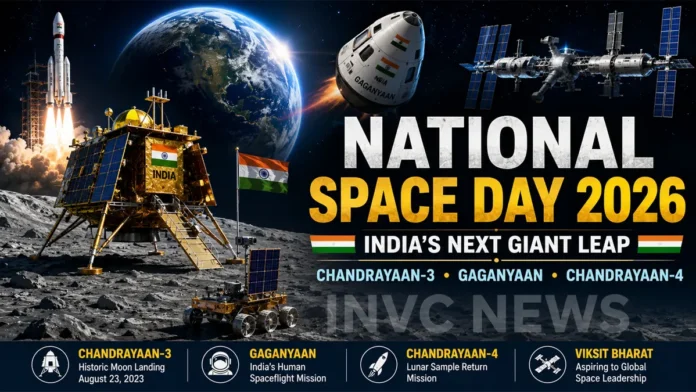
National Space Day 2026 is being celebrated across India on Sunday as the country marks three years since Chandrayaan-3’s historic lunar landing and looks toward a far more ambitious era of human spaceflight, Moon exploration, planetary science and commercial space development.
India celebrates National Space Day every August 23 to commemorate the successful landing of Chandrayaan-3’s Vikram lander on August 23, 2023. The official theme for 2026 is “Towards Viksit Bharat: Innovating, Collaborating and Aspiring to Global Space Leadership.”
The theme captures how dramatically India’s space ambitions have expanded. Chandrayaan-3 demonstrated India’s ability to accomplish a complex lunar landing. The next phase is about building technologies for human spaceflight, returning samples from the Moon, exploring Venus, developing a national space station and bringing private companies deeper into India’s space ecosystem.
Why India Celebrates National Space Day on August 23
August 23 has a special place in India’s scientific history.
On August 23, 2023, Chandrayaan-3’s Vikram lander successfully touched down in the lunar south polar region. The Pragyan rover subsequently rolled onto the Moon and conducted surface observations.
India became the fourth country to achieve a successful soft landing on the Moon and the first to land in the lunar south polar region.
The achievement transformed Chandrayaan-3 into much more than a scientific mission. It became a moment of national celebration and triggered fresh interest in space science among students, researchers and young entrepreneurs.
The Government of India subsequently designated August 23 as National Space Day to commemorate the achievement every year.
National Space Day 2026 Theme: What It Means
The National Space Day 2026 theme places three ideas at the center of India’s future strategy: innovation, collaboration and global leadership.
Innovation reflects the push toward more advanced launch vehicles, lunar technologies, human-rated spacecraft, docking systems and planetary missions.
Collaboration is becoming equally important. India’s next stage of space development will increasingly involve ISRO working alongside universities, research institutions, startups, established industries and international partners.
The final element — global space leadership — shows the scale of the ambition.
India is no longer looking only at conducting successful missions. It wants to build a wider scientific and commercial ecosystem capable of competing internationally.
National Space Day 2026 Reaches Students Across India
A major focus of this year’s celebrations has been young people.
Vikram Sarabhai Space Centre, Liquid Propulsion Systems Centre, ISRO Inertial Systems Unit and the Indian Institute of Space Science and Technology have jointly organized activities connected with National Space Day in Kerala, Mahe and Lakshadweep.
The program has included one-day workshops, space exhibitions, technical sessions, quizzes, demonstrations, lectures and interactions with scientists.
Workshops were designed to introduce school and college students to satellites, launch vehicles, space applications, emerging technologies and future missions.
Public events have also included open houses, exhibitions, interactive photo points and outreach programs aimed at taking India’s space story beyond laboratories and research institutions.
Gaganyaan Moves India Toward Human Spaceflight
If Chandrayaan-3 represents India’s breakthrough on the Moon, Gaganyaan represents another historic frontier — sending Indian astronauts to space using an indigenous human-spaceflight system.
ISRO continues to test critical systems required for the mission.
On July 7, 2026, the agency successfully carried out another Integrated Main Parachute Airdrop Test for Gaganyaan at Sheopur in Madhya Pradesh.
The parachute system is crucial because it must safely slow the Crew Module before splashdown following its return to Earth.
The successful test helped validate the main parachute under demanding load conditions for the first uncrewed Gaganyaan mission.
ISRO also reported successful qualification tests in July involving Crew Module systems, including equipment designed to keep the module upright after splashdown and systems related to module separation.
India’s human-spaceflight program is also benefiting from experience gained through international missions and microgravity research.
Also Read: India’s Historic Axiom-4 Mission: Shubhanshu Shukla and India’s Human Spaceflight Journey
The experience from human spaceflight and microgravity research is particularly relevant as India prepares not only for Gaganyaan but eventually for a sustained human presence in low-Earth orbit.
Chandrayaan-4 Could Bring Moon Samples Back to Earth
India’s next major lunar challenge is substantially more complicated than Chandrayaan-3.
Chandrayaan-4 is being developed as India’s lunar sample-return mission.
The objective is to land on the Moon, collect lunar material and safely return those samples to Earth for detailed scientific analysis.
That requires technologies far beyond a conventional landing mission.
The spacecraft architecture must support landing, sample collection, ascent from the lunar surface, rendezvous and docking, transfer of the lunar samples and safe return to Earth.
ISRO’s 2025–26 annual report confirms that preparations for Chandrayaan-4 are progressing, including evaluation of potential landing sites and plans for sample analysis and archival facilities.
These technologies could eventually support much more ambitious lunar exploration.
India Is Preparing to Explore Venus
The Moon is not India’s only major planetary destination.
India’s approved Venus Orbiter Mission will study one of Earth’s most mysterious planetary neighbors.
The mission is expected to investigate Venus’ atmosphere, clouds, aerosols, ionosphere, interaction with the solar wind, and features of its surface and subsurface.
ISRO has said the Venus mission is targeted for 2028.
Venus is particularly valuable scientifically because it is similar to Earth in size yet has developed an extraordinarily hot and hostile environment.
Understanding how that happened could provide important insights into planetary evolution and atmospheric processes.
India Targets Its Own Space Station by 2035
India’s plans stretch far beyond individual robotic missions.
Under its long-term Space Vision, the country aims to establish the Bharatiya Antariksh Station by 2035.
The station is envisioned as an Indian orbital research platform capable of supporting scientific experiments in microgravity and contributing to sustained human activity in space.
ISRO has already begun inviting Indian researchers to develop microgravity experiments that could eventually fly aboard Indian human-spaceflight platforms and the Bharatiya Antariksh Station.
The space station could serve as a laboratory for research in areas including science, technology, medicine and advanced manufacturing.
Indian Astronauts on the Moon by 2040?
India’s longer-term vision becomes even more ambitious after the space-station program.
ISRO’s Space Vision 2047 includes the objective of achieving an Indian crewed lunar landing by 2040 using indigenous technologies.
That goal will require major advances in heavy-lift launch systems, human-rated spacecraft, docking systems, high-capacity landers, re-entry technology and long-duration human-spaceflight capabilities.
Viewed from that perspective, Gaganyaan and Chandrayaan-4 are not isolated missions.
They are technological building blocks for a much larger exploration program.
Private Companies Are Becoming Central to India’s Space Story
One of the biggest changes since Chandrayaan-3 has been the increasing role of private industry.
India is moving away from a system in which nearly every major space activity revolves around ISRO alone.
Private companies are increasingly participating in launch vehicles, satellites, propulsion systems, Earth observation, space data and other specialized technologies.
Startups such as Skyroot Aerospace and Agnikul Cosmos have helped make privately developed rockets one of the most closely watched areas of India’s emerging commercial space industry.
Also Read: India’s Private Space Race: Skyroot vs Agnikul vs Others — Who Will Lead the Next Orbit Revolution?
This emerging competition is important because India’s future ambitions require far greater scale than a government agency can create alone.
A successful commercial ecosystem could generate specialized jobs, attract investment and allow Indian companies to compete for global launch, satellite and space-services contracts.
ISRO’s Own Role Is Beginning to Change
The expansion of private industry could eventually change ISRO itself.
Rather than using a large share of its scientific and engineering resources to repeatedly manufacture mature launch vehicles and satellites, the agency is moving toward a model in which industry takes greater responsibility for established systems.
That could free ISRO to concentrate more heavily on advanced research, new propulsion systems, human spaceflight, planetary exploration and next-generation missions.
Technology and production rights for the Small Satellite Launch Vehicle have already moved toward industry, demonstrating how mature technologies can transition beyond ISRO’s traditional manufacturing structure.
If this transition succeeds, India could eventually have two powerful engines working together: an ISRO focused heavily on frontier science and technology, and a competitive private sector capable of turning proven technologies into commercial products and services.
Chandrayaan-3’s Legacy Is Bigger Than One Moon Landing
Three years after the landing, Chandrayaan-3’s most important legacy may be what it made possible next.
The mission strengthened confidence in India’s lunar capabilities and demonstrated that complex planetary exploration could be accomplished using indigenous technologies.
It also inspired millions of students who watched Vikram’s descent and Pragyan’s exploration of the lunar surface.
For many young Indians, Chandrayaan-3 was their first direct experience of watching a major scientific milestone unfold live.
National Space Day is designed in part to preserve that enthusiasm.
The workshops, exhibitions, quizzes and student interactions being organized around the 2026 celebration show that India’s future space program is also being presented as an opportunity for the next generation.
Why National Space Day 2026 Matters
The significance of National Space Day 2026 lies in the contrast between India’s past achievement and its future ambitions.
Chandrayaan-3 proved that India could land near the Moon’s south polar region.
Gaganyaan aims to establish indigenous human-spaceflight capability.
Chandrayaan-4 seeks to bring lunar samples back to Earth.
The Venus Orbiter Mission will expand India’s planetary science program.
The Bharatiya Antariksh Station could provide India with its own permanent orbital research platform.
And beyond that lies the ambition of sending Indian astronauts to the Moon.
At the same time, private companies are moving from being suppliers to becoming increasingly important participants in India’s space ecosystem.
Taken together, these developments explain the 2026 National Space Day theme.
The celebration is no longer only about remembering what happened on August 23, 2023.
It is increasingly about answering a much bigger question:
What will India do after reaching the Moon?
If its current roadmap succeeds, the answer could include Indian astronauts in orbit, Moon samples returning to laboratories on Earth, an Indian space station circling the planet and eventually Indian explorers standing on the lunar surface.
That is what makes National Space Day 2026 both a celebration of Chandrayaan-3 and a preview of India’s next giant leap.