
New Delhi, India | August 22, 2026 —
Indian smartphone buyers may be surrounded by advertisements promoting artificial intelligence, generative AI tools and increasingly sophisticated software features, but new consumer research suggests something much more fundamental is driving purchase decisions: performance.
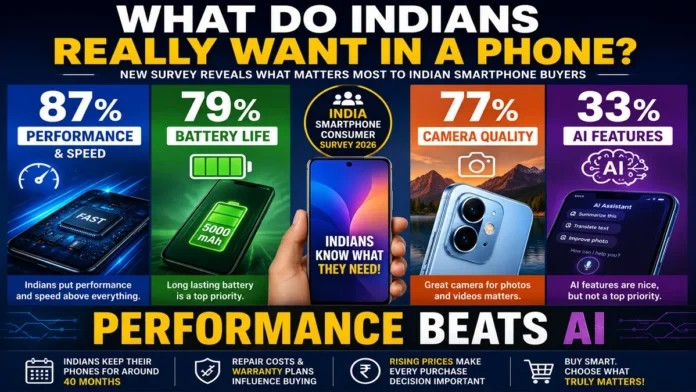
A new smartphone consumer survey finds that 87% of Indian consumers prioritize performance and speed when choosing a smartphone, significantly ahead of AI features.
Battery life comes next, with 79% of consumers considering it important, while 77% prioritize camera quality.
AI features, despite becoming one of the smartphone industry’s biggest marketing themes, are a priority for only 33% of surveyed consumers.
The findings provide a revealing look at what Indian buyers actually value as smartphone prices rise and consumers hold on to their devices for longer.
Performance Beats AI for Indian Smartphone Buyers
Artificial intelligence has dominated smartphone launches over the past two years.
Brands increasingly promote AI photography, image editing, translation, voice assistance, summarization and generative features.
But when consumers are spending their own money, practical fundamentals appear to matter considerably more.
According to the survey, performance and speed rank first at 87%.
For consumers, performance can influence almost every aspect of everyday phone usage — from opening apps and multitasking to gaming, photography and keeping the device responsive over several years.
This becomes even more important as buyers keep their smartphones for longer.
Battery Life Comes in at 79%
The second-biggest priority is battery life.
About 79% of surveyed consumers consider battery performance important when purchasing a smartphone.
That is hardly surprising.
Smartphones have become central to payments, messaging, social media, entertainment, navigation, photography and work.
A powerful processor or sophisticated AI system provides limited value if the phone struggles to last through a normal day.
Manufacturers have consequently been increasing battery capacities while adopting silicon-carbon and other newer battery technologies in selected devices.
Camera Quality Still Matters—A Lot
Camera quality ranks almost alongside battery life.
The survey indicates that 77% of Indian consumers consider the camera an important factor in their smartphone purchase.
Phone cameras have effectively replaced dedicated compact cameras for millions of consumers.
Photography is also deeply connected to social media, video calling, short-form video and content creation.
As a result, buyers increasingly evaluate not merely megapixel counts but low-light photography, stabilization, portrait processing, video quality and consistency between different camera lenses.
So Where Does AI Rank?
Here is the surprising part.
Only 33% of respondents identified AI features as an important smartphone consideration.
That does not mean consumers dislike AI.
Instead, it suggests that AI is currently an additional benefit rather than the primary reason many Indians choose one smartphone over another.
A buyer may appreciate AI photo editing or automatic transcription, but those features apparently do not compensate for weak performance, poor battery endurance or an inadequate camera.
For smartphone manufacturers, that distinction matters.
Smartphone Buyers Are Keeping Their Phones Longer
Another particularly important finding concerns replacement cycles.
Indian consumers now expect to keep their smartphones for around 40 months.
That is more than three years.
Longer ownership changes the purchase calculation.
A phone that feels fast today must ideally remain usable years later. Battery health, storage capacity, software updates, durability and repair costs therefore become increasingly important.
This also helps explain why performance ranks so highly.
Consumers are not necessarily purchasing a phone only for its capabilities on launch day. They increasingly need it to remain useful well into the future.
Repair Costs Are Changing Buying Behavior
Longer ownership periods create another concern: repairs.
Consumers keeping smartphones for more than three years face greater exposure to battery degradation, accidental damage, display failures and other hardware problems.
As smartphone prices rise, replacing a damaged device can also become increasingly expensive.
That is contributing to growing interest in extended warranties and device-protection plans.
Consumers are increasingly evaluating the total cost of ownership, rather than only the initial purchase price.
Rising Smartphone Prices Make Practical Features More Important
The findings arrive at an interesting moment for India’s smartphone market.
Higher memory and component costs are already pushing handset prices upward.
That makes every purchase decision more consequential, particularly for budget and mid-range consumers.
Also Read: Don’t Wait for Diwali Sale? Smartphone Prices Are Rising in India—Here’s What Buyers Should Know
When a consumer is paying more and expecting to use the same device for around 40 months, dependable everyday performance can become more valuable than a headline feature that may only be used occasionally.
This creates an interesting challenge for brands aggressively marketing AI.
Are Smartphone Brands Over-Marketing AI?
Not necessarily.
AI will almost certainly become more deeply integrated into smartphones.
Features such as real-time translation, intelligent photography, voice assistance, fraud detection and productivity tools could become increasingly useful as the technology matures.
However, the survey suggests brands should be careful about assuming that the words “AI smartphone” automatically translate into purchase intent.
Consumers still appear to judge devices on traditional fundamentals.
A compelling smartphone in 2026 may therefore need to deliver AI without compromising performance, battery, camera quality or value.
What Should You Check Before Buying Your Next Smartphone?
The survey offers a useful framework for consumers planning an upgrade.
Start with the processor and real-world performance rather than marketing terminology.
Next, examine battery capacity, charging speed and expected battery longevity.
Then evaluate camera performance using real photographs and independent testing rather than megapixel numbers alone.
Software support also matters considerably if you expect to keep the phone for three or four years.
Storage is another important consideration. A 128GB device that seems sufficient today could become restrictive after years of photos, videos, apps and software updates.
Finally, consider repair costs and warranty coverage before purchasing an expensive device.
AI features can then become an additional differentiator rather than the sole reason for buying.
India’s Smartphone Market Is Sending Brands a Message
The bigger message from the research is surprisingly straightforward.
Consumers may enjoy innovation, but fundamentals still win.
Performance and speed lead at 87%, followed by battery life at 79% and camera quality at 77%.
AI features stand at 33%.
As Indian consumers keep smartphones longer and face higher device prices, reliability and long-term usability could become even more important.
For smartphone brands, the lesson is clear: AI may sell the advertisement, but performance may still sell the phone.











Comments are closed.