New Delhi, India | August 22, 2026 —
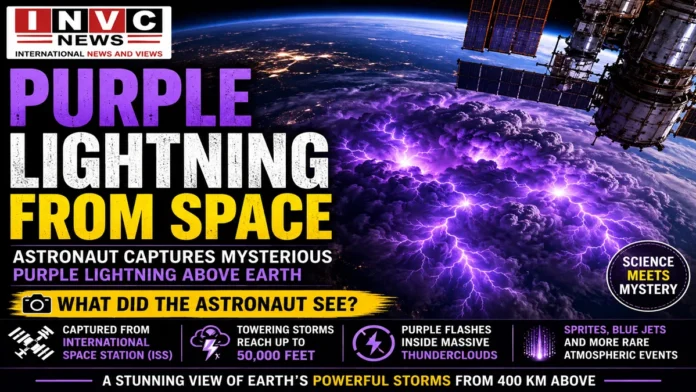
A breathtaking view of purple lightning from space is drawing fresh attention after NASA astronaut and renowned space photographer Don Pettit’s imagery revealed powerful electrical flashes illuminating enormous storm clouds far below the International Space Station.
The spectacular view shows bright purple flashes spreading through towering thunderclouds as seen from orbit—an angle that people on the ground rarely experience.
Pettit described the imagery as a nadir view, meaning the camera was pointed directly toward Earth from the ISS.
According to Pettit, some of the thunderheads visible from orbit can rise to approximately 50,000 feet, or about 15 kilometers—higher than most commercial aircraft normally fly.
But what makes lightning appear purple from space, and are these flashes the same as the mysterious sprites and blue jets that scientists observe above thunderstorms?
The answer is fascinating.
What Did Don Pettit Capture From the ISS?
Pettit’s imagery shows electrical activity flashing through massive cloud systems below the International Space Station.
From Earth’s surface, observers typically see lightning from underneath or alongside a storm.
Astronauts have a completely different perspective.
Orbiting hundreds of kilometers above Earth allows them to look directly down onto huge storm systems and observe electrical activity across enormous areas.
That makes the ISS a remarkable platform for observing thunderstorms that can be difficult to understand from ground level.
Pettit said storms of this scale are particularly well suited to overhead observation from orbit.
Why Does the Lightning Look Purple?
Lightning itself can appear in different colors depending on atmospheric conditions, distance, cloud structure, camera settings and how light is scattered or absorbed.
In Pettit’s imagery, intense electrical activity illuminates the surrounding cloud structure, producing the striking purple appearance.
The view from orbit makes the phenomenon especially dramatic because astronauts are observing the storm from above rather than through layers of cloud and atmosphere from below.
However, an important distinction is needed.
Purple-looking lightning inside clouds should not automatically be described as a rare sprite or blue jet.
Sprites and blue jets are separate forms of upper-atmospheric electrical activity associated with thunderstorms.
What Are Red Sprites?
Sprites are extraordinary electrical events that occur high above thunderstorms.
Unlike ordinary lightning, which typically occurs within clouds or between a cloud and the ground, sprites can extend upward into the upper atmosphere.
They often appear reddish and can form unusual shapes, sometimes resembling giant jellyfish or branching structures.
They occur extremely quickly and can therefore be difficult to observe from the ground.
Space provides scientists and astronauts with a much better vantage point.
And What Are Blue Jets?
Blue jets are another unusual electrical phenomenon associated with thunderstorms.
Instead of traveling downward toward Earth, these luminous events can shoot upward from the tops of thunderclouds.
Their characteristic blue appearance distinguishes them from reddish sprites.
Pettit specifically noted that orbital observations allow astronauts to watch for rare sprites and blue jets above large storms.
Thunderclouds Can Tower Higher Than Most Aircraft
One of the most striking details is the sheer size of the storms.
Pettit said thunderheads can rise to around 50,000 feet.
For comparison, commercial passenger aircraft commonly cruise well below the highest tops of severe thunderstorms.
Pilots generally avoid powerful storm cells because they can contain extreme turbulence, lightning, hail and strong vertical air currents.
From the ISS, however, astronauts can observe the complete storm structure from far above.
That perspective transforms what appears from the ground as a dark thunderstorm into a vast electrical system stretching across the atmosphere.
Pettit Used a Nikon Z9 to Capture the Lightning
There is also a fascinating photography angle.
Pettit said he used a Nikon Z9 with a shutter speed of 1/1200 second and recorded at 120 frames per second to optimize the detail visible in the lightning.
Lightning happens extremely quickly, so high-speed imaging dramatically increases the chances of capturing individual flashes and their structure.
Pettit has become particularly well known for experimenting with photography from orbit.
His images frequently show Earth, stars, atmospheric phenomena and spacecraft from perspectives that are impossible to reproduce on the ground.
Was the Purple Lightning Captured Today?
No—and this is where some current coverage can become confusing.
The imagery is receiving renewed attention now, but Pettit’s original material was released earlier in January 2026, and the footage was captured during his fourth space mission.
Pettit’s most recent ISS mission ran from September 2024 until April 19, 2025, when he returned to Earth after spending 220 days in space.
That distinction matters because spectacular space imagery frequently becomes viral again months or even years after it was originally captured.
Why Scientists Study Lightning From Space
These images are far more than spectacular photographs.
Scientists study electrical activity above thunderstorms to understand how energy moves between storm systems and the upper atmosphere.
Sprites, jets and related phenomena are collectively associated with electrical processes occurring far above conventional lightning.
Space-based observations can help researchers see structures that ground observers may miss because clouds obscure the view.
Understanding these events contributes to the broader scientific study of Earth’s atmosphere, severe thunderstorms and atmospheric electricity.
Earth Looks Very Different From Orbit
Perhaps the biggest reason Pettit’s imagery attracts so much attention is perspective.
A thunderstorm viewed from the ground can feel enormous.
Viewed from orbit, it becomes part of an even larger atmospheric system—with lightning illuminating clouds across vast distances.
And occasionally, above those clouds, astronauts can glimpse electrical phenomena that most people will never see with their own eyes.
That is what makes purple lightning from space such compelling imagery: it reveals an electrical world continuously unfolding above and inside Earth’s storms, largely hidden from those watching from below.