
NEW DELHI, August 18, 2026 —
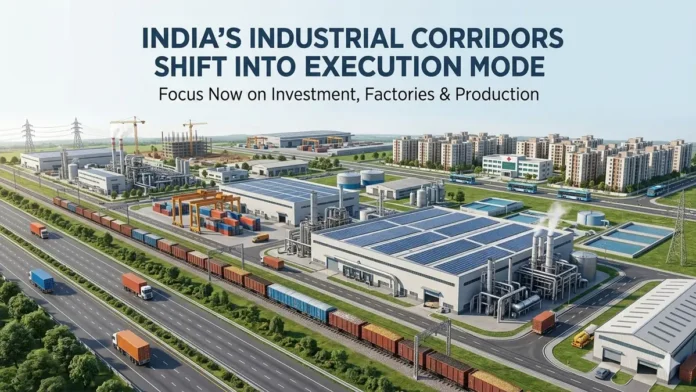
India Industrial Corridors are entering a more execution-focused phase, with the central government making it clear that approving large industrial projects is no longer enough. The priority now is to complete infrastructure on time, allot land faster, attract investors and ensure factories actually begin production.
The shift was emphasized at the third meeting of the Apex Monitoring Authority of the National Industrial Corridor Development and Implementation Trust (NICDIT), chaired by Union Finance and Corporate Affairs Minister Nirmala Sitharaman in New Delhi. The meeting reviewed projects under the National Industrial Corridor Development Programme and priorities for the next phase of development.
The government wants states to remove bottlenecks involving land, connectivity, utilities, statutory approvals and project Special Purpose Vehicles so that industrial nodes can move more rapidly from planning to economic activity.
Official Government Release:
https://www.pib.gov.in/PressReleasePage.aspx?PRID=2300658
National Industrial Corridor Development Corporation:
https://nicdc.in/
Government Says Project Approval Alone Is Not Enough
The government’s message at the meeting was centered on outcomes.
Sitharaman said the focus must now move beyond project approvals toward timely completion of infrastructure, land allotment, investment and commencement of production. She urged participating states to resolve hurdles associated with land, connectivity, utilities, statutory clearances and the authority available to project SPVs.
That represents an important transition in the industrial corridor program.
Rather than measuring success primarily by announcements and sanctioned projects, policymakers are increasingly looking at whether industrial land becomes operational, companies begin investing, factories start production and employment is generated.
States Asked to Speed Up Land and Infrastructure
Land availability remains one of the most important elements in converting industrial plans into operating manufacturing clusters.
States have therefore been asked to prioritize issues involving:
- Industrial land availability and allotment
- Road and transport connectivity
- Power supply
- Water and other utilities
- Statutory and regulatory clearances
- Powers delegated to project SPVs
- Investor facilitation
- Supporting social infrastructure
The Finance Minister also emphasized integrated planning through PM GatiShakti and continued use of investor-friendly land allotment systems.
Official PM GatiShakti Information:
https://www.gatishakti.gov.in/
Industrial Corridors to Link Factories, Railways and Expressways
A key part of the strategy is to prevent industrial development from taking place in isolation.
Sitharaman stressed convergence between freight infrastructure, industrial development, railways and expressways, describing their integration as important to the success of industrial corridors.
This approach is designed to make manufacturing locations more competitive by ensuring that factories are connected efficiently to suppliers, domestic markets, ports and export gateways.
Better integration can also reduce travel times and logistics bottlenecks—factors that directly affect the cost of manufacturing in India.
Worker Housing and Healthcare to Become Part of Industrial Planning
The government is also pushing for industrial cities to be planned as complete economic ecosystems rather than collections of factories.
Sitharaman said worker housing, healthcare, skill development, public transportation and other social amenities should form an integral part of industrial development.
This could become increasingly important as large industrial nodes attract workers from surrounding districts and other states.
Without affordable housing and reliable transport, even well-built manufacturing zones can struggle to attract and retain a stable workforce.
The government’s emerging model therefore combines industrial infrastructure with the services required by the people who work there.
Piyush Goyal Pushes Investor-Ready Industrial Ecosystems
Union Commerce and Industry Minister Piyush Goyal called for future industrial developments to follow an integrated area-development model aligned with PM GatiShakti.
He emphasized the need for investor-ready ecosystems, including plug-and-play infrastructure that allows companies to establish operations faster.
The broader objective is to reduce the time between an investor selecting a location and commercial production actually beginning.
That means industrial nodes will increasingly need to provide not just land, but a package of ready infrastructure and services.
Plug-and-Play Factories Could Speed Up Manufacturing Investment
The proposed industrial ecosystem includes facilities such as:
- Plug-and-play infrastructure
- Flatted factories
- Worker accommodation
- Road and logistics connectivity
- Reliable power and water
- Social infrastructure
- Commercial and economic facilities
For manufacturers, these facilities can significantly lower the barriers involved in establishing a new plant.
Instead of acquiring undeveloped land and independently building every piece of supporting infrastructure, companies can move into investment-ready locations where essential services are already available.
That could be especially useful for MSMEs and manufacturers seeking to begin production relatively quickly.
India Wants to Use FTAs to Build Specialized Industrial Enclaves
Goyal also called for industrial development to take advantage of opportunities emerging from India’s trade agreements.
The idea is to develop country-specific and sector-specific industrial enclaves that can serve investors with particular supply-chain, export or manufacturing requirements.
Such clusters could potentially be tailored for industries linked to specific overseas markets and trade agreements.
The approach also fits into India’s wider effort to attract global manufacturers seeking diversified production bases and supply chains.
New Industrial Land Pipeline Needed Before Existing Areas Fill Up
The government also sees signs of growing investor demand.
Sitharaman said the results being seen on the ground indicate increasing interest and emphasized that the next pipeline of industrial land and infrastructure should be prepared before existing inventory is exhausted.
This is significant because development of a large industrial node can take years.
Waiting until an existing industrial city is fully occupied before preparing the next location could create a shortage of investment-ready land and potentially delay new projects.
The government’s approach is therefore moving toward creating capacity ahead of demand.
Four Industrial Smart Cities Have Reached Production Stage
The National Industrial Corridor Development Programme currently covers 20 approved projects across 13 states and seven industrial corridors, according to the government’s latest review.
Four industrial smart cities have already entered the production stage:
- Dholera
- Shendra-Bidkin
- Greater Noida
- Vikram Udyogpuri
These projects are increasingly being treated as examples of how industrial corridors can move from physical infrastructure construction to actual manufacturing and investment activity.
Official NICDC Projects Portal:
https://nicdc.in/projects/national-industrial-corridor-development-programme
Greater Noida Among Industrial Nodes Already Developed
The Integrated Industrial Township at Greater Noida is one of the flagship industrial corridor developments.
According to NICDC, the township spans approximately 747 acres and forms part of the Delhi-Mumbai Industrial Corridor ecosystem.
The wider Greater Noida-Dadri region is also being strengthened through multimodal logistics infrastructure. NICDC says the Dadri logistics and transport hub covers about 825 acres and is strategically located near the Eastern and Western Dedicated Freight Corridors.
This type of proximity between industry and freight networks illustrates the integrated development model the government wants to replicate.
Waterways Could Become Part of Industrial Corridor Strategy
Union Ports, Shipping and Waterways Minister Sarbananda Sonowal proposed examining stronger connections between industrial corridors and India’s national waterways.
The underlying objective is to use waterways as an additional freight option for industrial clusters.
Moving suitable bulk cargo by waterways can potentially reduce pressure on highways and provide manufacturers with another logistics route.
For industrial corridors located near navigable waterways, multimodal integration involving road, rail, ports and inland waterways could therefore become increasingly important.
Ministry of Ports, Shipping and Waterways:
https://shipmin.gov.in/
Inland Waterways Authority of India:
https://iwai.nic.in/
Northeast Could Become a Bigger Industrial Focus
The meeting also highlighted opportunities to expand industrial infrastructure in India’s northeastern states.
Better connectivity, availability of suitable land, local resources and access to regional markets could make selected locations suitable for new manufacturing and processing clusters.
The Northeast has also gained greater strategic importance as India’s road, rail, air and waterway links with neighboring regions improve.
Building industrial infrastructure alongside those connections could help transform transit investment into local manufacturing and employment opportunities.
Project SPVs Need Greater Operational Authority
Another important issue discussed was the functioning of Special Purpose Vehicles, which are responsible for implementing individual industrial corridor projects.
The view emerging from the review is that SPVs need adequate powers over planning, development and local administration if projects are to be implemented quickly.
Industrial projects can otherwise become slowed by repeated approvals across multiple government agencies.
Giving project entities clearly defined authority can potentially shorten decision-making and improve accountability.
What Is NICDIT?
The National Industrial Corridor Development and Implementation Trust, or NICDIT, was established by the Government of India to coordinate the development of industrial corridors across the country.
It operates under the administrative control of the Department for Promotion of Industry and Internal Trade (DPIIT) in the Ministry of Commerce and Industry.
NICDIT supports trunk infrastructure development at industrial nodes under the approved National Industrial Corridor Development Programme.
DPIIT Official Website:
https://dpiit.gov.in/
NICDC Official Website:
https://nicdc.in/
What Is NICDC?
The National Industrial Corridor Development Corporation Limited (NICDC) is a special-purpose company under DPIIT.
It undertakes project-development activities and coordinates implementation of industrial corridor projects with state governments and project SPVs. Its objective includes developing investment-ready industrial regions and smart industrial cities.
NICDC describes the National Industrial Corridor Development Programme as a major initiative aimed at developing next-generation industrial cities and manufacturing ecosystems.
Government Wants Industrial Projects to Generate Economic Activity Faster
The latest policy direction makes the government’s benchmark increasingly clear: industrial infrastructure must translate into investment and production.
Land that has been acquired but not allotted, infrastructure that remains incomplete or industrial nodes without operating factories will not deliver the intended economic return.
The next phase of India Industrial Corridors will therefore focus more heavily on getting companies onto the ground, reducing the time required to establish factories and ensuring that industrial cities are supported by housing, healthcare, skills, transport and logistics infrastructure.
For investors, that could mean a gradual move toward industrial locations where land, utilities, transportation and regulatory support are packaged together.
For the government, the measure of success will increasingly be visible on the factory floor: investment committed, plants commissioned, jobs generated and production started.











Comments are closed.