New Delhi, India — August 20, 2026
India Sugar Exports have fallen sharply from the record volumes shipped only a few years ago, but the change cannot be explained by lower sugar production alone. A powerful combination of government export controls, rising domestic consumption, India’s expanding ethanol program and renewed weather risks linked to El Niño is changing how much sugar the world’s second-largest producer can send overseas.
India remains the world’s second-largest sugar producer behind Brazil, according to the U.S. Department of Agriculture. USDA data place India’s sugar output at roughly 30 million metric tons in its current global production tables, underscoring the country’s importance to international supply.
Yet India’s position as a giant producer no longer automatically translates into equally large exports.
The central reason is a change in priorities. New Delhi increasingly has to balance three competing uses for its sugarcane crop: keeping enough sugar available for Indian consumers, supporting fuel-ethanol production and allowing exports when domestic stocks permit.
That means the real explanation for weaker exports is not El Niño versus ethanol versus production. All three matter, but government policy and the expanding ethanol economy are becoming increasingly important structural forces.
How Important Is India to the Global Sugar Market?
India is one of the two dominant sugar-producing countries globally.
Brazil remains the largest producer, while India ranks second. USDA’s May 2026 global sugar outlook forecasts India remaining a critical supplier, with production expected to recover in the 2026-27 marketing year after several years of tighter output.
That scale matters internationally.
Whenever India exports large quantities, additional supply can ease pressure on world markets. When New Delhi restricts shipments, import-dependent countries must source more sugar from Brazil, Thailand and other producers.
As a result, even comparatively small changes in Indian export policy can influence global expectations.
How Has India’s Sugar Production Changed?
India’s sugar output has experienced major swings over the past decade.
Production rose strongly during the late 2010s and reached exceptionally high levels around the 2021-22 season. It subsequently weakened as weather conditions, crop yields and the diversion of sugar feedstocks toward ethanol affected the amount ultimately available as crystal sugar.
For 2026-27, however, USDA’s April assessment is notably more optimistic than the idea of a continuing structural production collapse.
The agency forecasts a recovery in India’s sugar sector following several years of production deficits, saying favorable monsoons had helped rebuild groundwater reserves in important sugarcane-producing states and supported better acreage and yields. USDA expected production to move back above domestic consumption.
This is an important distinction: India can produce more sugar and still keep exports restricted if policymakers want larger domestic inventories or greater ethanol production.
Maharashtra, Uttar Pradesh and Karnataka Dominate Sugar Production
India’s sugar industry is heavily concentrated geographically.
Maharashtra, Uttar Pradesh and Karnataka account for the overwhelming majority of the country’s output, meaning weather or crop conditions in these three states can significantly change the national balance.
Maharashtra is particularly sensitive to rainfall and reservoir conditions because sugarcane is a water-intensive crop.
Uttar Pradesh benefits from a different growing cycle and irrigation profile, while Karnataka is another major contributor to both sugar and ethanol production.
This concentration means a weak crop in one or two major producing states can quickly alter India’s export calculations.
How Did India’s Sugar Exports Change?
India’s export trajectory has been dramatic.
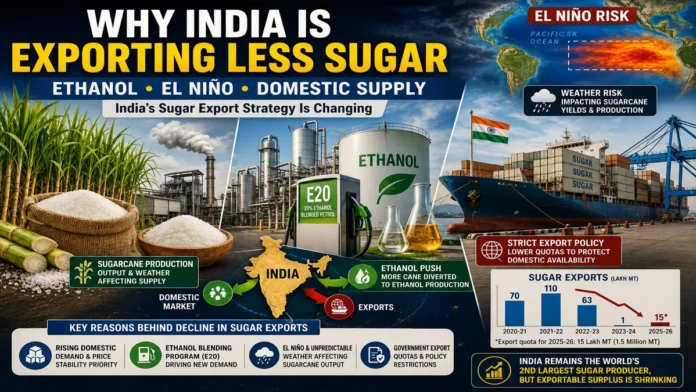
During the 2020-21 sugar season, India exported around 7 million metric tons of sugar. Shipments then climbed to a record of roughly 11 million metric tons in 2021-22.
The situation changed sharply afterward.
For the 2022-23 season, the government allocated an export quota of 6 million metric tons, while tighter domestic supply conditions subsequently pushed India toward much stricter export controls. Official Department of Food and Public Distribution records confirm the government’s shift from large unrestricted export availability toward controlled allocations.
The contrast with the latest policy is striking.
For the 2025-26 sugar season, the government allowed exports of only 1.5 million metric tons, or 15 lakh metric tons.
That is only a fraction of the record volume shipped in 2021-22.
Why Has the Government Restricted Sugar Exports?
Domestic availability is the first priority.
India consumes enormous quantities of sugar every year. The government therefore monitors expected production, consumption, opening stocks and ethanol diversion before deciding how much can safely leave the country.
Allowing excessive exports during a tighter crop year could reduce inventories and contribute to higher domestic prices.
Sugar is also politically sensitive because price increases affect households as well as food manufacturers, bakeries, beverage companies and confectionery businesses.
For this reason, India’s export policy has increasingly operated through restrictions and government-approved quotas, rather than allowing mills to export unlimited quantities.
The 2025-26 allocation of 15 lakh metric tons illustrates this controlled approach.
Is Ethanol Becoming the Bigger Reason Behind Lower Sugar Exports?
Over the longer term, ethanol may be the most important structural change.
India has aggressively expanded its Ethanol Blended Petrol program, creating another major market for sugarcane, molasses and sugar-based feedstocks.
Instead of converting all available cane into crystal sugar, mills can divert suitable feedstock toward ethanol production.
That changes the economics of the sugar sector.
The government says ethanol blending has increased from less than 1.5% in 2013-14 to 20% in 2025-26, with India reaching the 20% blending milestone years ahead of its original timetable. Ethanol procurement is projected at more than 1,200 crore liters in 2025-26, while production capacity has expanded dramatically.
That creates a permanent competing use for sugarcane.
Why Does India Want More Ethanol?
The ethanol strategy serves several policy goals at once.
First, blending domestically produced ethanol into gasoline can reduce the amount of petroleum-based fuel required.
Second, ethanol creates another revenue stream for sugar mills.
Third, it provides an additional market for agricultural feedstocks.
Fourth, policymakers see biofuels as part of India’s wider energy-security and emissions strategy.
The National Policy on Biofuels was amended to bring forward the target of 20% ethanol blending to the 2025-26 ethanol supply year from the original 2030 timeline.
India has now achieved that E20 milestone.
How Does Ethanol Reduce the Amount of Sugar Available for Export?
The mechanism is relatively straightforward.
Sugarcane juice can be processed into sugar, but sugar-based feedstocks and molasses can also be used to manufacture ethanol.
When more feedstock goes into ethanol, less potentially becomes exportable sugar.
That does not necessarily mean ethanol directly removes the same quantity of finished sugar in every season. The exact effect depends on which feedstock is used, government diversion rules, relative prices and mill economics.
Nevertheless, increasing ethanol demand gives mills another commercially important outlet.
In years when domestic sugar supplies are comfortable, India can simultaneously produce substantial ethanol and permit exports.
In tighter years, however, the government faces a choice between maintaining domestic sugar stocks, supporting ethanol production and releasing larger quantities to international buyers.
Is El Niño Now Another Threat to India’s Sugar Crop?
Yes, but it should be treated as a risk rather than the sole explanation for today’s export policy.
The India Meteorological Department said at the end of June that weak El Niño conditions were prevailing over the equatorial Pacific and were likely to strengthen during the southwest monsoon season.
El Niño can influence Indian monsoon rainfall, although the relationship is not automatic and rainfall outcomes can vary substantially by region.
The risk matters especially for sugarcane because it is a high-water-demand crop.
Rainfall that arrives too late, is poorly distributed or leaves important cane-growing regions dry can reduce planted area, yields or sugar recovery.
Has India’s 2026 Monsoon Actually Been Weak?
The rainfall story is more complicated than simply saying India is facing a failed monsoon.
USDA reported on August 10 that India’s cumulative 2026 southwest monsoon rainfall deficit had narrowed to approximately 11.5% below the long-period average by August 1, after a weaker earlier phase.
Meanwhile, parts of India have subsequently experienced intense rainfall and flooding.
This is an important feature of agricultural weather risk: a country can have a seasonal rainfall deficit while simultaneously experiencing destructive heavy rainfall in specific regions.
For sugarcane, where and when rain falls can matter almost as much as the national total.
Could El Niño Reduce Sugar Production in the Next Season?
It could, particularly if strengthening El Niño conditions result in inadequate rainfall across major sugarcane districts.
But a lower crop is not yet a guaranteed outcome.
USDA’s April 2026 India sugar outlook forecast recovery in the 2026-27 marketing year and expected production to exceed consumption for the first time in two years.
The newer monsoon developments therefore introduce additional uncertainty into that earlier forecast.
Actual output will depend on rainfall distribution, reservoir levels, planted acreage, cane yields and the quantity diverted to ethanol.
So What Is the Real Reason India Is Exporting Less Sugar?
There are four interconnected reasons.
1. India Is Protecting Domestic Sugar Supplies
The government does not want strong overseas demand to reduce domestic availability or cause a major price spike.
That has led to controlled export quotas.
2. Ethanol Is Competing With Sugar for Cane Feedstock
India’s E20 program has turned ethanol into a strategic destination for sugar-industry raw materials.
The stronger the ethanol program becomes, the more policymakers must account for diversion before setting export volumes.
3. Production Has Been Volatile
India has moved from periods of record sugar production to tighter years, limiting the amount of surplus available for unrestricted exports.
4. El Niño Adds Future Weather Risk
Strengthening El Niño conditions could pressure rainfall and sugarcane yields, potentially making policymakers even more conservative about future export approvals.
Is Falling Production Really the Main Cause?
Not by itself.
If production were the only issue, exports should automatically recover whenever the crop rebounds.
But India’s sugar economy has structurally changed.
Ethanol has created a major additional source of demand for cane feedstock, while the government has become increasingly active in deciding how much sugar can leave the country.
That means even a good crop may no longer produce the same export surplus seen in the record 2021-22 season.
This is one of the most important changes for global sugar traders to understand.
Why Did India Allow 15 Lakh Metric Tons of Exports in 2025-26?
The government’s decision to permit 15 lakh metric tons indicates that export restrictions are not the same as a permanent prohibition.
Instead, authorities calculate what they consider an exportable surplus and allocate quotas accordingly.
Official orders confirm that the 15 LMT export authorization for 2025-26 was issued in November 2025, followed by reallocations among mills.
This gives mills access to global markets while allowing the government to retain control over the overall volume leaving India.
How Does Brazil Fit Into the Story?
Brazil is crucial because it is the world’s largest sugar producer and the biggest alternative source of supply when India exports less.
USDA’s 2026 Brazil outlook forecasts sugarcane production of about 675 million metric tons in 2026-27, supported by improved climatic conditions.
Brazil also faces its own sugar-versus-ethanol calculation.
Brazilian mills can alter the proportion of sugarcane converted into sugar or ethanol depending on prices and market incentives.
As a result, the global sugar market increasingly depends on decisions made in both India and Brazil.
If India restricts exports while Brazilian mills favor ethanol, world sugar supplies can tighten rapidly.
If Brazil maximizes sugar output while India’s production recovers, international supply pressure can ease.
Could the World Get Less Indian Sugar in the Future?
Possibly — but it should not be treated as inevitable.
India’s long-term ethanol expansion suggests that a growing share of agricultural feedstock will be needed for the domestic fuel market.
At the same time, domestic sugar consumption will continue competing for supply.
Those factors could mean that India’s exportable surplus remains structurally smaller than during the extraordinary 2021-22 export year.
However, excellent sugarcane crops could still allow larger export quotas in future seasons.
The decisive factor will be the amount left after domestic consumption, required stocks and ethanol diversion have been accounted for.
What Does This Mean for Global Sugar Prices?
India’s reduced presence in export markets can make global sugar supply more dependent on Brazil and a smaller group of exporters.
That potentially increases market sensitivity to drought, excessive rainfall, crop disease or production disruptions elsewhere.
USDA’s global outlook continues to identify India as the second-largest producer, meaning any major shift in Indian production or export policy remains internationally significant.
Still, global prices depend on more than India alone. Brazilian production, Thailand’s crop, oil prices, currency movements, global consumption and speculative trading can all influence sugar futures.
The Bigger Picture: India Is Turning Sugarcane Into an Energy Crop Too
The biggest transformation may ultimately be conceptual.
Sugarcane in India is no longer merely a crop used to manufacture sugar.
It is increasingly part of the country’s energy strategy.
The same agricultural system now helps supply food markets and fuel markets.
That creates potential benefits for mills, farmers and energy security, but it also means policymakers have to constantly balance sugar prices against ethanol demand.
India’s shrinking export volumes therefore reflect something broader than a temporary production problem.
They reflect the transformation of the country’s sugar industry itself.
Bottom Line: El Niño, Ethanol or Lower Production?
The answer is all three — but not equally.
Production fluctuations and El Niño-related weather risks can reduce the available sugar surplus in individual seasons.
However, India’s push toward ethanol and its determination to protect domestic sugar supplies represent the deeper structural reasons exports may remain well below the record levels reached earlier this decade.
The India Sugar Exports story is therefore becoming as much about energy security and domestic policy as it is about sugarcane production.
For global buyers, that means India’s return to the export market cannot be judged by crop size alone. The increasingly important question is how much sugar New Delhi is willing to release after domestic consumption and ethanol requirements are met.