Srinagar, India — August 20, 2026
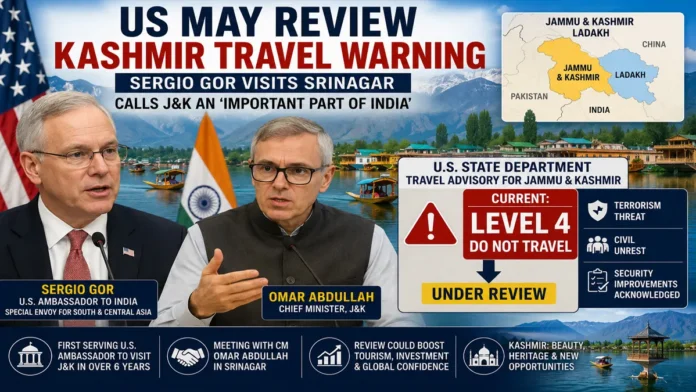
US Kashmir Travel Advisory Review has emerged as a significant diplomatic and security story after U.S. Ambassador to India Sergio Gor visited Srinagar, described Jammu and Kashmir as an “important part of India,” and said Washington would reconsider its existing travel warning for the region.
Gor met Jammu and Kashmir Chief Minister Omar Abdullah on August 19 during a two-day visit covering Jammu and Kashmir and Ladakh. He said the central and local governments had taken important steps to improve security and indicated that the United States would examine whether its current travel guidance should be revised.
The development is notable because the U.S. State Department currently keeps the Union Territory of Jammu and Kashmir in its highest Level 4 — “Do Not Travel” category, citing terrorism and civil unrest. Eastern Ladakh and Leh are excluded from that specific warning.
However, Gor’s remarks should be read carefully. Washington has not yet downgraded the advisory, and no formal change in U.S. policy toward Kashmir has been announced.
Sergio Gor Says Kashmir Is an ‘Important Part of India’
Speaking after his meeting with Omar Abdullah in Srinagar, Gor called Kashmir an “important part of India” and praised the region’s natural beauty.
His remarks immediately attracted attention because of the political sensitivity surrounding Jammu and Kashmir and the long-running differences between India and Pakistan over the region.
Gor’s trip is also significant because he is the first serving U.S. ambassador to visit Jammu and Kashmir in more than six years. He also serves as President Donald Trump’s special envoy for South and Central Asia.
The visit therefore carries significance beyond tourism.
It gives Washington an opportunity to assess conditions directly while expanding diplomatic engagement with the local government.
US Could Re-Evaluate Kashmir Travel Advisory
One of the most consequential parts of Gor’s visit was his acknowledgment that the United States could reassess its existing travel warning.
The State Department’s current India advisory places the country overall at Level 2 — Exercise Increased Caution, but Jammu and Kashmir remains under the tougher Level 4 warning.
The advisory specifically cites terrorism and civil unrest and advises Americans not to travel to Jammu and Kashmir, with the exception of eastern Ladakh and Leh.
Gor stopped short of announcing an immediate change but suggested that improved security conditions could be considered when Washington next evaluates the advisory.
That distinction is important.
A review does not automatically mean the advisory will be downgraded, but it indicates that the existing assessment is not necessarily permanent.
Why a US Travel Advisory Matters Beyond Tourism
A travel advisory is primarily intended to guide American citizens, but its impact can extend much further.
International tourists, companies, insurers and business travelers often examine U.S. State Department assessments when evaluating risk.
A softer advisory on Jammu and Kashmir could therefore influence perceptions of the region among foreign travelers and international businesses.
It could also support efforts to reposition Kashmir internationally as a destination for tourism and investment rather than viewing it primarily through a security lens.
Still, any eventual change would depend on a formal State Department assessment rather than ambassadorial remarks alone.
Does Gor’s Visit Signal a Change in Washington’s Kashmir Policy?
It may signal a change in security perception and diplomatic engagement, but it is too early to describe it as a formal shift in U.S. Kashmir policy.
Gor’s statement that Jammu and Kashmir is an “important part of India” aligns closely with New Delhi’s position and has already generated a diplomatic reaction from Pakistan.
However, the most concrete policy development so far is simply Washington’s willingness to reconsider its travel advisory.
There has been no formal announcement changing the United States’ broader diplomatic position on the India-Pakistan dispute.
For that reason, describing the visit as a potential change in Washington’s assessment is more accurate than presenting it as a finalized strategic realignment.
Pakistan Protests Gor’s Kashmir Remarks
Pakistan reacted strongly to Gor’s comments.
Islamabad summoned U.S. Chargé d’Affaires Natalie Baker and lodged a formal diplomatic protest over the ambassador’s description of Jammu and Kashmir as an important part of India.
Pakistan said the remarks differed from what it considers Washington’s traditional position on the Kashmir issue.
India, meanwhile, has consistently maintained that Jammu and Kashmir and Ladakh are integral parts of the country and rejects outside mediation over the issue.
The Pakistani reaction demonstrates why even carefully worded remarks by senior U.S. officials can have significant diplomatic consequences in South Asia.
Omar Abdullah Keeps Focus on India’s Internal Process
Chief Minister Omar Abdullah also sought to draw a clear line around the diplomatic engagement.
Ahead of his meeting with Gor, Abdullah said Jammu and Kashmir’s problems were matters to be addressed within India and that he was not in the habit of taking complaints to another country’s envoy.
His remarks underscored the view that engagement with the United States should focus on tourism, investment and broader cooperation rather than internationalizing Jammu and Kashmir’s internal political issues.
After the meeting, discussions were reported to have included opportunities for deeper engagement between Jammu and Kashmir and the United States.
Why the Security Question Is Still Complicated
Despite the discussion of improved conditions, security concerns have not disappeared.
The State Department continues to warn of possible terrorist attacks and unrest in Jammu and Kashmir, particularly around the Line of Control and key tourist areas.
Local authorities also continue to deal with terrorism-related threats.
Only days before Gor’s visit, Omar Abdullah publicly urged security agencies not to underestimate threats against Kashmiri Pandits working in the Valley, referring to previous targeted killings.
That context explains why any U.S. advisory revision would likely involve a detailed security assessment rather than a purely political decision.
Pakistan-China Defense Cooperation Adds a Wider Strategic Layer
The visit also comes amid evolving strategic dynamics involving Pakistan and China.
Pakistan remains one of China’s closest defense partners, with Beijing supplying military equipment and technology across multiple platforms.
For Washington, South Asia increasingly involves overlapping calculations involving India, Pakistan, China, regional security and the Indo-Pacific.
Jammu and Kashmir and Ladakh occupy a particularly sensitive geographical position because the broader region touches strategic frontiers involving all three countries.
Gor’s decision to continue from Kashmir to Ladakh therefore adds another strategic dimension to the trip, although there is no official evidence that Washington intends the visit as a direct signal to Beijing.
Ladakh Visit Draws Attention to China Factor
Gor’s itinerary includes Ladakh after Srinagar, making the trip geographically important.
Ladakh borders China and has been at the center of India-China military tensions along the Line of Actual Control in recent years.
India and China have nevertheless been attempting to stabilize their relationship through military and diplomatic talks.
Against that backdrop, a senior U.S. envoy visiting both Kashmir and Ladakh naturally attracts strategic attention.
However, it would be speculative to claim that the trip is specifically aimed at China unless Washington states that directly.
What Could Change if Washington Lowers the Advisory?
If the United States ultimately lowers its Jammu and Kashmir travel warning, the immediate effect would be on American travelers.
But the broader impact could include:
greater confidence among foreign tourists,
lower perceived travel risk,
potentially easier insurance decisions,
stronger international tourism marketing,
greater interest from hospitality investors, and
a gradual change in international perceptions of Kashmir’s security environment.
A downgrade would therefore carry symbolic as well as practical significance.
Why the Timing Matters
Gor’s visit comes at a time when India-U.S. ties continue to extend across defense, trade, technology and Indo-Pacific strategy.
At the same time, Washington is managing its own relationships with Pakistan and monitoring China’s growing strategic influence across South Asia.
That makes Kashmir a sensitive location where tourism, security and geopolitics intersect.
The ambassador’s language and the possible advisory review suggest that Washington is willing to reassess conditions on the ground rather than relying indefinitely on an older security framework.
Is America Changing Its Long-Standing View of Jammu and Kashmir?
The clearest answer at this stage is: possibly on security assessment, but not yet formally on overall policy.
Gor’s visit, his description of Jammu and Kashmir as an important part of India and his willingness to reconsider the Level 4 travel warning are meaningful developments.
They suggest that Washington may increasingly distinguish between its historical diplomatic approach to the Kashmir question and its current assessment of day-to-day security conditions inside the Indian-administered Union Territory.
Pakistan’s formal protest shows that the language has already had regional diplomatic consequences.
The next key development will be whether the US Kashmir Travel Advisory Review results in an actual downgrade.
Until the State Department changes the advisory formally, Jammu and Kashmir remains under the U.S. government’s Level 4 “Do Not Travel” warning.