New Delhi, India, August 19, 2026
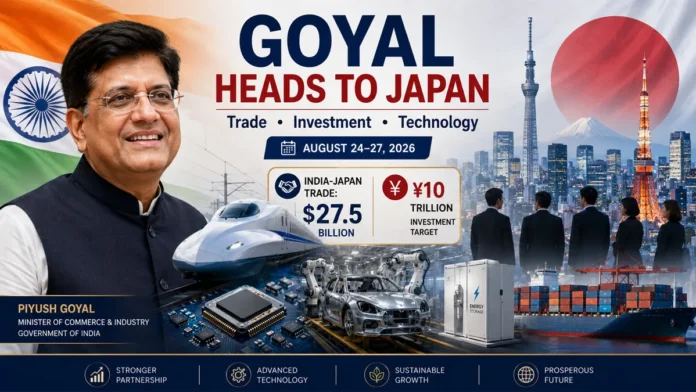
Piyush Goyal Japan Visit 2026 is set to put trade, investment and advanced industrial cooperation at the center of India-Japan economic engagement, with the Union Commerce and Industry Minister scheduled to travel to Japan from August 24 to 27 for high-level discussions with government and business leaders.
Goyal said the visit would seek to take ongoing conversations forward at the highest levels of government and industry and further strengthen the India-Japan Special Strategic and Global Partnership. The trip comes as bilateral trade has reached about $27.5 billion in FY2025-26, while Japan remains India’s fifth-largest source of foreign direct investment.
The minister announced his Japan visit while addressing a dinner hosted by the Uttar Pradesh government for a delegation from Japan’s Yamanashi Prefecture in New Delhi. Uttar Pradesh Chief Minister Yogi Adityanath was also present at the event.
Goyal to Visit Japan From August 24 to 27
Goyal said he will visit Japan between August 24 and August 27, 2026, with talks expected to focus on expanding investment, industrial partnerships, technology cooperation and business opportunities between the two countries.
The minister said India and Japan share a close and enduring relationship based on common aspirations for peace, progress and prosperity across the Indo-Pacific.
He described the partnership as going beyond economic growth, arguing that the two countries have the potential to become increasingly trusted partners in global progress.
The visit is particularly significant because it follows the 16th India-Japan Annual Summit held in New Delhi in July, where the two sides agreed to deepen cooperation across economic security, energy, technology, innovation and defense.
India-Japan Trade Reaches $27.5 Billion
Economic ties between India and Japan have continued to expand.
According to figures cited by Goyal, bilateral trade reached approximately $27.5 billion in FY2025-26.
Japan has also become India’s fifth-largest source of FDI, underscoring the growing role of Japanese capital in India’s manufacturing, infrastructure and technology sectors.
The figures provide a strong foundation for Goyal’s upcoming visit, during which India is expected to encourage Japanese companies to expand their manufacturing and investment footprint.
Japan’s ¥10 Trillion India Investment Target in Focus
A major element of the economic relationship is Japan’s ambitious target of mobilizing ¥10 trillion in private investment in India over a decade.
The target was established at the 15th India-Japan Annual Summit in 2025. At the 16th summit in July 2026, Prime Minister Narendra Modi and Japanese Prime Minister Sanae Takaichi welcomed progress toward that goal.
Japan’s Foreign Ministry said approximately ¥2 trillion in investment commitments had already been made since the ¥10 trillion target was established.
The scale of the investment ambition could significantly deepen Japanese participation in India’s manufacturing and technology-driven growth.
AI, Semiconductors and Critical Minerals Could Drive Next Phase
India and Japan are increasingly looking beyond traditional infrastructure and automobile cooperation.
Goyal highlighted sectors including:
- artificial intelligence;
- semiconductors;
- critical minerals;
- batteries;
- energy; and
- next-generation mobility.
These industries are expected to become important pillars of future economic cooperation.
The July summit also resulted in a Japan-India Joint Declaration on Economic Security Cooperation covering key sectors including semiconductors, critical minerals, information and communication technology, clean energy and pharmaceuticals.
Such cooperation is becoming increasingly important as major economies seek to diversify supply chains and reduce dependence on any single country for critical technologies and raw materials.
More Than 1,400 Japanese Companies Operating in India
Japan already has a substantial corporate presence in India.
Goyal said more than 1,400 Japanese companies are currently operating in the country.
Major Japanese brands include Suzuki, Toyota and Honda in mobility, Sony in electronics, and Hitachi and Mitsubishi in engineering and industrial technology.
India is now seeking to expand that presence beyond established sectors such as automobiles and consumer electronics into emerging industries including semiconductors, clean energy and advanced manufacturing.
Japanese Investment Visible Across Indian Infrastructure
India-Japan economic cooperation is already visible through several major infrastructure projects.
Goyal highlighted the Mumbai-Ahmedabad High-Speed Rail project as one of the flagship examples of the partnership.
He also referred to Japanese-assisted metro systems in Delhi, Ahmedabad, Bengaluru and Chennai, as well as 11 Japanese industrial townships across eight Indian states.
The July summit reaffirmed the importance of the Mumbai-Ahmedabad High-Speed Rail project, with the two governments continuing cooperation toward the introduction of Japan’s advanced E10-series Shinkansen technology.
Uttar Pradesh Seeks Larger Share of Japanese Investment
Goyal used the interaction with the Japanese delegation to highlight Uttar Pradesh as an emerging investment destination.
He said the state is working toward its ambition of becoming a $1 trillion economy under Chief Minister Yogi Adityanath.
Its large consumer base, improving connectivity, industrial development and skilled workforce could offer Japanese companies substantial opportunities, he said.
The minister argued that Japan’s technological expertise could complement India’s young workforce and rapidly expanding market.
UP Has More Than 9 Million MSMEs
The Commerce Minister also highlighted the scale of Uttar Pradesh’s industrial base.
According to the government statement, Uttar Pradesh has more than 9 million MSMEs and ranks as India’s fifth-largest state exporter.
Japanese-linked businesses including Escorts Kubota and Seiko Advance are already contributing to the state’s manufacturing ecosystem.
Goyal also pointed to infrastructure including Jewar International Airport, the Yamuna Expressway and the JICA-supported Western Dedicated Freight Corridor.
The state has 27 industrial clusters and developing ecosystems covering sectors such as defense, semiconductors and electronics.
Yamanashi Delegation Signals State-Level Partnership
The presence of a delegation from Japan’s Yamanashi Prefecture was highlighted as evidence that India-Japan relations are expanding beyond national governments.
Both countries are increasingly encouraging direct cooperation between Indian states and Japanese prefectures.
The July summit joint statement specifically recognized growing subnational links, including cooperation between Yamanashi Prefecture and Uttar Pradesh.
Such partnerships can help companies identify local investment opportunities while supporting education, skills, technology and cultural exchanges.
Japan and India Expand Regional Cooperation
The bilateral relationship increasingly combines economic engagement with broader Indo-Pacific strategy.
At the July summit, India and Japan described themselves as natural and indispensable partners and agreed to advance cooperation in three broad areas: defense and security, economic partnership and people-to-people exchanges.
The two sides also emphasized resilient supply chains, energy security and cooperation in critical technologies.
That strategic dimension gives investment and trade talks a significance extending beyond the direct commercial value of individual projects.
High-Speed Rail Remains Flagship Partnership
The Mumbai-Ahmedabad High-Speed Rail project continues to symbolize the scale of infrastructure cooperation between India and Japan.
At the July summit, Japan reiterated support for India’s objective of beginning commercial operations on priority sections in 2027.
Both countries also expressed interest in exploring Japanese participation in future high-speed rail corridors as India develops its longer-term vision for a national high-speed network.
The project combines Japanese technological expertise with India’s large infrastructure market, a model both governments hope can be replicated in other sectors.
India Seeks Japanese Technology and Capital
Goyal’s message to Japanese companies was clear: India wants deeper participation in its next phase of growth.
The government’s pitch combines several advantages — a large consumer market, a young workforce, expanding infrastructure, digital public systems and ongoing improvements in the business environment.
Goyal linked India’s reform program with the Japanese philosophy of Kaizen, or continuous improvement, pointing to reforms in logistics, infrastructure, ease of doing business and Japanese-language capabilities.
The effort is aimed not simply at attracting capital but at encouraging long-term manufacturing and technology partnerships.
What to Expect From Goyal’s Japan Visit
During the Piyush Goyal Japan Visit 2026, discussions are expected to focus on converting the broader strategic relationship into greater business activity.
Investment in semiconductors, artificial intelligence, critical minerals, energy, batteries and next-generation transportation is likely to receive particular attention, based on the priorities outlined by both governments.
India will also seek deeper engagement from Japanese businesses in states such as Uttar Pradesh as the partnership expands beyond traditional economic centers.
With bilateral trade at about $27.5 billion, more than 1,400 Japanese companies already operating in India and the ¥10 trillion investment target providing a long-term framework, the August 24-27 visit could become another important step in deepening one of India’s most consequential economic relationships in the Indo-Pacific.