
Mumbai, India — August 20, 2026
RBI Rate Hike expectations are back in focus after minutes from the Reserve Bank of India’s August monetary policy meeting showed policymakers becoming increasingly cautious about inflation risks from high crude oil prices, food costs and broader input pressures.
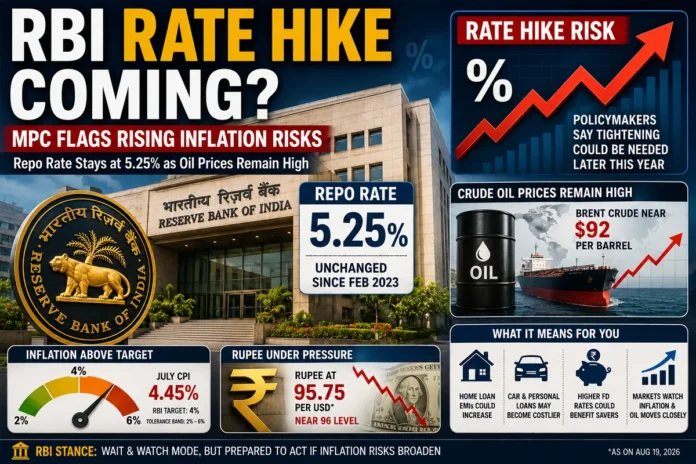
The RBI kept the benchmark repo rate unchanged at 5.25% at its August 5 meeting, but the newly released minutes suggest the central bank is preparing for the possibility that its next major policy move may eventually be a rate increase rather than a cut if inflation becomes more persistent.
The minutes indicate that policymakers are not rushing to tighten immediately. Instead, they are watching whether elevated energy costs begin to spread more broadly across the economy through transportation, manufacturing, food and services prices.
That makes incoming inflation data crucial for the direction of Indian interest rates over the rest of the financial year.
RBI Keeps Repo Rate at 5.25%
At its August policy meeting, the Monetary Policy Committee decided to leave the repo rate unchanged at 5.25%.
The decision was widely expected after policymakers chose to wait for clearer evidence on whether higher oil prices would create sustained inflation rather than a temporary price shock.
The current pause allows the central bank to assess two competing risks:
- inflation could accelerate if oil and input costs remain high; and
- premature tightening could weaken economic growth unnecessarily.
For now, the RBI appears to believe that waiting for more evidence provides the greatest flexibility.
Why Are RBI Policymakers Worried About Inflation?
The biggest concern is crude oil.
India imports the vast majority of the crude oil it consumes, making the economy particularly vulnerable to sustained increases in global energy prices.
Brent crude has recently traded close to $92 a barrel, while geopolitical tensions in the Middle East and uncertainty surrounding the Strait of Hormuz have added further volatility.
Higher crude prices can affect the economy far beyond fuel pumps.
Transportation becomes more expensive, companies face higher logistics and production costs, and businesses may eventually pass part of those costs on to consumers.
That is the type of second-round inflation effect the RBI is closely monitoring.
July Inflation Rose Above RBI’s 4% Target
India’s consumer inflation stood at approximately 4.45% in July, moving above the RBI’s medium-term 4% target while remaining comfortably inside its legally mandated tolerance band of 2% to 6%.
On its own, that level does not require an immediate rate increase.
The concern is what happens next.
If food, fuel and manufacturing input prices all begin rising simultaneously, inflation could become more broad-based and harder to reverse.
That would strengthen the case for monetary tightening.
Governor Sanjay Malhotra Flags Broader Inflation Risk
RBI Governor Sanjay Malhotra has emphasized that policymakers need to distinguish between temporary inflation shocks and a more generalized increase in prices.
The August minutes indicate that the central bank is particularly focused on whether higher fuel and input costs begin affecting a wider range of goods and services.
That distinction matters because monetary policy cannot directly reduce global crude oil prices.
However, the RBI can raise interest rates if higher oil prices begin influencing inflation expectations, wages and domestic demand.
Poonam Gupta Signals There Is Little Room for Rate Cuts
Deputy Governor Poonam Gupta offered one of the clearest signals in the minutes.
Her assessment suggested there is little room for further rate cuts under current conditions and that the central bank should remain prepared to tighten policy later in the fiscal year if inflation risks intensify.
That does not mean a rate hike has already been decided.
But it strengthens the view that the easing cycle is effectively over unless economic conditions change substantially.
Is an RBI Rate Hike Certain?
No.
A rate increase is now a meaningful possibility, but it is not guaranteed.
A Reuters poll conducted before the August meeting showed economists largely expecting the RBI to keep rates unchanged through the remainder of 2026, with growth concerns still weighing against an immediate tightening cycle.
That means the central bank and private-sector forecasters are still working with considerable uncertainty.
A significant fall in oil prices or softer inflation could reduce pressure for a hike.
Persistent inflation, a weaker rupee or another sharp rise in crude could push policy in the opposite direction.
What Could Trigger a Rate Hike?
Several developments could make an increase more likely.
Persistently High Crude Oil
If Brent crude remains around current elevated levels or moves higher, India’s import bill and inflation pressures could increase.
Broader Consumer Inflation
The RBI will watch whether price increases remain concentrated in fuel and food or spread into services and manufactured goods.
Rupee Weakness
A weaker rupee makes imported commodities more expensive in domestic currency terms, potentially adding another layer of inflation pressure.
Rising Inflation Expectations
If households and businesses begin expecting prices to keep rising, the RBI may act more aggressively to prevent those expectations from becoming entrenched.
Rupee Weakness Adds Another Challenge
The Indian rupee has also been under pressure.
On August 19, it weakened to around 95.75 per U.S. dollar, close to the psychologically important 96 level, as rising crude oil prices and corporate dollar demand weighed on the currency.
The RBI has reportedly been active in foreign-exchange markets through state-owned banks to limit excessive volatility.
A weaker currency matters for monetary policy because it raises the rupee cost of imported oil, gas and other commodities.
That can amplify inflation even when global prices themselves do not increase further.
Markets Are Already Pricing in Future Tightening
Financial markets are beginning to account for the possibility that rates may eventually move higher.
Market pricing suggests investors see meaningful scope for RBI tightening over the next year, although the timing remains uncertain.
Bond yields are particularly sensitive to these expectations.
If traders become convinced that the next RBI move will be a hike, government bond yields could rise as investors demand higher returns.
What Does This Mean for Home Loan Borrowers?
An RBI rate hike would eventually increase borrowing costs across the economy.
For borrowers with floating-rate home loans linked to external benchmarks, higher policy rates can lead to:
- higher monthly EMIs;
- longer loan tenures; or
- a combination of both.
Banks do not always pass every policy change through immediately, but sustained monetary tightening usually affects lending rates over time.
For prospective homebuyers, rising rates can also reduce borrowing capacity.
What Could Happen to Car and Personal Loans?
Auto loans, personal loans and other retail credit products could also become more expensive if the RBI begins tightening.
Banks generally adjust lending rates based on funding costs, liquidity conditions and policy rates.
Consumers planning large purchases may therefore watch the next few inflation readings closely.
What Would Higher Rates Mean for Fixed Deposits?
Depositors could potentially benefit.
When policy rates rise, banks often increase fixed-deposit rates to attract more funds, although the timing and size of increases differ between institutions.
This means a rate-hike cycle can improve returns for savers even as it raises costs for borrowers.
RBI Raises Growth Forecast Despite Inflation Concerns
Interestingly, the RBI’s concern about inflation comes alongside a relatively resilient growth outlook.
According to the August policy assessment, the central bank raised its growth forecast to around 6.7%, while slightly trimming its inflation projection to approximately 5%.
That combination gives policymakers some room to tighten later if necessary.
A stronger economy can generally withstand higher interest rates better than a weak one.
Why Oil Is So Important for India’s Monetary Policy
Oil prices have an unusually large influence on India’s macroeconomic outlook because the country relies heavily on imports.
Higher crude prices can affect:
fuel costs,
transportation expenses,
the current-account balance,
the rupee,
government finances,
corporate margins, and
consumer inflation.
That is why sustained geopolitical tension in the Middle East can quickly become a domestic monetary-policy issue for India.
Middle East Crisis Keeps RBI on Alert
The ongoing instability involving Iran and the Strait of Hormuz has created uncertainty around global energy supply.
Even if oil continues flowing through the waterway, concerns about disruptions can keep a risk premium embedded in crude prices.
For the RBI, this means geopolitical developments outside India could significantly influence the timing of its next interest-rate move.
The central bank faced similar concerns earlier in the year, when policymakers opted for a wait-and-watch approach as oil and food prices threatened to generate more generalized inflation.
Could RBI Raise Rates Before the End of 2026?
It is possible, but the minutes do not commit the central bank to a specific date.
Earlier surveys produced mixed expectations.
A May poll found that a majority of economists expected at least one increase before the end of the year because of high crude prices and rupee pressure. By late July, however, more economists had shifted toward expecting rates to remain unchanged through 2026.
That shift shows how quickly expectations are changing.
The next few inflation readings could therefore be decisive.
What Should Investors Watch Next?
Markets will focus on several indicators:
Consumer inflation: Whether headline CPI remains close to or above 4%.
Core inflation: Whether price pressures spread beyond food and energy.
Brent crude: Sustained prices around or above current levels would increase risk.
Rupee: Further depreciation could raise imported inflation.
Food prices: Monsoon performance and agricultural supply will remain important.
RBI commentary: Any stronger language from policymakers could reshape expectations quickly.
RBI Rate Hike: The Bottom Line
The latest MPC minutes do not say an RBI Rate Hike is imminent.
They do, however, indicate a clear change in the policy debate.
The central bank is increasingly focused on whether high oil prices and other supply-side pressures could push inflation beyond temporary shocks and into a broader, more persistent trend.
For now, the repo rate remains at 5.25%.
But with crude prices elevated, the rupee under pressure and inflation above the RBI’s 4% target, policymakers are keeping the door open to tighter monetary policy if the data deteriorates.
For households, borrowers, businesses and markets, that means the next few inflation reports may determine whether India enters a new rate-hike cycle later this fiscal year.