By Team INVC | INVC NEWS
NEW DELHI, India | October 2, 2026 —
If you are heading out to shop on Gandhi Jayanti and wondering whether your UPI payment will work, the most important answer is simple:
Yes, UPI itself is working. But some merchants may choose not to accept it today.
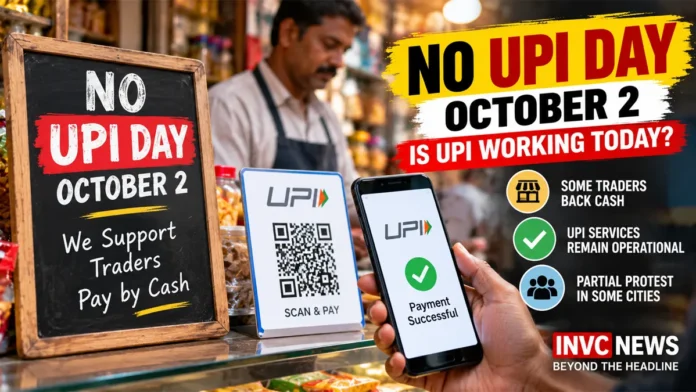
The much-discussed “No UPI Day” on October 2 is not a nationwide shutdown of UPI and does not mean digital payments have been switched off across India. Instead, it is a fragmented merchant protest against the new Merchant Discount Rate, or MDR, framework scheduled to take effect from October 15.
Delhi-based Chamber of Trade and Industry (CTI) has urged participating traders to symbolically cover UPI QR codes, scanners and payment sound boxes with black cloth and accept cash instead.
But India’s trader community is far from united.
The Confederation of All India Traders (CAIT) has categorically said it neither announced nor endorsed a nationwide No UPI Day. Adding another major twist, the All India Mobile Retailers Association (AIMRA) and All India Consumer Products Distributors Federation (AICPDF) withdrew their October 2 protest call after representatives met Finance Minister Nirmala Sitharaman and received an assurance that their concerns would be considered.
That leaves consumers facing a patchwork situation today:
UPI is operational, many merchants are accepting it normally, while some participating stores and regional trader groups may insist on cash as a symbolic protest.
THE 60-SECOND BRIEF
Is UPI shut down today?
No. There is no nationwide shutdown of the UPI network.
What is “No UPI Day”?
It is a merchant-led protest against the new MDR framework for certain UPI merchant payments.
What is CTI asking traders to do?
CTI has urged participating merchants to cover their QR codes, scanners and sound boxes with black cloth and accept cash.
Is CAIT supporting the protest?
No. CAIT has explicitly said it did not call for or endorse a nationwide No UPI Day.
Did some organizations withdraw?
Yes. AIMRA and AICPDF withdrew their planned October 2 protest after discussions with Finance Minister Nirmala Sitharaman.
Can customers still use UPI?
Yes. UPI remains operational. Whether a particular merchant accepts UPI today depends on that merchant’s participation in the protest.
Should you carry cash?
Keeping some cash may be useful if you are shopping at a business participating in the protest, but there is no need to assume UPI has stopped working nationwide.
Why Are Some Traders Saying ‘No UPI’ Today?
The dispute centers on Merchant Discount Rate, or MDR.
Under the new framework scheduled to take effect on October 15, a 0.4% MDR will apply to specified person-to-merchant UPI payments above ₹2,000.
The fee will be borne by merchants rather than being directly charged to consumers.
The charge is capped at ₹300 for qualifying transactions of ₹75,000 or more.
This distinction matters.
A customer paying a merchant through UPI is not being asked to pay an additional 0.4% MDR directly at checkout under the framework.
The concern comes from merchants who argue that absorbing the charge could reduce margins, particularly in businesses where profits on individual products are already tight.
That concern triggered calls for the symbolic October 2 protest.
Why Cover QR Codes With Black Cloth?
The black cloth is intended as a visual symbol rather than a technical measure.
CTI had called on traders participating in No UPI Day to cover QR codes, scanners and payment sound boxes and encourage cash transactions instead.
The idea is straightforward:
Rather than merely issuing a statement opposing MDR, participating merchants want customers to notice the protest at the point of payment.
A covered QR code immediately raises the question: Why is this shop refusing UPI today?
That creates visibility for the traders’ demand.
But participation is voluntary and uneven.
This is why customers should not interpret a covered QR code at one store as evidence that UPI has stopped working everywhere.
CAIT Says: We Did Not Call for No UPI Day
One of the biggest sources of confusion has been disagreement among trade organizations themselves.
CAIT has clearly distanced itself from claims that it announced or supported a nationwide October 2 boycott.
The organization said it had made no decision or resolution calling for a nationwide No UPI Day.
It also acknowledged that individual trade organizations and regional groups could organize their own protests.
That is a crucial distinction.
Some traders are protesting UPI MDR. That does not mean India’s entire trading community has collectively rejected UPI today.
Major Twist: AIMRA and AICPDF Withdraw Protest Call
The situation changed significantly just before October 2.
Representatives of small traders met Finance Minister Nirmala Sitharaman and presented their concerns over the proposed MDR framework.
Following those discussions, AIMRA and AICPDF decided to withdraw their planned No UPI Day protest for October 2.
The organizations cited constructive discussions and assurances that concerns raised by the trading community would receive consideration.
They have sought changes to the proposed framework, including relief for merchants and reconsideration of transaction thresholds.
Their withdrawal substantially changes the scale of today’s protest.
It means reports suggesting that all mobile retailers or all major trader organizations are participating in a nationwide UPI boycott would be misleading.
So Who Is Actually Protesting?
The answer varies by city, market and organization.
CTI has supported the protest, while some regional and local trader associations in different parts of India have also announced participation.
Reports from cities including Pune and areas of Rajasthan and Gujarat indicate that some merchant groups have backed symbolic No UPI Day actions.
But other major trade organizations have either declined to participate or withdrawn earlier protest calls.
That makes “partial protest” the most accurate description of October 2.
There is no single nationwide instruction requiring merchants to reject UPI.
Will Google Pay, PhonePe, Paytm and Other UPI Apps Work?
For consumers, this may be the biggest practical question.
No UPI Day does not mean the UPI infrastructure has been switched off.
If your bank, UPI app and the recipient’s payment setup are functioning normally, UPI transactions can continue.
However, a merchant participating in the protest may choose not to provide or accept a UPI payment option.
In that situation, the problem is not that your UPI app has stopped working.
The merchant has voluntarily decided not to accept that payment method for the protest.
This distinction can prevent unnecessary confusion.
What Happens to Person-to-Person UPI Payments?
Another important point: the controversy is centered on merchant payments.
Ordinary person-to-person UPI transfers are not the target of the merchant protest in the same way.
Sending money to a friend or family member should therefore not be confused with a shopkeeper’s decision to temporarily stop accepting UPI payments.
The debate concerns the economics of merchant acceptance of digital payments — not the existence of UPI itself.
Why Traders Are Worried About MDR
For a business with healthy margins, a fraction of a percentage point may appear small.
Retailers argue that the calculation looks very different in high-volume, low-margin businesses.
Consider a qualifying merchant payment of ₹10,000.
At 0.4%, the MDR would amount to ₹40.
On a ₹50,000 qualifying transaction, 0.4% would equal ₹200.
For an individual consumer, those numbers may appear modest.
For a retailer processing many eligible transactions every day, merchants argue that the cumulative cost could become significant.
This is particularly sensitive in sectors such as electronics, mobile phones and distribution, where merchants say competition can keep margins tight.
Why the Government and Payment Ecosystem Face a Difficult Balance
There is a broader policy challenge behind the dispute.
India has spent years encouraging digital payments.
UPI succeeded partly because it made instant payments extremely easy for consumers and gave even small merchants access to digital transactions through inexpensive QR-code infrastructure.
But payment infrastructure also has costs.
Banks, payment companies and technology providers must maintain systems capable of processing enormous transaction volumes securely and reliably.
That creates a difficult policy question:
Who should ultimately pay for the infrastructure behind a payment system that consumers increasingly expect to use for free?
Merchants argue that new charges should not undermine the digital-payment habits India has spent years building.
The other side of the debate centers on how the payments ecosystem can remain economically sustainable as transaction volumes and infrastructure requirements expand.
That is the real policy battle beneath No UPI Day.
Will Customers Eventually Pay More?
Consumers are not directly liable for the MDR under the announced structure.
However, traders worry about indirect consequences.
If businesses face higher payment-processing costs, some argue that those costs could eventually influence pricing, discounts or the payment methods merchants prefer.
That does not mean prices will automatically rise because of MDR.
But it explains why the dispute matters to consumers even when the fee itself is imposed on merchants.
Why Gandhi Jayanti Was Chosen
Holding the symbolic protest on October 2 also carries deliberate messaging.
Gandhi Jayanti is associated with Mahatma Gandhi’s ideas of Swadeshi, economic self-reliance and local enterprise.
Some trader organizations have sought to connect their protest with those themes.
The symbolism gives the campaign greater visibility.
But the choice of date should not obscure the practical reality:
October 2 is not an official UPI holiday.
WHAT SHOULD YOU DO TODAY?
For most consumers, there is no reason to panic or stop using UPI.
Your best approach is simple.
Continue using UPI where merchants accept it.
If you are visiting local markets or stores where traders may be participating in No UPI Day, carrying a reasonable amount of cash or an alternative payment method could save time.
Most importantly, do not assume that a payment problem at one participating shop means UPI has stopped working across India.
It has not.
THE BIGGER PICTURE
The real significance of No UPI Day may not be how many QR codes are covered today.
It is what happens before October 15.
The withdrawal of protest calls by AIMRA and AICPDF after discussions with the Finance Minister suggests that negotiations between trader organizations and the government remain important.
Merchant groups want their concerns over transaction costs addressed.
Policymakers must weigh those concerns against the economics of sustaining one of the world’s largest real-time digital-payment ecosystems.
And consumers have another interest altogether:
They want payments to remain simple, inexpensive and widely accepted.
Reconciling those three interests — merchants, the payments ecosystem and consumers — will determine whether the MDR controversy becomes a short-lived protest or a much larger debate over the future economics of UPI.
WHAT HAPPENS NEXT
The key date is October 15, 2026, when the new MDR framework is scheduled to take effect.
Before then, attention will remain focused on whether the government or payment authorities make any changes, clarifications or concessions in response to representations from trader organizations.
The scale of today’s protest will also matter.
If participation remains fragmented, negotiations may become more important than street-level or shop-level protest.
If opposition among merchants grows, pressure for further changes could increase.
Either way, October 2 is unlikely to be the end of the MDR debate.
INVC NEWS BOTTOM LINE
No UPI Day does not mean UPI is down today.
CTI and some regional merchant organizations are backing symbolic protests, including covering QR codes and encouraging cash payments. But CAIT has not endorsed a nationwide boycott, while AIMRA and AICPDF withdrew their October 2 protest after talks with Finance Minister Nirmala Sitharaman.
That makes today’s action partial, voluntary and fragmented — not a nationwide UPI shutdown.
For consumers, the takeaway is practical: UPI continues to work, but carrying some cash may help if an individual merchant chooses to participate in the protest.
For India’s digital-payment ecosystem, however, the bigger question comes next:
Can UPI remain convenient for consumers, affordable for merchants and financially sustainable for the institutions that keep it running?
The answer will matter long after today’s QR codes are uncovered.