By Team INVC | INVC NEWS
WASHINGTON, United States | October 2, 2026 —
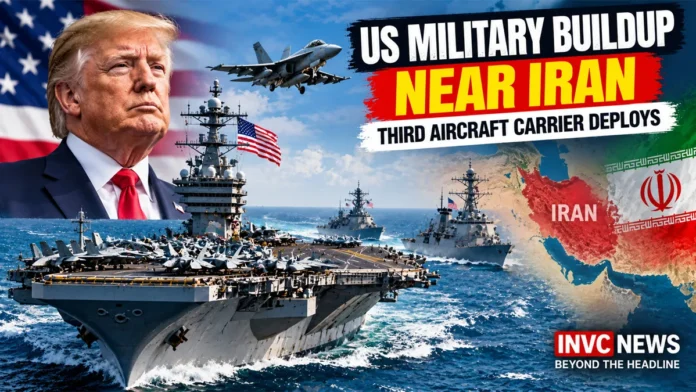
The United States is moving one of its most powerful symbols of military force toward the Middle East — and it is not traveling alone.
The USS Theodore Roosevelt Carrier Strike Group, accompanied by additional warships, is heading toward the region as Washington reinforces its military posture amid renewed tensions with Iran. At the same time, the USS Makin Island Amphibious Ready Group, carrying more than 2,000 Marines as part of a broader force, has also deployed.
Together, the ships carry roughly 9,000 to 10,000 additional sailors and Marines, according to U.S. officials cited in multiple reports.
If current deployments overlap as expected, the United States could temporarily have three aircraft carrier strike groups operating in or around the Middle East — an unusually concentrated display of American naval power.
The buildup comes as President Donald Trump has warned that Iran would face a severe response if investigators establish Iranian involvement in the attempted attack aboard a Flydubai flight bound for Israel.
No such Iranian link has been publicly established.
That distinction is critical.
Washington has not announced that these deployments constitute an order for a new attack on Iran. But the additional carrier, Marines, aircraft and warships significantly expand the military options available to Trump if diplomacy fails or the regional security situation deteriorates.
For Iran — and for every country dependent on stability in the Persian Gulf and Strait of Hormuz — that is the development that matters most.
THE 60-SECOND BRIEF
What is the U.S. sending?
The USS Theodore Roosevelt Carrier Strike Group and the USS Makin Island Amphibious Ready Group are deploying toward the Middle East.
How many additional personnel are involved?
The combined deployment involves roughly 9,000 to 10,000 sailors and Marines.
Could the U.S. have three aircraft carriers in the region?
Yes. Current deployments could temporarily place three U.S. carrier strike groups in or around the Middle East, depending on rotations and deployment schedules.
Does that mean Trump has ordered another major attack on Iran?
No. A force deployment expands military options; it is not by itself an announcement of a new strike.
Why is tension rising now?
The buildup comes amid continuing U.S.-Iran confrontation, stalled diplomacy, tensions around the Strait of Hormuz and a recent Flydubai incident that triggered new security concerns.
What did Trump say about the aircraft incident?
Trump warned of a severe response if Iran is found to have been involved.
Has Iran’s involvement been proven?
No. The motive behind the Flydubai incident remains under investigation, and no publicly established evidence has confirmed Iranian responsibility.
Why should the world care?
A major U.S.-Iran escalation could affect regional security, shipping through the Strait of Hormuz, oil markets and U.S. allies across the Middle East.
A Third Carrier Changes the Military Equation
Aircraft carriers are not merely large ships.
A U.S. carrier strike group functions as a mobile military ecosystem.
It can include fighter aircraft, surveillance platforms, missile-capable escort ships, air-defense capabilities and thousands of sailors operating together across a vast area.
The USS Theodore Roosevelt, a nuclear-powered Nimitz-class aircraft carrier, departed San Diego on September 27.
Its deployment includes Carrier Air Wing 11 and supporting warships.
Separately, the USS Makin Island Amphibious Ready Group left San Diego carrying the 13th Marine Expeditionary Unit.
The amphibious force includes more than 2,000 Marines and provides capabilities that differ from those of a carrier strike group.
Combined, the two deployments substantially increase the number of U.S. military personnel and platforms moving toward the theater.
That gives commanders greater flexibility across air, sea and amphibious operations.
Nearly 10,000 More Sailors and Marines
The headline number requires some precision.
Reports have described the buildup as involving up to 10,000 additional personnel, while other accounts put the combined force closer to 9,000 sailors and Marines.
The difference reflects how various deployments and ship complements are counted.
What is clear is the scale.
More than 7,000 sailors are associated with the carrier force and accompanying vessels, while more than 2,000 Marines are deploying with the Makin Island group.
This is not a small reinforcement.
It is a substantial addition to an already significant U.S. military presence in the broader region.
Three Aircraft Carriers — But Possibly Only Temporarily
The possibility of three U.S. aircraft carriers operating around the Middle East is strategically significant, but it needs context.
The United States already has carrier forces operating in the region.
When the Theodore Roosevelt arrives, deployment schedules could result in three carrier strike groups being present simultaneously.
However, that does not necessarily mean Washington intends to maintain three carriers there indefinitely.
Carrier deployments involve rotations.
One existing carrier could eventually leave as the Theodore Roosevelt arrives or after a period of overlap.
Therefore, the strongest factual conclusion is not that the U.S. has permanently established a three-carrier force around Iran.
It is this:
Washington is positioning enough naval power to create the possibility of an unusually large three-carrier presence while preserving flexibility over what happens next.
Why the Flydubai Incident Raised the Stakes
The military buildup is unfolding against the backdrop of a dramatic aviation security incident.
A Flydubai flight traveling toward Tel Aviv was forced into an emergency diversion after its co-pilot allegedly attacked the captain during the flight.
Passengers and crew intervened, and the aircraft landed safely in Saudi Arabia.
Authorities are investigating the suspect’s motive.
Israeli officials have raised the possibility of terrorism, while questions have also emerged about whether any outside actor was involved.
But publicly available evidence has not established that Iran directed or supported the incident.
President Trump nevertheless delivered a warning when asked about the possibility of Iranian involvement.
His position was conditional but unmistakable:
If Iran is found responsible, the U.S. response would be severe.
That warning immediately raised the geopolitical stakes around an incident whose underlying motive remains unresolved.
The Most Important Word Is ‘If’
This distinction is essential.
Trump did not publicly establish that Iran was responsible.
Investigators have not publicly demonstrated such a connection.
And an allegation, suspicion or political statement cannot substitute for evidence.
Therefore, any potential American response linked specifically to the Flydubai incident would depend on what investigators ultimately establish.
That does not make Trump’s warning insignificant.
Quite the opposite.
The warning matters because it comes while the Pentagon is simultaneously moving additional military power into the region.
The investigation determines whether there is a trigger. The military buildup determines what options Washington could have if one emerges.
The Real Pressure Point: Strait of Hormuz
The most dangerous part of the U.S.-Iran confrontation may not be over land.
It may be at sea.
The Strait of Hormuz remains one of the world’s most strategically important energy corridors.
Any serious disruption there can quickly move beyond a regional military confrontation and become a global economic problem.
Oil and liquefied natural gas shipments passing through the Gulf connect Middle Eastern producers with customers across Asia and other major markets.
That means military tension around Iran can affect countries that have no direct role in the confrontation.
Shipping insurance can rise.
Freight costs can increase.
Oil traders can price additional geopolitical risk into crude.
And countries heavily dependent on imported energy can face greater economic pressure.
Why India Should Watch This Closely
For India, developments around Iran and the Persian Gulf are not distant geopolitical theater.
They can become an economic issue.
India remains a major importer of crude oil, meaning a sustained increase in international oil prices can influence the country’s import bill, inflation outlook, corporate costs and currency dynamics.
The Strait of Hormuz also sits at the heart of shipping routes connecting Gulf energy producers with Asian economies.
That is why the arrival of another aircraft carrier matters even if no new missile is fired.
Markets do not always wait for war.
They react to the risk of war.
Trump Keeps Military Escalation on the Table
The deployment also comes amid uncertainty over the future of U.S.-Iran diplomacy.
Trump has indicated that renewed military action remains an option if negotiations fail.
At the same time, diplomatic efforts have continued through intermediaries.
That creates a familiar but increasingly dangerous pattern:
Diplomacy continues while military pressure increases.
From Washington’s perspective, additional forces can strengthen deterrence and give the president more options.
From Tehran’s perspective, the same buildup can look like preparation for escalation.
Those interpretations can coexist — and that is precisely what makes military signaling dangerous.
A force intended to deter an opponent can also convince that opponent that an attack is coming.
Iran Signals It Is Preparing for a Bigger Response
Iran is also preparing for the possibility of renewed large-scale U.S. attacks.
Iranian officials and people familiar with Tehran’s planning have indicated that the country could respond more broadly if major strikes resume.
That creates another risk.
A future confrontation may not remain confined to direct U.S.-Iran exchanges.
American bases, regional partners, maritime infrastructure and shipping lanes could all become part of a wider security calculation.
The consequences would depend heavily on the scale and targets of any future military action.
For now, however, those scenarios remain contingencies rather than confirmed outcomes.
WHAT EACH SIDE SAYS
United States: Washington is expanding its military options while Trump continues to warn that Iran could face further action if diplomacy fails or if Tehran is established to be responsible for attacks against U.S. or allied interests.
Iran: Tehran has warned that renewed major attacks could trigger a stronger response while also continuing to pursue diplomatic channels.
On the Flydubai incident: U.S. and Israeli officials have raised questions about possible Iranian involvement, but no publicly established evidence has confirmed such a connection. The investigation remains crucial.
These are separate issues.
The deployment is real.
The military capability is real.
The political warning is real.
But an Iranian role in the aircraft incident has not been established.
NUMBERS THAT MATTER
1 — USS Theodore Roosevelt:
The additional U.S. aircraft carrier strike group moving toward the Middle East.
2,000+ — Marines:
More than 2,000 Marines are deploying with the Makin Island amphibious force.
9,000–10,000 — Additional Personnel:
Approximate combined number of sailors and Marines associated with the new naval deployment.
3 — Potential Carrier Strike Groups:
The number of U.S. carrier groups that could temporarily operate in or around the Middle East if deployment schedules overlap.
October 15 and beyond:
Diplomatic, military and economic developments over the coming weeks will determine whether the buildup functions primarily as deterrence or precedes a new phase of escalation.
Why This Deployment Is Different
One aircraft carrier signals capability.
Three potentially overlapping carrier groups signal something larger:
choice.
With more aircraft, ships, Marines and supporting capabilities available, U.S. commanders can respond to a wider range of contingencies.
Those could include protecting American forces, defending shipping, intercepting missiles or drones, reinforcing regional partners or carrying out offensive operations if ordered.
That does not tell us which option Trump will choose.
It tells us that Washington is building the capacity to choose among more of them.
And in military strategy, that difference matters enormously.
THE BIGGER PICTURE
The Middle East is entering a period in which diplomacy and military pressure are running in parallel.
Washington wants Tehran to understand that military escalation remains available.
Iran wants Washington to understand that another major attack could produce a wider response.
Meanwhile, every military movement increases the possibility of miscalculation.
A drone can be misidentified.
A missile can land somewhere unexpected.
A commercial ship can become caught in a confrontation.
An unproven allegation can harden into political pressure before an investigation is complete.
That is why the next phase may depend as much on restraint and verification as on military power.
WHAT HAPPENS NEXT
Watch four things.
First, the Theodore Roosevelt’s arrival.
Its movement will determine when the potential three-carrier overlap becomes operationally significant.
Second, carrier rotations.
If an existing carrier leaves, the three-carrier presence may prove temporary.
Third, the Flydubai investigation.
Any credible evidence linking the incident to an outside state actor would sharply change the political environment.
Fourth, U.S.-Iran diplomacy.
If negotiations produce movement, the buildup may function primarily as leverage and deterrence. If diplomacy collapses, the same forces give Washington substantially greater military capacity.
INVC NEWS BOTTOM LINE
The United States is not merely sending another ship toward the Middle East. It is giving President Donald Trump a much larger military menu at one of the most dangerous moments in the U.S.-Iran confrontation.
The USS Theodore Roosevelt Carrier Strike Group and Makin Island amphibious force bring roughly 9,000 to 10,000 additional sailors and Marines into the deployment picture. Depending on rotations, Washington could temporarily have three carrier strike groups operating around the region.
Trump has simultaneously warned of a severe response if Iran is found responsible for the Flydubai incident.
But that “if” matters enormously.
Iranian involvement has not been publicly established, and a military buildup does not mean a new attack has been ordered.
For now, the message from Washington is about capability:
More ships. More aircraft. More personnel. More options.
Whether those forces become instruments of deterrence, diplomatic pressure or another round of military escalation may determine not only the next chapter of the U.S.-Iran confrontation — but also the outlook for the Strait of Hormuz, global oil markets and security across the Middle East.