NEW DELHI, India | October 1, 2026 —
Planning a party, dinner, wedding event or festive get-together this October? One calendar check could save you a last-minute surprise.
October 2026 brings several major festivals and public observances across India, and some of them can trigger dry-day restrictions on the sale of alcohol. Liquor stores may remain closed, while bars, pubs, restaurants and hotels can face restrictions depending on local excise rules and license categories.
But there is one crucial detail: India does not have one identical October dry-day calendar for every state and city.
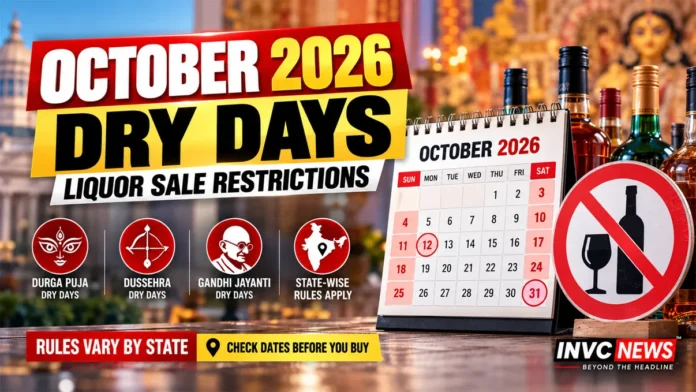
For Delhi, three dates deserve particular attention this month: October 2, October 20 and October 26.
Elsewhere, the applicable dates can differ. That means travelers and people organizing events should check the latest notification issued by the relevant state or Union Territory excise authority before making plans.
THE 60-SECOND BRIEF
October 2, Friday — Gandhi Jayanti
The month’s most important and widely observed dry day.
October 20, Tuesday — Dussehra/Vijayadashami
Dry-day restrictions apply in several jurisdictions, subject to state excise rules.
October 26, Monday — Maharishi Valmiki Jayanti
An important date for Delhi and certain other jurisdictions, depending on local notification.
Additional dry days can be announced locally, particularly around elections or through state-specific excise orders.
The key takeaway: Do not assume that every date circulating in an all-India dry-day list applies to your city.
October 2: Gandhi Jayanti Is the Date Everyone Should Remember
The first major dry day of October arrives immediately.
Friday, October 2, 2026, marks Gandhi Jayanti, one of India’s most widely observed dry days.
For consumers, this generally means licensed retail liquor outlets covered by the applicable excise rules cannot sell alcohol during the notified period.
Bars, restaurants, clubs and hotels may also face restrictions, although the exact rules can depend on the state, type of establishment and liquor license.
In Delhi, Gandhi Jayanti is one of the established dry days under the excise framework.
For anyone planning a Friday night gathering or an event that weekend, this is therefore the first date worth checking.
October 20: Dussehra Could Affect Your Festive Plans
The second major date falls during the heart of the festive season.
Dussehra, or Vijayadashami, falls on Tuesday, October 20, 2026.
The festival is associated with dry-day restrictions in several parts of India, but its application should not automatically be treated as identical nationwide.
This distinction matters for travelers.
Someone visiting another state during the Dussehra holidays should not assume that the rules at the destination are identical to those in their home city.
For Delhi, October 20 is a key date to keep on the dry-day calendar.
October 26: Maharishi Valmiki Jayanti
The third important October date for Delhi is Monday, October 26, when Maharishi Valmiki Jayanti is observed.
This date deserves special attention because inaccurate 2026 dry-day calendars circulating online can create confusion over the festival date.
For planning purposes, Delhi residents should keep October 26 on their calendar and check the applicable excise notification before purchasing or serving alcohol commercially.
Because October 26 falls on a Monday, it also comes immediately after the October 24-25 weekend.
That could matter for anyone scheduling an event around the final weekend of the month.
October 2026 Dry Days: Dates to Watch
October 2, Friday
Occasion: Gandhi Jayanti
Status: Major dry day; widely observed
October 20, Tuesday
Occasion: Dussehra/Vijayadashami
Status: Applies under the relevant state/local excise rules; a key dry day in Delhi
October 26, Monday
Occasion: Maharishi Valmiki Jayanti
Status: Important dry-day date in Delhi and potentially other jurisdictions, subject to local rules
Does a Dry Day Mean Drinking Alcohol Is Illegal?
Not necessarily.
This is one of the most commonly misunderstood parts of dry-day rules.
A dry day primarily concerns the sale and commercial service of alcohol under the applicable excise notification.
It does not automatically mean that every form of private possession or consumption becomes illegal.
However, state excise laws vary considerably, and restrictions can differ depending on location, venue, license type and the specific government order.
The safest interpretation is therefore simple:
A dry day is primarily a sales and service restriction, not a universal nationwide prohibition on all private consumption.
Will Bars, Pubs and Restaurants Also Stop Serving Alcohol?
They can.
Dry-day orders can apply not only to retail liquor stores but also to licensed bars, pubs, clubs and restaurants.
However, the scope is not always identical for every type of license.
Delhi’s excise rules illustrate why this distinction matters. Government dry-day orders specify the categories of liquor licenses affected and can contain particular exceptions. For example, certain hotel license categories may operate under different conditions for service to resident guests.
So a claim such as “every hotel bar in India will be closed” would be too broad.
Customers should check directly with the venue if alcohol service is an important part of their reservation or event.
Can You Buy Alcohol Online on a Dry Day?
Do not assume online ordering bypasses a dry-day restriction.
Where online alcohol delivery is legally available, the service still operates within the relevant state excise framework.
If retail sale is prohibited under the applicable dry-day order, switching from a physical store to an app does not automatically make the transaction permissible.
Availability also varies significantly because alcohol regulation is largely state-specific in India.
Why Dry-Day Lists Differ From One Website to Another
There is a simple reason: alcohol regulation is not governed by one uniform retail calendar for the entire country.
States and Union Territories administer their own excise regimes.
Some dates are widely observed. Others apply only in particular states, cities or districts.
Authorities can also announce additional dry days for elections and other circumstances.
That is why an article claiming that every liquor store across India will close on exactly the same set of festival dates can be misleading.
The local government notification should take precedence over a generic national calendar.
Election Dry Days Can Be Added Separately
Festival dates are not the only reason liquor sales can be restricted.
Election authorities and local administrations can impose additional dry periods around polling.
Such restrictions may cover the constituency, district or other notified area and can sometimes begin before polling day rather than only on the day voting takes place.
These election-related restrictions are not necessarily part of an annual festival dry-day calendar.
Anyone organizing a large event during an election period should therefore check for a fresh local order even if the date does not appear on the standard annual list.
Delhi, Mumbai, Bengaluru or Another City? Check Locally
This is the most useful rule for readers.
If you are in Delhi, October 2, October 20 and October 26 are the three dates that deserve particular attention.
If you are in Mumbai, Bengaluru, Chennai, Kolkata, Goa, Gurugram, Noida or another city, do not automatically copy Delhi’s calendar.
State-specific excise rules can produce different outcomes.
The same festival can be a dry day in one jurisdiction and not result in identical restrictions somewhere else.
What About States With Broader Alcohol Prohibition?
A dry-day calendar has limited relevance in jurisdictions where alcohol is already subject to much broader prohibition.
Consumers should therefore distinguish between a temporary dry day and a state’s regular prohibition regime.
The legal position can also contain permit systems, exemptions or other specific rules, so travelers should check the law applicable at their destination rather than relying on rules from their home state.
Planning a Party? Check These Three Things First
Before booking an October party, wedding function, corporate event or restaurant dinner where alcohol service matters, verify:
The date — Is it a notified dry day?
The location — Which state’s or Union Territory’s excise rules apply?
The venue’s license — Does the dry-day order cover that particular establishment and service?
Those three checks are far more reliable than simply searching for a generic “India dry days” list.
INVC NEWS Bottom Line
October 2026 dry days are not one-size-fits-all.
Gandhi Jayanti on October 2 is the month’s most important widely observed dry day. Dussehra on October 20 can bring additional restrictions, while October 26, Maharishi Valmiki Jayanti, is another important date for Delhi.
But the real takeaway is bigger than those three dates.
If alcohol service matters to your party, dinner, wedding or travel plan, check the rule for your specific city before you leave home. A dry-day calendar copied from another state may not tell you what actually applies where you are.