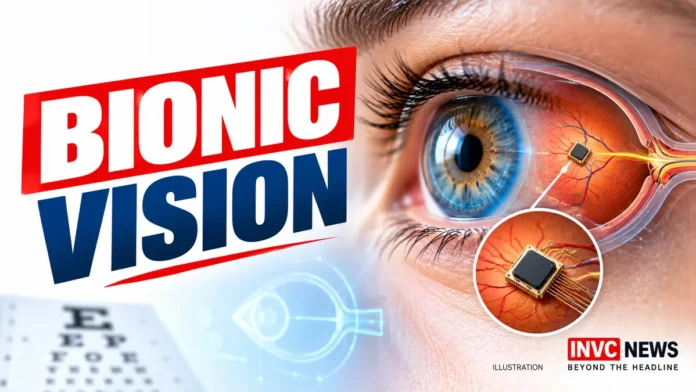
By Team INVC | INVC NEWS
NEW DELHI, India | October 2, 2026 — Recognizing a light or an object’s outline could make a meaningful difference to someone living with profound sight loss. That possibility drives bionic eye research, which uses electronic implants to create visual signals. However, a claim that Chennai surgeons have performed India’s first successful implant in a 35-year-old patient remains unverified. The distinction matters for families seeking treatment: evidence of progress in artificial vision does not establish that a particular procedure is available, suitable or capable of restoring natural sight.
INVC NEWS | BEYOND THE HEADLINE
THE 60-SECOND BRIEF
- Some retinal implants can produce artificial visual signals in carefully selected patients.
- Outcomes depend on the device, the underlying eye condition and the remaining visual pathway.
- A retinal chip implant differs from a whole-eye transplant.
- INVC NEWS could not independently confirm the described Chennai case or its claimed national-first status.
- Families should seek a specialist assessment and documented information about eligibility, outcomes and follow-up care.
What Is a Bionic Eye?
“Bionic eye” is a broad term for technology that stimulates parts of the visual system to produce visual perception.
In retinal implant systems, an electronic device works with remaining retinal nerve cells. Some designs also require camera-equipped glasses and an external processor.
The U.S. National Eye Institute’s description of the Argus II system offers one documented example. A glasses-mounted camera captures images, a processor converts them into signals, and an implanted electrode array stimulates the retina.
Users perceive patterns of light that can provide visual information.
However, that historical example should not serve as confirmation of current treatment availability in India. Different devices also have different designs and clinical requirements.
Why “Transplant” Can Create the Wrong Expectation
A chip implanted in or near the retina does not replace the entire eye.
Therefore, describing every bionic implant as an “eye transplant” can leave readers with an inaccurate picture of the operation.
The more precise wording depends on the device: retinal implant, retinal prosthesis or electronic visual implant.
This distinction also helps explain the treatment’s purpose. An implant aims to generate useful signals through an existing biological pathway. It does not simply exchange an eye with sight loss for a normally functioning one.
Light Detection Is Different From Natural Vision
Detecting light, identifying a shape and reading text represent different outcomes.
Consequently, a report that a patient recognizes basic forms should not imply that the person can recognize faces, read ordinary print or navigate independently.
Researchers must measure those abilities separately.
Moreover, the experience of artificial vision varies across technologies. Moorfields Eye Hospital describes the PRIMA system as combining a wireless retinal implant, specialized glasses and a processor to generate artificial visual perception.
That explanation demonstrates why the chip alone does not tell the full story. External equipment, the condition of the eye and the patient’s ability to use the system all matter.
What Would Confirm the Chennai Claim?
A credible account of the proposed Indian breakthrough needs more than a patient’s age and a description of improved vision.
The essential details include the institution, surgical team, operation date, device name and diagnosis responsible for the patient’s sight loss.
The report should also explain how clinicians measured the outcome and how long they followed the patient.
Finally, “India’s first” requires a clearly defined benchmark. The first use of a particular device, the first trial procedure and the first commercial implantation are different claims.
Without those details, readers cannot assess the significance of the reported achievement.
Why Eligibility Requires an Individual Assessment
Sight loss has many causes. A retinal implant designed for one condition cannot automatically address another.
For example, the National Eye Institute’s Argus II account concerns retinitis pigmentosa. Moorfields’ PRIMA research concerns geographic atrophy associated with dry age-related macular degeneration.
Those examples involve different clinical settings. Neither establishes that every person with profound sight loss could benefit from the same intervention.
A specialist must assess the diagnosis and whether the relevant parts of the visual pathway can support the proposed technology.
Questions Families Should Ask Before Considering an Implant
- What device would clinicians use, and what evidence supports it?
- Does the patient’s diagnosis match the conditions studied?
- Is the procedure part of a clinical trial or an authorized treatment offering?
- What improvement is realistic, and how will clinicians measure it?
- What surgical risks, rehabilitation needs and follow-up commitments apply?
- Who will provide long-term device support?
Written answers help families compare a treatment’s documented potential with the expectations created by a headline.
INVC NEWS Bottom Line
Bionic eye research offers a real route toward useful artificial vision for some patients. However, the described Chennai operation and its “India’s first” status still require confirmation. The strongest breakthrough story will identify the device, explain the evidence and describe exactly what changed for the patient—without turning limited visual improvement into a promise of normal sight.