New Delhi, August 19, 2026
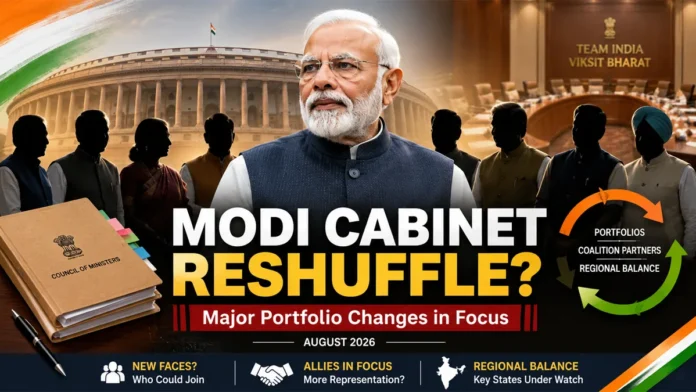
Modi Cabinet Reshuffle 2026 speculation is gaining momentum in political circles, with the possibility of changes in ministerial responsibilities, greater representation for allies and adjustments aimed at regional and social balance ahead of a crucial phase in the government’s third term. However, no official announcement confirming a Cabinet reshuffle or its timing had been issued by the Prime Minister’s Office as of Wednesday.
Political discussions surrounding a possible restructuring have intensified following changes within the Bharatiya Janata Party’s organizational setup. The speculation centers on whether Prime Minister Narendra Modi could use a ministerial exercise to redistribute responsibilities, bring new faces into the government and strengthen representation from politically significant states.
Reports and political discussions have suggested that the portfolios of a sizable number of ministers could come under review. Some ministers holding demanding responsibilities could see their workload reduced, while others may receive additional or more politically significant assignments.
There is also speculation that some leaders could move between government and party organization as the BJP prepares for upcoming state elections and the remaining years of the Modi government’s current term.
For now, however, these possibilities remain unconfirmed.
No Official Confirmation of Modi Cabinet Reshuffle Yet
The most important distinction is between political speculation and an announced government decision.
As of August 19, the Prime Minister’s official website had not announced a new Council of Ministers or a Cabinet reshuffle. The existing official portfolio list continues to identify the current members of the Union Council of Ministers and their responsibilities.
Any final decision on induction, removal or reassignment of ministers would become authoritative only after an official communication from the government or Rashtrapati Bhavan.
Still, the growing political focus on the composition of the Council of Ministers has raised questions about which leaders could gain or lose responsibilities if Prime Minister Modi eventually undertakes a restructuring.
Piyush Goyal’s Role Draws Attention
Commerce and Industry Minister Piyush Goyal is among the senior BJP figures whose responsibilities are attracting attention.
The BJP currently lists Goyal in its national organizational structure, while he also continues to serve as Union Minister of Commerce and Industry. Official government records continue to identify him in that Cabinet position.
His government portfolio is particularly significant because the Commerce Ministry is central to India’s trade negotiations, export strategy and engagement with major economic partners.
That makes any potential change involving Goyal consequential not only politically but also economically.
There is no official indication, however, that he is about to leave the Commerce and Industry Ministry.
Dharmendra Pradhan Remains Education Minister
Political speculation surrounding Dharmendra Pradhan requires particular caution.
Contrary to claims that he has resigned as Education Minister, official government records continue to list Pradhan as the Union Minister of Education.
A PMO update available in August 2026 also identifies him as Education Minister, while the government’s Council of Ministers information continues to carry the same designation.
Therefore, reports presenting his resignation from the Education Ministry as an established fact would be inaccurate on the basis of currently available official information.
If a reshuffle takes place, Pradhan’s future assignment could naturally become part of the broader political discussion, but no change should be treated as confirmed before an official announcement.
Hardeep Singh Puri’s Position Also Under Watch
Petroleum and Natural Gas Minister Hardeep Singh Puri is another senior minister whose position has figured in reshuffle speculation.
Official records currently identify Puri as the Union Minister for Petroleum and Natural Gas. He has remained an important face of the government on energy policy, fuel supplies and India’s engagement with global energy producers.
Questions surrounding parliamentary terms and future political assignments can often trigger speculation ahead of a reshuffle, but ministerial exits cannot be assumed solely on that basis.
Any decision involving Puri would also attract attention because of representation considerations within the Union Cabinet.
Could More Women Join the Union Council of Ministers?
Another issue being discussed is whether a future reshuffle could increase women’s representation in the government.
The existing Cabinet includes women in senior ministerial responsibilities, but expanding their representation could allow the BJP to address both governance and political considerations ahead of major electoral contests.
Names from Rajasthan and other states have surfaced in political discussions, although no official shortlist has been released.
Any induction would ultimately depend on the Prime Minister’s assessment of administrative requirements, parliamentary representation, regional balance and the BJP-led coalition’s political strategy.
South India Could Become an Important Factor
Southern representation could also influence any future Cabinet exercise.
The BJP has spent considerable political capital expanding its presence across Tamil Nadu, Kerala, Telangana, Andhra Pradesh and Karnataka.
A reshuffle could therefore be used to adjust representation from southern India, particularly if the party leadership believes additional ministerial visibility could strengthen its political outreach.
However, claims about specific parties or individuals entering the government remain speculative unless formally confirmed.
Could DMK Join the Modi Government?
One of the most politically striking claims circulating around the reshuffle discussion is that Tamil Nadu’s DMK could receive representation in the Union government.
At present, there is no official confirmation from the Prime Minister’s Office establishing that DMK is joining the Union Council of Ministers.
No such development should therefore be presented as settled or imminent.
A move of that magnitude would represent a major change in national political alignments and would require clear confirmation from the parties concerned.
Until that happens, the possibility should be treated strictly as political speculation rather than an expected Cabinet decision.
NDA Allies Could Seek Greater Representation
The demands of coalition partners are likely to be an important consideration whenever Prime Minister Modi decides to alter his Council of Ministers.
The BJP does not operate in isolation at the Centre, and the National Democratic Alliance includes several regional parties whose parliamentary strength gives them influence in coalition management.
Chirag Paswan, president of the Lok Janshakti Party (Ram Vilas), currently serves as Union Minister of Food Processing Industries. The official government portfolio list confirms his current responsibility.
Whether he or his party receives a different or expanded role would depend on negotiations within the NDA.
Similarly, Maharashtra’s coalition arithmetic could become relevant if the Union Council of Ministers is expanded.
Maharashtra Equation Could Matter
Maharashtra remains politically important to the BJP-led alliance, with competing regional formations and multiple coalition partners influencing the balance of power.
Any Cabinet reshuffle could provide the government an opportunity to reassess representation from the state.
The Shiv Sena led by Eknath Shinde and other NDA partners could seek greater representation if ministerial berths are expanded.
At the same time, decisions at the Centre would need to be balanced against political arrangements within Maharashtra.
The Prime Minister and senior BJP leadership traditionally weigh parliamentary numbers, regional influence and coalition stability while allocating Cabinet positions.
Uttar Pradesh Likely to Remain Central to Political Calculations
With the 2027 Uttar Pradesh Assembly election approaching, the country’s most populous state could become one of the most important factors in any ministerial restructuring.
The BJP will be particularly conscious of caste representation, regional equations and organizational requirements in Uttar Pradesh.
Deputy Chief Ministers Keshav Prasad Maurya and Brajesh Pathak are among the state’s most prominent BJP leaders, and political discussions have periodically centered on whether senior figures from Uttar Pradesh could be shifted between state and national responsibilities.
No official announcement indicates that either leader is moving to the Union government.
Nevertheless, bringing a major Uttar Pradesh leader to Delhi could potentially trigger wider changes in the state’s political structure, making such a decision more complex than a routine ministerial induction.
Keshav Prasad Maurya Factor
Keshav Prasad Maurya remains an important OBC face of the BJP in Uttar Pradesh.
His political positioning means that any decision involving him would be viewed through the lens of the BJP’s broader social coalition ahead of the 2027 election.
If the central leadership were to assign him a national responsibility, the move could require corresponding changes within the Uttar Pradesh government.
For that reason, speculation regarding Maurya needs to be evaluated not only in terms of the Union Cabinet but also through its possible impact on state politics.
Brajesh Pathak Another Name in Political Discussions
Deputy Chief Minister Brajesh Pathak is another influential figure who could feature in discussions about the BJP’s future political structure.
Pathak has developed a significant political profile in Uttar Pradesh and represents a different social and organizational equation from Maurya.
Whether either leader is considered for a central assignment will ultimately depend on the BJP leadership’s strategy for the 2027 state election.
At present, neither move has been officially confirmed.
What About Anurag Thakur?
Former Union minister Anurag Thakur remains one of the BJP’s nationally recognizable leaders from Himachal Pradesh.
His experience in the Union government and his political profile ensure that his name can surface whenever Cabinet expansion or restructuring is discussed.
Representation from Himachal Pradesh and the party’s electoral calculations in the hill state could influence future decisions.
However, there is no official confirmation that Thakur is being inducted into the Cabinet.
JP Nadda’s Role Adds Another Dimension
The presence of senior BJP leader J.P. Nadda in national politics also adds another dimension to the Himachal equation.
When ministerial and organizational structures are revised, the BJP typically considers not only individual leaders but also geographical distribution and the broader balance between government and organization.
This makes Himachal Pradesh another state worth watching if a reshuffle is formally announced.
Why a Cabinet Reshuffle Could Matter Politically
A Cabinet reshuffle is rarely limited to changing ministerial names.
It can reveal the government’s priorities for the next phase of its term.
Changes could indicate a stronger focus on economic reforms, infrastructure, trade, employment, welfare delivery or preparation for state elections.
They could also reveal how Prime Minister Modi intends to balance experience with new political representation.
Coalition management is another important consideration. Giving allies greater responsibility can reinforce political stability while also broadening ownership of the government’s agenda.
Regional and Social Balance Could Drive Decisions
Cabinet formation in India typically involves several overlapping considerations.
State representation, caste and community balance, parliamentary strength, administrative performance, coalition requirements, electoral strategy and experience can all influence appointments.
Consequently, even if a reshuffle eventually involves a large number of ministers, the changes are unlikely to be based on a single criterion.
The BJP’s organizational changes could also interact with the government exercise, particularly if senior leaders move between party and ministerial responsibilities.
What Happens Next?
For now, Modi Cabinet Reshuffle 2026 remains a subject of intense political speculation rather than an officially announced exercise.
The Prime Minister’s existing Council of Ministers continues to function under the portfolios currently listed by the government.
If a reshuffle is undertaken, attention will be focused on three questions: which ministers receive new portfolios, whether fresh faces enter the government, and how much additional representation NDA allies receive.
Any development involving a major opposition party such as the DMK would require especially strong official confirmation before being treated as a political realignment.
Until Rashtrapati Bhavan, the Prime Minister’s Office or the parties concerned formally announce changes, individual names and portfolio shifts should be regarded as possibilities rather than confirmed decisions.