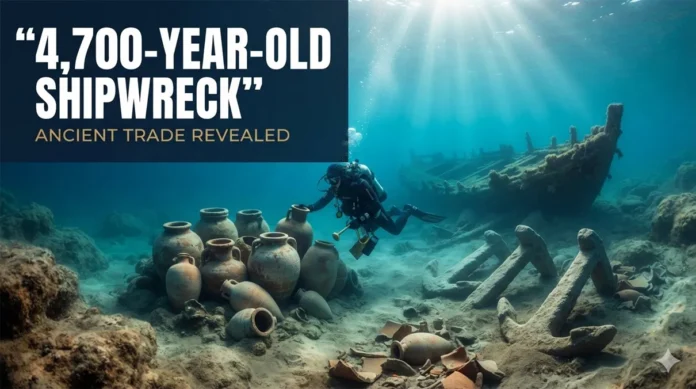
Archaeologists Recover More Than 30 Ceramic Jars and Three Stone Anchors Near Kekova Island in a Discovery That Could Rewrite Maritime History
ANTALYA, Türkiye | October 15, 2026 – Archaeologists have uncovered the remains of what may be the world’s oldest known shipwreck off the Mediterranean coast of Türkiye, revealing new evidence of maritime trade nearly 4,700 years ago. The discovery, made near Kekova Island in the southern province of Antalya, includes more than 30 ceramic storage jars and three large stone anchors preserved on the seabed.
The vessel is believed to date to the Early Bronze Age, placing it around the period when ancient Egypt’s monumental pyramids were being built. Although the ship’s wooden structure has deteriorated over thousands of years, its surviving cargo is offering researchers valuable clues about early seafaring, commercial exchange and the movement of goods across the eastern Mediterranean.
The discovery could also challenge the existing record for the oldest known shipwreck, previously associated with a site near Greece’s Dokos Island that dates back approximately 4,200 years.
What Archaeologists Found Beneath the Mediterranean
The wreck lies approximately 30 meters (98 feet) beneath the sea near Kekova Island, a region known for its archaeological and maritime heritage.
Researchers believe the vessel was a relatively small merchant ship, measuring around 10 meters (33 feet) in length. It may have been carrying commercial goods along one of the Mediterranean’s early trading routes when it sank.
The wooden hull has not survived, but the cargo remains scattered across the seabed. Divers recovered more than 30 large ceramic storage vessels, commonly known as amphorae, along with three substantial stone anchors.
These objects provide important evidence of the ship’s likely commercial purpose. Large ceramic containers were used in the ancient world to transport and store goods, including liquids and other valuable commodities.
Researchers believe the cargo may have included olive oil, wine or other trade products. Further examination of the vessels and any surviving residues could help narrow down what the ship was carrying and where its journey began.
A Shipwreck Dating Back to the Age of the Egyptian Pyramids
The estimated age of the wreck places it between approximately 4,400 and 4,700 years old, during the Early Bronze Age.
This was a period of growing social complexity and expanding commercial connections across the eastern Mediterranean and neighboring regions. Communities were exchanging raw materials, manufactured goods and agricultural products over increasingly extensive distances.
The comparison with Egypt’s pyramids provides a striking historical reference point. The Great Pyramid of Giza was constructed during Egypt’s Old Kingdom, roughly around the middle of the third millennium BCE.
If the dating of the Kekova wreck is confirmed at the upper end of the estimate, the vessel would offer a rare glimpse into seaborne commerce from a period for which relatively few shipwrecks have survived.
The age estimate is based on archaeological analysis of the recovered pottery and comparisons with similar vessels found at other ancient sites. It should therefore be understood as an archaeological assessment rather than a precise date for the ship’s final voyage.
What the Ceramic Jars Reveal About Ancient Trade
The shape and characteristics of the ceramic vessels are among the most important clues in the investigation.
Preliminary analysis suggests that the jars may have originated in workshops in the Jordan Valley, indicating a possible connection between the Levant and the Mediterranean coast of Anatolia, the historical region that forms much of modern Türkiye.
Similar pottery forms have been identified at archaeological sites in Egypt, Troy and Crete. These similarities suggest that communities across the region participated in interconnected networks of trade and cultural exchange.
If the proposed origins of the cargo are confirmed, the discovery could help researchers reconstruct how goods moved between the Levant and other Mediterranean societies during the Early Bronze Age.
The find also highlights the importance of studying everyday commercial objects. Unlike monumental buildings or royal inscriptions, storage vessels can provide direct evidence of what people transported, how goods were packaged and which communities may have been connected through trade.
One Unusual Vessel May Offer Clues About Life at Sea
Among the recovered objects, one ceramic vessel has attracted particular attention because of its distinctive markings and unusual design.
The jar reportedly features nine markings and two holes in its body. Researchers have suggested that it may have been used as a churn for making cheese or butter.
If that interpretation is correct, the vessel could offer an unusual glimpse into the practical challenges of long-distance sea travel in the ancient world.
Food preservation and access to fresh provisions would have been important considerations for crews undertaking extended voyages. The possibility that sailors processed dairy products aboard their vessels raises questions about how they stored food, managed supplies and adapted everyday domestic practices to life at sea.
However, the proposed use of the jar remains an interpretation that requires further investigation. Its markings, construction and any surviving residues may help researchers determine its original function more confidently.
How the Discovery Could Change Our Understanding of Maritime History
The Mediterranean connected some of the ancient world’s most influential communities. Ships carried agricultural products, raw materials and manufactured goods between coastal settlements, helping commercial networks develop long before modern navigation technology.
The Kekova discovery provides a rare opportunity to examine the material remains of one such voyage.
Even without a surviving wooden hull, the combination of ceramic cargo and stone anchors can help archaeologists investigate the vessel’s likely purpose and the commercial connections of the people who used it.
The findings may also help researchers understand the development of early maritime transport, including the types of cargo vessels carried and the routes that linked different parts of the eastern Mediterranean.
The wreck’s potential significance extends beyond its age. Its cargo may preserve evidence of economic relationships and everyday seafaring practices that are otherwise difficult to reconstruct from the archaeological record.
Why the Shipwreck Matters Today
Underwater archaeological sites can preserve objects that have disappeared from many land-based settlements. In this case, the surviving cargo offers a rare window into a trading voyage that ended thousands of years ago.
Further excavation and scientific analysis may establish more precisely when the ship sank, where its cargo originated and what it was carrying.
Researchers will also need to assess how the site can be documented and protected. Underwater remains can be vulnerable to disturbance, environmental changes and unauthorized recovery, making careful conservation essential.
For Türkiye, the discovery adds to the archaeological importance of the Antalya coastline and the wider Anatolian region, where centuries of maritime activity have left a complex record beneath the sea.
The bottom line: The shipwreck near Kekova Island may represent one of the earliest known examples of a seagoing merchant vessel preserved in the archaeological record. Its ceramic cargo and stone anchors are offering fresh clues about trade during the Early Bronze Age, although further research will be needed to establish the wreck’s precise age, route and place in the history of ancient seafaring.