SHANGHAI, China | September 28, 2026 —
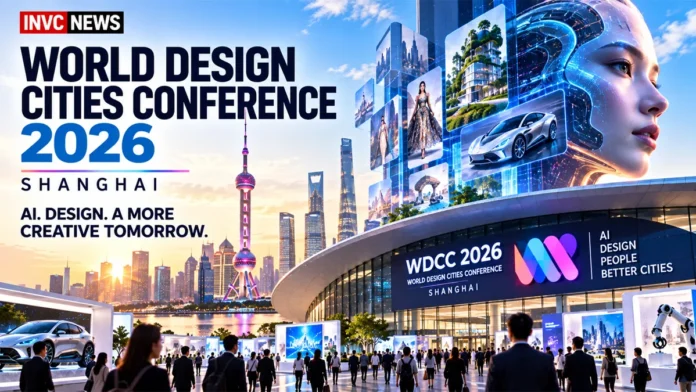
The World Design Cities Conference 2026 opened in Shanghai on Monday with a question that reaches far beyond architecture, fashion or technology:
What happens to human creativity when artificial intelligence can also design, imagine and create?
The fifth edition of the global design gathering is bringing together nearly 1,000 experts, scholars and industry leaders as Shanghai turns its attention to the rapidly changing relationship between artificial intelligence, creativity, technology and everyday life.
From AI-generated content and human-machine collaboration to smart vehicles, home robots, fashion, architecture and digital experiences, WDCC 2026 is positioning design not simply as a matter of appearance — but as a force that could reshape how people work, create, travel and live.
And that is precisely why this conference matters even if you are not a designer.
THE 60-SECOND BRIEF
The World Design Cities Conference 2026 runs in Shanghai from September 28 to 30.
The main venue is in Huangpu District.
Nearly 1,000 experts, scholars and industry leaders are expected to participate.
More than 100 events will examine artificial intelligence, sustainable design and innovation across industrial, fashion, architectural, digital and service design.
A 15,000-square-meter exhibition features more than 3,000 exhibits from nearly 500 brands.
AI is one of the defining themes, with dedicated discussions on human-machine collaboration, intelligent interactive design and AIGC-driven transformation.
The central question running through the event is becoming increasingly important:
Will AI simply become another tool for designers — or will it begin redefining what creativity itself means?
Shanghai Puts AI at the Center of the Design Conversation
For years, discussions about artificial intelligence focused heavily on computing power, software and automation.
WDCC 2026 takes the conversation somewhere different.
Into the creative process.
AI is increasingly capable of generating images, videos, product concepts, advertising, music, virtual environments and even early architectural ideas.
That means designers are no longer asking only how to use AI.
They are beginning to ask a more uncomfortable question:
What is left for humans when machines become increasingly capable of creating?
Several AI-focused forums at the conference are examining exactly that tension.
Subjects include the future of human-machine collaborative design, intelligent interaction and the transformation being driven by AI-generated content.
The Big Question: Is AI a Tool — or a Creative Partner?
There is a major difference between using AI to speed up work and allowing AI to participate in creative decision-making.
That distinction could shape the future of the creative economy.
A graphic designer can already generate dozens of visual concepts in seconds.
A filmmaker can use AI to help create scenes that previously required expensive production.
A fashion designer can explore colors, silhouettes and patterns almost instantly.
Architects can test design possibilities faster.
Brands can create personalized visual experiences at enormous scale.
But as those systems become more capable, the role of the human designer begins to change.
The creator may increasingly become a director, editor and decision-maker rather than the person manually producing every element.
That shift is one of the most important ideas hanging over WDCC 2026.
More Than 3,000 Exhibits Show What the Future Could Look Like
The scale of the conference makes the discussion tangible.
The main exhibition spans around 15,000 square meters and brings together more than 3,000 exhibits from nearly 500 brands.
Visitors can see products ranging from smart vehicles and home robots to AI-powered devices.
The goal is not simply to display futuristic technology.
It is to show how technology and design are beginning to merge.
A robot is not only an engineering challenge.
It also needs to understand human movement, physical spaces and interaction.
A smart vehicle is not only a transportation machine.
Its software, interface, interior, safety systems and user experience all depend on design.
AI devices face the same challenge.
Technology may provide the intelligence.
Design determines whether people actually want to live with it.
AI Could Change Who Gets to Be Creative
One of the most disruptive possibilities is that AI could dramatically lower the technical barrier to creation.
A person who cannot professionally draw may be able to visualize an idea.
Someone without traditional filmmaking resources may create sophisticated video.
A small company could potentially produce marketing material that once required a much larger creative team.
That democratization could unleash a new wave of creativity.
But it creates another problem.
If everyone can generate professional-looking content almost instantly, how does truly original work stand out?
The value of creativity may increasingly shift away from technical execution and toward ideas, taste, judgment and originality.
The future creative advantage may not belong to the person who can generate the most.
It may belong to the person who knows what is worth generating in the first place.
Human-Machine Collaboration Moves From Theory to Reality
WDCC 2026 is also examining a concept that could become central to future workplaces: human-machine collaboration.
The debate is often framed as humans versus AI.
The real future may be far less dramatic — and far more complicated.
AI can generate options.
Humans can judge context.
AI can analyze large amounts of information.
Humans can interpret meaning.
AI can replicate patterns at extraordinary speed.
Humans can decide whether the result is useful, ethical or emotionally appropriate.
That relationship could transform professions far beyond traditional design.
Advertising, entertainment, product development, architecture, media and education could all be affected.
Fashion Is Entering the AI Era Too
Shanghai is also using the conference to connect artificial intelligence with one of its most visible creative industries: fashion.
AI can already assist with trend analysis, visual experimentation, virtual clothing, supply-chain decisions and personalized shopping experiences.
But fashion also demonstrates the limits of purely technological thinking.
Clothing involves culture.
Identity.
Emotion.
History.
Personal expression.
An algorithm may generate thousands of designs.
But determining which one becomes culturally meaningful remains a much more complicated challenge.
That tension between machine capability and human meaning is likely to become one of the defining debates of the creative industries.
The Conference Is Bigger Than AI
Artificial intelligence may dominate attention, but WDCC 2026 reaches much further.
Events cover five major design fields:
industrial design, fashion design, architectural design, digital design and service design.
Sustainable and green design also feature prominently.
That matters because the next generation of products and cities will need to solve two challenges simultaneously.
They must become smarter.
But they must also become more sustainable.
A technologically advanced product that consumes excessive resources may not represent good future design.
Likewise, a beautiful city that cannot adapt to environmental pressures is not truly future-ready.
This is where technology, sustainability and design increasingly intersect.
Why Shanghai Wants to Lead This Conversation
Shanghai has been part of UNESCO’s Creative Cities Network since 2010 and has spent years positioning itself as an international center for design, fashion, technology and consumption.
WDCC gives the city a platform to bring those industries together.
That is strategically important.
The global AI race is often described as a competition over chips, models and computing capacity.
But there is another race developing underneath it:
Who can turn AI technology into products and experiences people actually want?
That is ultimately a design challenge.
The countries and companies that solve it could capture enormous economic value.
Nearly 500 Brands — But This Is Also About Young Designers
The exhibition includes international companies, established brands and emerging creative businesses.
However, WDCC also gives visibility to younger designers through programs such as the U35 Young Design Talent initiative.
That part of the conference may become increasingly important.
Young designers entering the industry today will work in an environment fundamentally different from the one their predecessors entered.
AI will not be an optional future technology for them.
It will already be part of the creative environment.
Their challenge will therefore not be simply learning how to use artificial intelligence.
It will be learning how to remain distinctive when everyone else has access to the same powerful tools.
Could AI Make Design More Human?
It sounds contradictory.
But one possibility is that greater automation could make distinctly human qualities more valuable.
If AI handles routine production, people may spend more time on storytelling, empathy, cultural understanding and conceptual thinking.
Those are difficult qualities to measure.
They are also difficult to automate completely.
That could ultimately change what companies look for in creative professionals.
Technical skill will still matter.
But judgment may matter more.
Taste may matter more.
The ability to ask the right question may matter more.
And originality could become more valuable precisely because imitation becomes easier.
The Risk: A World That Starts Looking the Same
There is also a less optimistic possibility.
Generative AI systems learn from enormous amounts of existing material.
If millions of people rely on similar systems and similar prompts, creative output could begin converging toward familiar patterns.
Images may become polished but predictable.
Advertising may become efficient but repetitive.
Design may become optimized but less surprising.
That creates another challenge for the AI era:
How do we use machines to expand human imagination without allowing machines to standardize it?
For designers, that may become the defining creative problem of the next decade.
What Visitors Can Expect at WDCC 2026
The conference runs through September 30, while the main exhibition opened to the public earlier on September 26.
Alongside exhibitions, WDCC includes major forums, fashion events, international design discussions, young-talent programs and more than 50 activities spread across Shanghai.
The event also includes conversations involving UNESCO-linked creative cities and international designers.
Admission to the main exhibition is free, although advance registration is required for exhibitions and forums.
THE BIGGER PICTURE
The World Design Cities Conference arrives at a moment when artificial intelligence is moving from experimental technology into everyday creative work.
The question is no longer whether designers will use AI.
Many already do.
The more important questions are now about how they use it, where human judgment remains essential and what happens when machines become capable of producing creative work at enormous scale.
Those questions will influence more than design studios.
They could shape advertising, movies, fashion, architecture, consumer technology and the future workplace itself.