By Team INVC | INVC NEWS
Published: August 29, 2026 | 9 : 05 AM IST
WASHINGTON, UNITED STATES | August 29, 2026 —
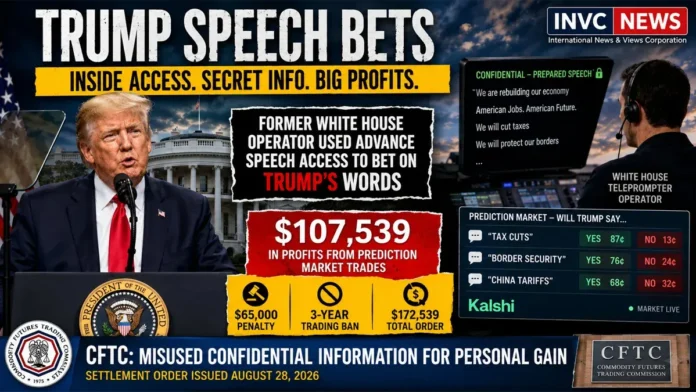
A White House prediction market insider trading case has exploded into one of the most unusual financial scandals surrounding President Donald Trump after a former teleprompter operator was ordered to pay $172,539 for using advance access to presidential speeches to place profitable bets on the very words Trump was expected to say.
Gabriel Perez worked as a White House teleprompter operator and, according to the U.S. Commodity Futures Trading Commission, had access to Trump’s prepared speeches before the president delivered them publicly.
Perez then used that confidential information to trade so-called presidential “mention market” contracts on prediction platform Kalshi.
These contracts pay depending on whether a president says a particular word or phrase during a speech.
In simple terms:
Perez knew what Trump was preparing to say—and regulators say he bet on it before everyone else knew.
The trades generated more than $107,500 in profits.
Now the CFTC has ordered him to give the money back, pay an additional civil penalty and stay out of trading for three years.
$107,539 Profit, $65,000 Fine, Three-Year Ban
The CFTC settlement requires Perez to:
- Return $107,539.02 in trading profits
- Pay a $65,000 civil monetary penalty
- Stop violating federal commodities rules
- Accept a three-year trading ban
Total financial payment:
$172,539.02
The regulator said Perez misappropriated “material, nonpublic information” obtained through his federal government employment.
The CFTC also said the $65,000 penalty was substantially reduced because Perez cooperated extensively with investigators.
How the Trump Speech Bets Worked
The trades were made between December 2025 and February 2026.
Perez traded contracts tied to Trump’s speeches on Kalshi.
Unlike a conventional stock trade, these contracts can revolve around very specific real-world events.
A presidential mention contract might effectively ask:
Will President Trump say a particular word or phrase during tonight’s speech?
If a trader already possesses the prepared speech, that trader has information ordinary market participants do not.
That is precisely the advantage the CFTC says Perez exploited.
As a teleprompter operator, Perez could see presidential speech material before Trump stepped before the cameras.
He then used that advance knowledge for his personal benefit, according to the regulator.
Why This Case Is So Unusual
Traditional insider-trading scandals usually involve:
- Company earnings
- Mergers and acquisitions
- Regulatory decisions
- Confidential corporate information
- Stock or options trading
This case involved something very different:
The words of the President of the United States.
Prediction markets have grown rapidly because they allow users to trade contracts linked to politics, elections, economic data, sporting events and other real-world outcomes.
But the Perez case demonstrates the obvious vulnerability created when someone with privileged government access can trade contracts directly tied to information they receive through their job.
Also Read – : Suspicious $580M Trades Before Trump’s Iran Post Trigger Insider Trading Concerns Across Global Markets
Kalshi Assisted the Investigation
KalshiEX cooperated with the CFTC investigation.
That point matters because prediction markets face growing scrutiny over whether they can detect and prevent people with inside information from exploiting event contracts.
The Perez enforcement action gives regulators a clear example of how existing commodities rules can be applied when confidential information is used for prediction-market trading.
Perez is no longer working for the federal government.
He had previously been placed on unpaid leave after questions about his trading became public.
White House Access Became a Trading Edge
What makes the story particularly striking is the simplicity of the alleged advantage.
Perez did not need hacked documents, secret recordings or complex market intelligence.
His job itself gave him early access.
A presidential speech has to be prepared and loaded before it appears on a teleprompter.
That information may include words, subjects and phrases that prediction-market traders are simultaneously attempting to forecast.
For an ordinary trader, the contract is a prediction.
For someone holding the prepared speech, it can become something very different.
That distinction lies at the heart of the CFTC action.
Prediction Markets Face a Bigger Problem
The case arrives at a difficult moment for prediction-market platforms.
Kalshi and rival platforms have rapidly expanded the types of contracts available to users.
The industry argues that event markets can help measure public expectations about elections, policy changes and economic events.
Critics counter that some contracts increasingly resemble gambling and could create strong incentives for people with privileged information to trade against ordinary participants.
The Perez case now gives those concerns a concrete enforcement example.
If political staffers, government contractors, corporate employees or other insiders possess advance knowledge about an event, the integrity of the market depends on preventing them from using it.
Could More Government Insiders Face Scrutiny?
The enforcement action also creates a warning for anyone working around confidential government information.
The lesson is straightforward:
Access to unpublished government information cannot be turned into a private prediction-market advantage.
The CFTC has already shown that it is willing to treat event contracts as regulated financial instruments and pursue people who misuse confidential information to trade them.
That could have implications far beyond presidential speeches.
Economic announcements, government contracts, regulatory decisions and other market-sensitive events could all create similar risks when insiders also have access to prediction platforms.
The Most Expensive Words Trump Never Knew Were Being Traded
For Perez, a job built around displaying Trump’s words before the president spoke them created an extraordinarily profitable opportunity.
It also created the evidence regulators needed.
The result:
$107,539 in profits surrendered.
$65,000 additional penalty.
Three years banned from trading.
And one of the clearest warnings yet that prediction markets may be entering an era in which insider trading is no longer merely a theoretical concern.
The strange irony of the case is difficult to miss:
Thousands of traders were trying to guess what Donald Trump would say next.
One of the people placing bets already had the speech.