NEW DELHI — August 15, 2026
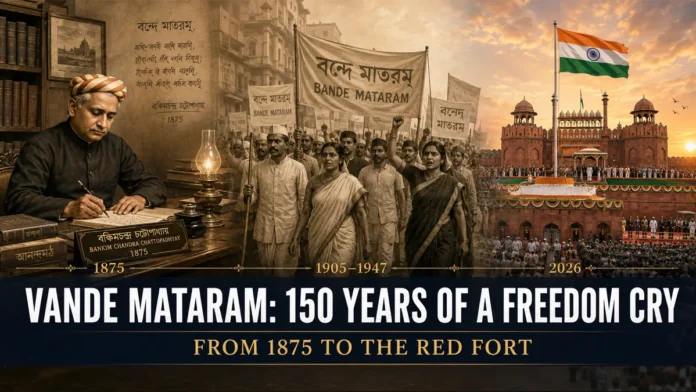
Vande Mataram history spans 150 years—from a Bengali literary composition to one of the most powerful rallying cries of India’s independence movement and, eventually, the country’s national song.
Written by Bankim Chandra Chattopadhyay in 1875, the composition moved beyond literature as India’s anti-colonial struggle gathered momentum. Protesters sang it in processions, students chanted it at political gatherings, and freedom fighters invoked its opening words while challenging British rule.
Following independence, Vande Mataram was accorded a place of national honor distinct from—but historically connected to—India’s national anthem, Jana Gana Mana. Yet only its first two verses were commonly performed at official and political events for decades because later portions contained religious imagery that had generated objections.
That established practice changed significantly during the song’s 150th-anniversary commemorations. The government introduced an official six-verse rendition lasting approximately three minutes and 10 seconds, and Akashvani began broadcasting the complete version in March 2026.
Its inclusion in the 2026 Independence Day ceremony has now placed the entire composition—and the debate surrounding its history—back in the national spotlight.
When was Vande Mataram written?
Bankim Chandra Chattopadhyay, one of Bengal’s most influential novelists and intellectuals, wrote Vande Mataram on November 7, 1875, according to the government’s official anniversary record.
The song appeared in the literary journal Bangadarshan and was subsequently incorporated into Bankim Chandra’s novel Anandamath, published in book form in 1882. The government’s Rashtraparv portal records November 7, 1875, as the composition date.
“Vande Mataram” can be translated simply as “Mother, I bow to you” or “I salute you, Mother.” In the composition, the mother represents the motherland.
The opening verses describe a land blessed with water, crops, cooling winds, greenery and natural beauty. Later verses present the motherland through images of strength, prosperity, wisdom and divine power.
In Anandamath, the song appears within a story centered on a group of ascetics known as the Santans, who dedicate themselves to their homeland. Its literary setting helped transform the motherland from a geographical territory into an emotional and moral symbol.
How did the song enter India’s political movement?
Vande Mataram gained national political visibility in 1896, when Rabindranath Tagore performed it at the Indian National Congress session in Calcutta.
The moment took the composition beyond the literary world and placed it before an emerging national political audience. Its first two verses subsequently became a regular feature at Congress gatherings, according to the government’s Azadi Ka Amrit Mahotsav record.
The song’s language and imagery allowed people to connect patriotism with an intimate idea: the country as a mother deserving love, service and sacrifice.
How the 1905 Bengal partition turned it into a freedom cry
The partition of Bengal in 1905 proved to be a decisive moment in the evolution of Vande Mataram.
The British administration’s decision to divide Bengal triggered widespread protests, marches and campaigns urging Indians to reject foreign products and support locally produced goods.
On August 7, 1905, thousands of people gathered in Calcutta during a major anti-partition mobilization. Vande Mataram was sung and chanted as protesters backed the boycott of foreign goods and the broader Swadeshi movement.
The phrase was no longer only part of a song. It had become a political slogan.
Later that year, the Congress session in Banaras further strengthened its position within the national movement. The words soon appeared on banners, pamphlets and flags and were heard at gatherings far beyond Bengal.
The Vande Mataram Sampradaya
In October 1905, activists in north Calcutta formed an organization known as the Vande Mataram Sampradaya.
Its members organized morning processions, sang the song in public and collected voluntary contributions for nationalist activities. Rabindranath Tagore was reportedly associated with some of these processions.
The movement demonstrated how the song had moved from novels and elite political meetings into streets, neighborhoods and everyday public life.
Why did British authorities try to suppress it?
Colonial officials recognized that Vande Mataram was helping unite protesters. Restrictions were consequently imposed on its performance and public chanting in several areas.
In November 1905, approximately 200 students at a school in Rangpur were reportedly fined five rupees each for chanting it. Orders restricting the song were also issued in educational institutions in parts of eastern Bengal.
The attempts at suppression often produced the opposite result. Each prohibition reinforced the song’s image as an act of defiance against colonial authority.
What happened at Barisal in 1906?
The confrontation became particularly visible during the Bengal Provincial Conference at Barisal in April 1906.
British officials prohibited public chanting of Vande Mataram and attempted to restrict the gathering. Delegates continued raising the slogan and faced police action.
On May 20, more than 10,000 people reportedly participated in a procession in Barisal carrying Vande Mataram flags. Hindus and Muslims joined the demonstration, reflecting the song’s ability—particularly during the early Swadeshi period—to mobilize people across communities.
How the slogan spread beyond Bengal
Vande Mataram soon traveled to other regions of India.
Young protesters raised the slogan in Lahore in 1907. It was heard during labor unrest in Tuticorin, now Thoothukudi, in 1908. Crowds in Bombay also sang it while supporting Bal Gangadhar Tilak during his prosecution by the colonial government.
Its expanding geographical reach showed that the song had become part of a broader vocabulary of resistance. It represented Swadeshi, self-respect, opposition to colonial rule and the demand for national freedom.
Why did the full song become controversial?
The first two verses focus primarily on the natural beauty and abundance of the motherland. They describe fertile fields, water, greenery, flowers and gentle winds.
The later verses employ religious imagery, including references associated with Durga, Lakshmi—also described as Kamala—and Saraswati or Vani. The country is portrayed not only as a mother but also through symbols of divine strength, prosperity and knowledge.
Some Muslim leaders and organizations objected to using those verses in a common national observance. Their concern was that religious imagery and the personification of the country as a deity might not be compatible with the beliefs of every community.
The debate became increasingly significant during the 1930s, when Congress leaders were attempting to maintain a broad and religiously diverse coalition against British rule.
What did the Congress decide in 1937?
In 1937, the Congress Working Committee examined the controversy and supported the use of the song’s first two verses at national gatherings.
Those verses were considered capable of standing independently and did not contain the religious references that had prompted objections to the later portions.
The decision was influenced by the need to protect the song’s historic place in the independence movement while addressing concerns about its suitability for people of different faiths.
The policy did not remove or rewrite the remaining verses. All six continued to exist as part of Bankim Chandra’s original composition. The decision concerned which portions would ordinarily be used at common national and political events.
For decades afterward, the shorter two-verse rendition became the version most Indians heard at public functions.
Why did Jana Gana Mana become the national anthem?
After India gained independence, the Constituent Assembly had to determine which compositions would represent the new republic.
On January 24, 1950, Constituent Assembly President Dr. Rajendra Prasad announced that Jana Gana Mana would be the national anthem. He added that Vande Mataram, because of its historic role in the freedom struggle, would be honored equally and possess equal status.
The announcement was made as a presidential statement rather than through a formal resolution of the Assembly. The Constituent Assembly record preserves Dr. Prasad’s statement and notes the applause that followed it.
The two compositions subsequently acquired distinct identities:
- National anthem: Jana Gana Mana
- National song: Vande Mataram
Jana Gana Mana became the anthem used for prescribed ceremonial purposes. Vande Mataram retained its special place as the song most closely associated with the emotional history of the freedom struggle.
Could Vande Mataram have become the national anthem?
Vande Mataram was a serious part of the national-symbol debate because of its enormous popularity during the independence movement.
However, concerns about the religious imagery in its later verses and the need for a composition acceptable across communities affected its prospects. The Constituent Assembly ultimately recognized Jana Gana Mana as the national anthem while ensuring that Vande Mataram’s historic contribution received national acknowledgment.
The result was not a declaration that one composition mattered and the other did not. Instead, the two were assigned different ceremonial roles.
What changed under the 2026 Vande Mataram protocol?
The Ministry of Home Affairs issued new official instructions on January 28, 2026, during the song’s 150th-anniversary year.
The protocol established that when Vande Mataram and Jana Gana Mana are both performed at the same event, the national song must come first, followed by the national anthem.
It also identified a complete six-verse rendition lasting approximately three minutes and 10 seconds as the official version for designated occasions. These include major state functions, flag-hoisting ceremonies and certain events attended by the president, governors and other constitutional authorities.
People attending an official rendition are expected to stand at attention. However, the protocol recognizes limited contextual exceptions, including instances in which the song forms part of a film, documentary or news presentation and requiring an audience to stand would interrupt the presentation.
The government’s public guidance describes the six-verse rendition as mandatory for specified official occasions and confirms the order in which the national song and anthem are to be performed. Official government guidance lists the rendition’s duration as three minutes and 10 seconds.
Akashvani begins broadcasting the complete version
Another major change came on March 26, 2026, when Akashvani replaced its long-used shorter rendition with the complete six-verse version during its morning transmission.
The broadcaster had traditionally used a rendition lasting approximately 65 seconds and containing the first two verses.
Prasar Bharati announced the change on March 25, with the new broadcast arrangement taking effect the following day. The official announcement is listed in Prasar Bharati’s press-release archive.
The move brought the entire composition to a national radio audience at a time when the government was organizing year-long commemorative programs.
What does the new national-honor law cover?
Parliament passed the Prevention of Insults to National Honour (Amendment) Bill, 2026, extending to the national song the statutory protection already applicable to the national anthem under Section 3 of the 1971 law.
The measure applies when someone intentionally prevents the singing of the national song or deliberately disturbs an assembly engaged in singing it. The punishment can extend to three years in prison, a fine or both.
The provision should not be inaccurately described as criminalizing every refusal to sing. Its stated focus is intentional prevention or disruption.
The legislation passed both Houses of Parliament, and the source material states that it subsequently received presidential assent. The legislative summary and bill text explain the scope of the amendment.
Why was the full version heard at the Red Fort?
The 2026 Independence Day ceremony coincided with the year-long commemoration of 150 years of Vande Mataram.
Under the revised protocol, the complete national song was placed before Jana Gana Mana in the ceremonial sequence. Its Red Fort rendition therefore represented the convergence of three developments: the anniversary campaign, the six-verse protocol and renewed statutory recognition.
The government’s year-long commemoration began on November 7, 2025, and runs until November 7, 2026. The inaugural program included nationwide mass singing of the complete composition, along with the release of a commemorative stamp and coin. The Prime Minister’s Office described the campaign as a tribute to a song that inspired India’s freedom movement.
What do the six verses contain?
The complete composition develops its image of the motherland in stages:
- The first two verses celebrate the country’s water, fields, greenery, flowers, moonlit nights and gentle winds.
- The following verses present the people as a source of collective strength and express devotion to the motherland.
- Later verses invoke Durga as strength, Kamala or Lakshmi as prosperity, and Vani or Saraswati as knowledge.
- The final portion returns to the beauty, dignity and sacred character of the motherland.
The religious imagery in the later verses is central to understanding both the composition’s original literary form and the controversy surrounding its use at official events.
The difference between 1937 and 2026
The contrast between the two years is straightforward.
In 1937, the Congress favored the first two verses for common national gatherings, primarily to retain broad acceptance across religious communities.
In 2026, the government established the entire six-verse composition as the official version for specified state occasions.
The four later verses are not new additions. They always formed part of the original composition. What has changed is the official protocol governing when and how the complete song is performed.
Vande Mataram timeline
- November 7, 1875: Bankim Chandra Chattopadhyay writes Vande Mataram.
- 1882: The composition appears in the published novel Anandamath.
- 1896: Rabindranath Tagore sings it at the Congress session in Calcutta.
- August 7, 1905: It emerges prominently as a political slogan during anti-partition protests.
- 1905: Vande Mataram becomes a defining expression of the Swadeshi movement.
- 1906: More than 10,000 people reportedly join a Vande Mataram procession in Barisal.
- 1937: The Congress Working Committee supports using the first two verses at national gatherings.
- January 24, 1950: Dr. Rajendra Prasad announces Jana Gana Mana as the national anthem and says Vande Mataram will receive equal honor and status.
- November 7, 2025: India begins a year-long commemoration marking 150 years of the composition.
- January 28, 2026: The Home Ministry issues an official protocol for the six-verse version.
- March 26, 2026: Akashvani begins broadcasting the complete three-minute-and-10-second rendition.
- August 15, 2026: The complete version becomes part of the Independence Day ceremonial sequence at the Red Fort.
Vande Mataram’s journey is therefore larger than the story of a patriotic composition. It is also the story of India’s freedom struggle, religious diversity, constitutional symbolism and continuing debate over how the country represents its shared national identity.