Dehradun | July 29, 2026
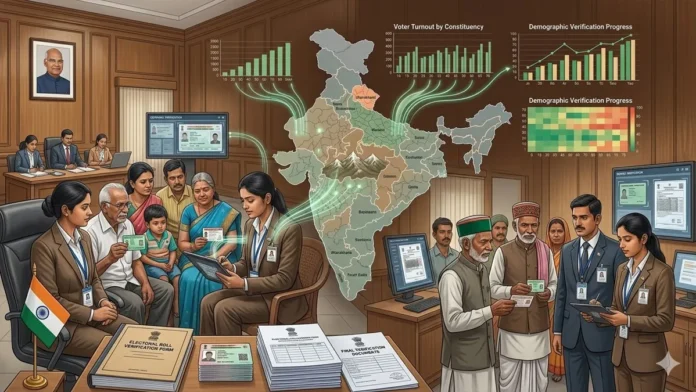
The Election Commission of India (ECI) has issued notices to 1.904 million (19.04 lakh) voters in Uttarakhand after discrepancies were detected during the state’s Special Intensive Revision (SIR) of the electoral rolls. The notices require voters to appear before the designated election authorities on the scheduled date with supporting documents to verify the information submitted in their SIR forms.
Election officials have warned that furnishing false information or submitting forged documents during the verification process could result in prosecution under the Bharatiya Nyaya Sanhita (BNS) and the Representation of the People Act, 1950.
The voter verification exercise is being conducted by the Election Commission of India (ECI) as part of its efforts to maintain accurate and updated electoral rolls ahead of future elections.
Why Were the Notices Issued?
According to election officials, the notices were sent to voters whose SIR application forms contained inconsistencies, including discrepancies relating to:
- Name
- Age
- Age of parents or relatives
- Other personal details submitted during voter verification
Each notice contains the voter’s EPIC (Elector Photo Identity Card) number, Assembly constituency, polling part number, serial number, residential address, and the specific reason why additional verification has been sought.
The notice also specifies the date, time, and venue where the voter must appear before the designated election authority with supporting documents.
False Information May Attract Criminal Action
The Election Commission has cautioned that voters found deliberately submitting false declarations or fabricated documents may face legal action under multiple laws.
Under Section 217 of the Bharatiya Nyaya Sanhita (BNS), knowingly providing false information to a public servant with the intention of causing wrongful action or harm is a punishable offence. Conviction may result in imprisonment for up to one year, a fine of up to ₹10,000, or both.
Officials have also cited Section 31 of the Representation of the People Act, 1950, which makes it an offence to knowingly submit false declarations for the inclusion, correction, or deletion of names in electoral rolls. Violations under this provision may also attract imprisonment of up to one year, a fine, or both.
The legal provisions governing electoral roll preparation and voter registration are available through the Election Commission of India (ECI) and the Ministry of Law and Justice.
Election Commission to Independently Verify Documents
Assistant Chief Electoral Officer Mastu Das said every document submitted by voters during the hearing process will undergo independent verification.
For example, if a voter submits a Class 10 certificate as proof of age, the Election Commission will verify the document directly with the concerned education board. Similar verification will be carried out for other supporting records submitted during the hearing.
If any document is found to be forged, fabricated, or misleading, the Commission may initiate legal proceedings under the applicable provisions of the Bharatiya Nyaya Sanhita and the Representation of the People Act, 1950.
What Voters Should Do
Election officials have advised recipients of the notices to:
- Attend the hearing on the scheduled date and time.
- Carry original supporting documents along with photocopies, wherever required.
- Ensure all declarations and documents submitted are accurate and authentic.
- Cooperate fully with the verification process to avoid delays or legal complications.
The Election Commission has emphasized that the Special Intensive Revision is intended to improve the accuracy of electoral rolls by identifying and correcting discrepancies while ensuring that only eligible voters remain registered.
Key Highlights
- The Election Commission has issued notices to 1.904 million (19.04 lakh) voters in Uttarakhand.
- Notices were issued after discrepancies were found during the Special Intensive Revision (SIR) of electoral rolls.
- Voters must appear before election authorities with supporting documents for verification.
- False declarations or forged documents may invite prosecution under Section 217 of the Bharatiya Nyaya Sanhita and Section 31 of the Representation of the People Act, 1950.
- Documents submitted during hearings will be independently verified with the issuing authorities.
- The verification exercise is part of the Election Commission’s effort to maintain accurate electoral rolls.