Washington, United States — August 20, 2026
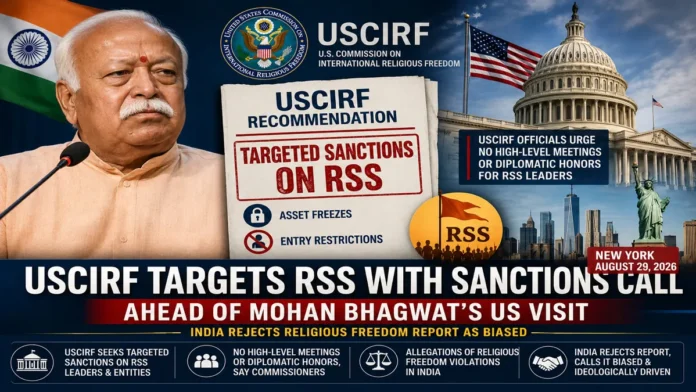
USCIRF RSS Sanctions calls have gained fresh attention ahead of Rashtriya Swayamsevak Sangh chief Mohan Bhagwat’s planned visit to the United States, with senior members of the U.S. Commission on International Religious Freedom urging Washington to avoid high-level official engagement with RSS leaders and focus instead on targeted penalties against individuals or entities found responsible for severe religious-freedom violations.
The development comes weeks after USCIRF’s 2026 Annual Report recommended targeted sanctions against individuals and entities including the Rashtriya Swayamsevak Sangh, or RSS, and India’s Research and Analysis Wing, or RAW. The commission said those measures could include asset freezes or restrictions on entry into the United States.
A key distinction is important: USCIRF has recommended targeted sanctions, not a blanket legal ban on the RSS in the United States. USCIRF is an independent, bipartisan U.S. government advisory commission whose recommendations are directed to the president, secretary of state and Congress; they do not automatically become U.S. government policy.
USCIRF Steps Up Pressure Before Mohan Bhagwat’s US Visit
USCIRF Chair Asif Mahmood has publicly raised concerns about the RSS ahead of Bhagwat’s expected visit to New York.
USCIRF’s official social-media account recently highlighted Mahmood’s remarks concerning the organization and Bhagwat’s planned U.S. trip. The commission has also reiterated its position that Washington should consider sanctions tied to serious violations of freedom of religion or belief.
Mahmood was elected USCIRF chair on July 20, 2026, after previously serving as vice chair. The commission is an independent federal legislative-branch entity created under the International Religious Freedom Act.
Commissioners Urge No High-Level Meetings or Diplomatic Honors
The latest debate centers not only on sanctions but also on how U.S. officials should engage with RSS leaders.
Commissioner Gene Mills, who joined USCIRF in July, has been identified among commissioners participating in the current discussion over religious freedom and India. USCIRF’s broader policy position calls for targeted measures against people or organizations it considers responsible for severe religious-freedom violations.
The thrust of the commissioners’ argument is that individuals associated with organizations accused by USCIRF of serious religious-freedom violations should not receive the type of diplomatic treatment normally associated with official government visitors.
However, these are recommendations from USCIRF commissioners, not an announced State Department decision.
What Did USCIRF’s 2026 Report Recommend on RSS?
USCIRF’s 2026 Annual Report went further than merely criticizing religious-freedom conditions in India.
In its recommendations to the U.S. government, the commission called for India to be designated a “Country of Particular Concern,” or CPC, under the International Religious Freedom Act.
It also recommended targeted sanctions on individuals and entities including RAW and the RSS, citing what the commission characterized as responsibility for or tolerance of severe religious-freedom violations.
The measures suggested by USCIRF include:
- freezing assets of targeted individuals or entities;
- barring their entry into the United States;
- linking future U.S. security assistance and trade policy with India to improvements in religious freedom; and
- increasing scrutiny of alleged transnational repression involving religious minorities.
These recommendations remain advisory unless acted upon separately by the U.S. administration.
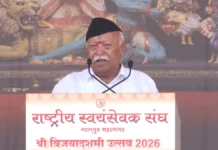
Mohan Bhagwat Expected in New York on August 29
Bhagwat is expected to address members of the Indian-American community in New York on August 29, 2026, during an event titled “Universal Oneness Celebrations.”
The event is being organized by American Hindus for Engagement and Dialogue and is expected to form part of the RSS’s wider centenary outreach in the United States.
The planned appearance has attracted heightened attention because it comes only months after USCIRF explicitly named the RSS in its annual policy recommendations.
Why Is Bhagwat’s Visit Politically Sensitive?
The controversy stems from sharply different assessments of the RSS.
USCIRF has linked the organization to broader concerns about religious freedom in India and has argued that Hindu nationalist organizations and affiliated networks have contributed to conditions affecting minority communities.
The RSS, its supporters and the Indian government have repeatedly rejected such portrayals, arguing that outside assessments often fail to reflect India’s constitutional system, social complexity and record of religious pluralism.
That divide has turned Bhagwat’s U.S. visit into more than a community event. It now sits at the intersection of religious-freedom advocacy, Indian domestic politics and the wider India-U.S. relationship.
India Has Rejected USCIRF’s 2026 Findings
India has formally rejected USCIRF’s latest assessment.
On March 16, 2026, India’s Ministry of External Affairs said it “categorically” rejected what it described as USCIRF’s motivated and biased characterization of India. New Delhi has consistently argued that USCIRF’s reports are selective and reflect ideological bias rather than an objective assessment of religious freedom in the country.
That official rejection is central to understanding the dispute.
USCIRF presents its recommendations as religious-freedom safeguards, while the Indian government considers the commission’s assessment fundamentally flawed and intrusive.
USCIRF Recommended India as a Country of Particular Concern
The 2026 report again recommended that the U.S. government designate India as a Country of Particular Concern for what USCIRF described as systematic, ongoing and egregious religious-freedom violations.
A USCIRF recommendation does not itself place India on the State Department’s CPC list.
The State Department makes its own designations under U.S. law, and it is not required to accept every USCIRF recommendation.
This distinction is particularly important when describing the current controversy because USCIRF is influential in policy debates but does not itself impose sanctions or determine U.S. diplomatic policy.
What Has USCIRF Said About Religious Minorities in India?
USCIRF’s country assessments have raised concerns over the treatment of Muslims, Christians and other religious minorities in India.
Its 2026 report alleges that religious-freedom conditions deteriorated during 2025 and cites laws, administrative actions and incidents of communal violence as part of its assessment.
The Indian government disputes this characterization.
India’s position is that its Constitution guarantees freedom of religion and that its democratic institutions and courts provide remedies for citizens regardless of faith.
Advocacy Groups Also Raise Objections to Bhagwat Visit
U.S.-based advocacy organization Hindus for Human Rights has also criticized Bhagwat’s upcoming visit and has welcomed USCIRF’s call for targeted sanctions on the RSS.
The group argues that public messaging around unity should be considered alongside allegations involving RSS-linked networks.
Such statements represent the position of the advocacy organization and should not be confused with a formal U.S. government determination.
Is the United States Actually Banning the RSS?
No such U.S. government ban has been announced.
This is the most important clarification in the current story.
USCIRF has recommended targeted sanctions against the RSS and other entities. Those recommendations could potentially involve entry restrictions or asset freezes if adopted by the relevant U.S. authorities.
But USCIRF does not itself have the authority to ban the RSS, cancel Bhagwat’s visit or impose sanctions.
Any such action would require a decision by relevant parts of the U.S. government under applicable law.
What Happens Next?
Attention will now focus on whether the U.S. administration responds to USCIRF’s recommendations before or during Bhagwat’s visit.
There is currently no official indication from the U.S. State Department that Bhagwat’s planned August 29 appearance has been canceled or that the administration has formally adopted USCIRF’s proposed sanctions.
For now, the controversy remains a policy recommendation and political debate, rather than an announced change in U.S. law or diplomatic policy.
The issue nevertheless adds another sensitive element to India-U.S. relations at a time when both countries continue to maintain broad strategic, economic and security ties