By Team INVC | INVC NEWS
WASHINGTON, United States | September 21, 2026 — Imagine a battlefield where thousands of drones scan the sky, robotic vehicles move ahead of soldiers, artificial intelligence processes enemy movements in seconds and commanders receive recommendations before a human analyst could finish reading the raw data.
That scenario is no longer confined to science fiction.
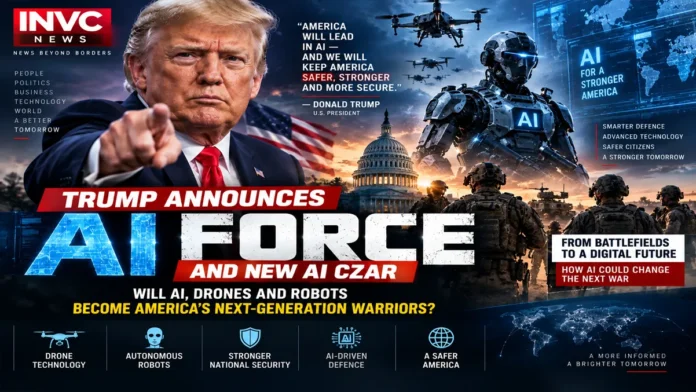
US President Donald Trump has announced plans to create a new “AI Force” and appoint an “AI Czar”, placing artificial intelligence even more firmly at the centre of America’s technology and national-security debate.
But one enormous question now hangs over Washington:
What exactly will Trump’s AI Force do?
The White House has not yet revealed its organisational structure, budget, leadership, legal authority or whether it will directly work with the US military.
Still, the announcement comes at a time when AI-powered drones, autonomous machines and robotic systems are rapidly changing how militaries prepare for future wars.
And America is already spending heavily to keep pace.
Trump Announces AI Force — But Leaves the Biggest Question Unanswered
Trump announced the AI Force on September 19 and said he would soon name an AI Czar.
He compared the idea with the creation of the Space Force during his first term, although the administration has not said that the AI Force will become a new branch of the US military.
The White House also did not immediately provide details explaining whether it will operate as a civilian body, a White House coordinating office, an inter-agency organisation or a national-security initiative.
That uncertainty makes one distinction essential:
Trump has announced an AI Force. He has not announced an army of autonomous combat robots.
At least not yet.
But America Is Already Preparing AI for National Security
The wider US strategy gives the announcement much more significance.
On June 5, Trump signed a National Security Presidential Memorandum ordering the national-security establishment to accelerate its adoption of advanced artificial intelligence.
The White House said the plan aims to put advanced, secure and reliable AI systems into the hands of American military and intelligence personnel.
It also ordered agencies to develop high-security computing infrastructure and rapidly introduce advanced AI models while maintaining systems that remain controllable and accountable through the chain of command.
In other words, America was already moving AI closer to military and intelligence operations before Trump announced the new AI Force.
The Numbers Reveal How Serious the Autonomous-Warfare Push Has Become
The scale of American investment is striking.
The US Defense Department’s FY2026 budget identified approximately $13.4 billion for autonomy and autonomous systems.
That included roughly:
$9.4 billion for unmanned and remotely operated aerial vehicles
$210 million for autonomous ground vehicles
$1.7 billion for autonomous systems operating on water
about $1.2 billion for underlying autonomy software and enabling capabilities
These are not theoretical laboratory experiments.
They form part of a much larger effort to integrate autonomous machines into real military operations.
Drone Warfare Has Already Changed the Battlefield
The Russia-Ukraine war has demonstrated how dramatically cheap drones can change warfare.
Small unmanned aircraft now perform surveillance, identify targets, carry explosives and challenge weapons systems costing many times more than the drones themselves.
The US Army openly says the experience in Ukraine is changing the way it prepares soldiers.
In September, the Army introduced a virtual-reality training system designed to teach units how to operate alongside friendly drones while defending themselves against hostile robotic swarms.
The Army described drone warfare in Ukraine as fundamentally changing modern combat.
That lesson is increasingly shaping American military planning.
Imagine Hundreds of AI Drones Moving as One
The next step may be even more consequential: drone swarms.
Instead of one operator controlling one drone, AI could allow multiple aircraft to coordinate their movements, divide an area between them, gather intelligence and share information.
The United States, Britain and Australia have already tested AI-assisted drone swarming.
During a 2026 military experiment, groups of drones autonomously divided sectors, searched designated areas and returned information to operators.
The US Air Force has separately explored systems that could deploy AI-controlled drone swarms to defend air bases.
This is where the idea of an AI-driven battlefield stops sounding futuristic.
Much of the technology already exists.
Robots Could Move Where Soldiers Face the Greatest Danger
Drones dominate the skies, but robotics development is also moving onto the ground.
The US Army recently showcased research involving AI, autonomous communications and multiple robotic systems designed to work alongside soldiers.
Army researchers say these technologies could protect personnel in hazardous environments while improving operational efficiency.
That could eventually mean machines entering dangerous areas before human troops.
Robots could potentially perform reconnaissance, transport supplies, detect threats or support combat missions.
But the US government has not said that Trump’s new AI Force will command such systems.
That remains an open question.
AI Could Become the Brain Behind the Machines
Robots and drones provide the physical platform.
AI provides something potentially more powerful: the ability to process enormous amounts of information quickly.
A battlefield can generate feeds from satellites, drones, radar, cameras, electronic sensors and intelligence databases simultaneously.
AI systems can potentially analyse that information much faster than human teams.
That could shorten the time between detecting a threat and deciding how to respond.
But it also creates serious questions.
What happens when the algorithm makes a mistake?
Who is responsible?
How much control should humans surrender to machines?
And should an AI system ever be allowed to make a lethal decision without meaningful human involvement?
Washington Says Human Accountability Must Remain
Trump’s June national-security AI directive specifically called for deployed systems to remain robust, controllable and accountable through established command structures.
That principle matters because increasingly autonomous weapons raise difficult legal and ethical questions.
An AI system may process information faster than a human, but speed does not eliminate the possibility of incorrect identification or software failure.
The debate over human control will therefore become more important as military AI grows more capable.
America Is Also Preparing to Fight Enemy Drones
The AI revolution works both ways.
The United States is not merely trying to build more autonomous systems.
It also has to defend against them.
The Pentagon has said increasingly sophisticated drones, supported by AI, autonomy and networking technologies, are changing how militaries and even non-state groups operate.
That creates a future battlefield where one AI-enabled network may have to detect, track and defeat another.
The conflict may involve humans making strategic decisions while machines execute much of the sensing, communication and movement underneath them.
China Is the Other Giant in the AI Race
Trump’s announcement also comes as strategic competition between the United States and China increasingly centres on artificial intelligence.
Washington and Beijing are competing over AI models, advanced chips, computing capacity and military applications.
Ahead of Trump’s upcoming meeting with Chinese President Xi Jinping, US officials have also proposed an AI security-notification mechanism designed to reduce risks when AI incidents threaten national security.
That produces an extraordinary contradiction.
The world’s two largest AI powers are racing to develop increasingly powerful systems while simultaneously discussing ways to prevent those systems from causing a crisis.
Will Robots Really Fight America’s Wars?
The short answer is:
They already participate in military operations in limited forms — but the future could be far more automated.
Drones already conduct reconnaissance and strike missions.
Autonomous systems already operate in the air, on land and at sea.
AI already assists intelligence and military decision-making.
The US military is already experimenting with swarms and human-machine teaming.
What remains uncertain is how far Washington will go.
The newly announced AI Force could become an important part of that story.
Or it could emerge primarily as a technology-policy and coordination body.
Until the administration publishes its formal structure, nobody can responsibly say that Trump has created a robot army.
One Thing Is Clear: Warfare Is Changing Fast
The wars of the future may not resemble the conflicts that defined the twentieth century.
Soldiers, aircraft and tanks will not necessarily disappear.
Instead, they may increasingly operate alongside autonomous drones, robotic vehicles, AI-assisted intelligence systems and machines capable of processing a battlefield at extraordinary speed.
Trump’s AI Force announcement therefore arrives at a pivotal moment.
The headline may be AI Force.
But the much larger story is the transformation already taking place behind it.
The next question for Washington is no longer simply whether the United States will use artificial intelligence in national security.
It already does.
The real question is:
How much of tomorrow’s battlefield will eventually be entrusted to machines?