New Delhi, India | August 21, 2026
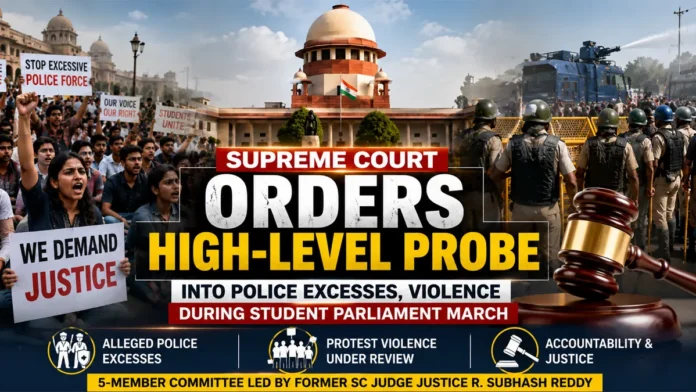
Supreme Court student protest probe: India’s Supreme Court has constituted a five-member High-Powered Enquiry Committee headed by former apex court judge Justice R. Subhash Reddy to independently examine allegations of excessive police force and violence during student protests in New Delhi and other parts of the country.
The inquiry follows clashes during the July 20 protest march from Jantar Mantar toward Parliament, which was linked to anger over alleged examination paper leaks, including the NEET controversy.
Importantly, the investigation will not be limited to allegations against police and security personnel. The committee will also examine claims of violence against law enforcement officers and injuries suffered by security personnel.
The court has asked the panel to conduct a continuing assessment and submit interim findings periodically.
Justice R. Subhash Reddy to Head Five-Member Committee
Former Supreme Court judge Justice R. Subhash Reddy will chair the High-Powered Enquiry Committee.
The other four members are:
- Former Punjab and Haryana High Court Chief Justice Ravi Shankar Jha
- Former Delhi High Court judge Justice Shalinder Kaur
- Former Central Bureau of Investigation Director Rishi Kumar Shukla
- Former Meghalaya Director General of Police L.R. Bishnoi
The committee combines judicial and senior law-enforcement experience as it examines competing allegations surrounding the protests.
Alleged Use of Pellet Guns, Electric Batons and Tear Gas Under Scrutiny
One of the most significant parts of the inquiry concerns allegations about the methods used to control protesters.
The committee has been tasked with examining allegations involving pellet guns, electric batons, lathi charges and tear gas.
It will assess whether the force allegedly used by police and other security agencies was excessive or disproportionate and whether adequate warnings were provided.
The broader question involves balancing law enforcement’s responsibility to maintain public order with the constitutional right to peaceful protest.
Alleged Violence Against Police Will Also Be Investigated
The inquiry will examine both sides of the July 20 confrontation.
Alongside allegations against security personnel, the panel will investigate claims that violence was directed at police and security forces.
This includes examining injuries suffered by personnel and allegations that criminal or disruptive elements may have infiltrated the demonstrations and contributed to violence or vandalism.
That dual mandate is significant because the Supreme Court has sought an independent examination rather than accepting either side’s version of events at face value.
Allegations Involving Women Protesters Get Priority
The Supreme Court has identified allegations involving women protesters as a priority area.
The committee will examine claims of targeted violence, harassment and molestation involving female demonstrators.
The court has asked for an early interim report on priority issues, underscoring the seriousness of these allegations.
The inquiry will establish the facts surrounding the claims and determine the circumstances in which the alleged incidents occurred.
CCTV, Drone and Body-Camera Footage to Be Examined
Digital evidence could play an important role in establishing what happened during the demonstrations.
Authorities had previously been directed to preserve material connected to the protests, including CCTV footage, drone footage, body-worn camera recordings, videography, wireless communication records and PCR call logs.
That material is to be made available to the High-Powered Enquiry Committee.
The records could help reconstruct the sequence of events and determine how decisions concerning crowd control and use of force were made.
Police Identification and Nameplates Also Under Review
Another issue before the committee concerns the identification of police and security personnel during protests.
The panel will consider the need to ensure officers wear proper uniforms and visible nameplates while making arrests or using force during crowd-control operations.
Clear identification can become particularly important when allegations of misconduct arise because it allows individual officers and their actions to be identified.
The issue therefore goes directly to transparency and accountability during public-order operations.
Prohibitory Orders and Peaceful Protest
The inquiry will also examine the use of prohibitory orders under Section 163 of the Bharatiya Nagarik Suraksha Sanhita and whether such restrictions are being applied in ways that unnecessarily prevent peaceful demonstrations.
Another question concerns the application of legal provisions against protesters and whether they could have the effect of suppressing legitimate political dissent.
These issues give the case significance beyond the July 20 demonstrations because the court’s consideration could influence how authorities manage future protests.
Supreme Court Retains Larger Constitutional Questions
While the committee will conduct the fact-finding inquiry, not every issue has been delegated to it.
Broader constitutional questions concerning areas such as facial-recognition technology, surveillance and privacy will remain before the Supreme Court itself.
That distinction is important.
The committee’s role is primarily to establish facts and examine specific allegations surrounding the protests, while the apex court will retain authority over wider questions of constitutional law.
Committee Asked to Submit Interim Findings
The Supreme Court has indicated that the inquiry should not be treated as a one-time exercise.
Instead, the committee is expected to conduct continuing and periodic assessments and submit interim findings.
The constitution of the committee also does not prevent police authorities or other security agencies from initiating their own administrative or disciplinary action against officers found to have violated applicable rules.
The next major development will be the committee’s first interim report, particularly its findings concerning the alleged use of excessive force and allegations involving women protesters.
The investigation could ultimately have implications extending well beyond a single demonstration, particularly for police accountability, crowd-control practices and the protection of the constitutional right to peaceful protest in India.