SINGAPORE | August 21, 2026
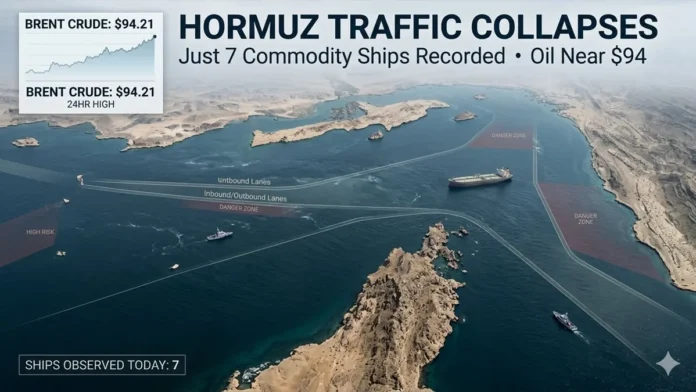
Strait of Hormuz shipping remains severely disrupted as preliminary tracking data showed only seven commodity vessels crossing the critical Middle East energy chokepoint on Thursday, while the continuing U.S.-Iran standoff keeps global oil markets on edge.
The latest vessel count was lower than Wednesday’s eight recorded crossings and remained well below the levels normally associated with one of the world’s most important maritime energy routes.
More significantly, the vessels tracked Thursday did not include any very large crude carriers, or VLCCs, or tankers transporting liquefied natural gas.
That absence underscores the continuing disruption to conventional large-scale energy movements through the strait.
At the same time, Brent crude was trading near $94 a barrel on Friday and was on course for another strong weekly increase as traders assessed the risk of prolonged supply disruption.
Only Seven Commodity Vessels Cross Hormuz
Ship-tracking data showed seven commodity vessels moving through the Strait of Hormuz on Thursday.
Four were entering the Gulf while three were leaving.
The total was down from eight vessels Wednesday.
Although day-to-day movements can fluctuate, the broader picture remains one of exceptionally limited traffic through a waterway that historically handled enormous volumes of crude oil, petroleum products and liquefied natural gas.
Some vessels may also travel with their transponders switched off, meaning they would not necessarily appear in conventional tracking data.
For that reason, vessel counts should be understood as observed traffic rather than an absolute count of every ship physically passing through the area.
No VLCC Crude Tankers or LNG Carriers Recorded
One of the most striking aspects of Thursday’s data was the absence of very large crude carriers and LNG tankers.
VLCCs are among the most important vessels in international oil trade because they can transport enormous quantities of crude over long distances.
LNG carriers are similarly important for moving liquefied natural gas from Gulf producers to major Asian and European markets.
Their absence from observed traffic illustrates how dramatically normal energy-shipping patterns have been affected.
One Large Gas Carrier Uses Iranian Route
The observed traffic did include a very large gas carrier transporting propane and butane.
The vessel exited the Gulf using the Iranian route through the strait.
Very large gas carriers, or VLGCs, primarily transport liquefied petroleum gases such as propane and butane rather than crude oil or LNG.
The movement shows that the strait has not become completely devoid of commodity traffic.
However, the overall volume remains extremely limited compared with its traditional role in global energy trade.
Why the Strait of Hormuz Matters to the World
The Strait of Hormuz is a narrow maritime passage connecting the Persian Gulf with the Gulf of Oman and Arabian Sea.
Before the current disruption, roughly one-fifth of global crude oil and LNG shipping moved through the waterway.
Major Gulf energy producers rely heavily on the route to reach international markets.
That makes disruption at Hormuz fundamentally different from a problem affecting an ordinary shipping lane.
Any sustained reduction in traffic can influence oil availability, tanker rates, insurance costs and ultimately energy prices across the world.
Oil Holds Near $94
Energy markets continue to reflect those concerns.
Brent crude was around $93.82 a barrel on Friday, while U.S. West Texas Intermediate crude was near $86.78.
Brent has gained more than 7% during the week, while WTI has risen more than 8%.
Oil is therefore heading toward a second consecutive weekly increase.
The gains reflect concern that the unresolved conflict and restricted Gulf shipping could continue limiting supplies from some of the world’s largest petroleum-producing countries.
Saudi Arabia, Iraq, UAE and Kuwait Are Important to the Equation
The Hormuz problem extends far beyond Iranian exports.
Saudi Arabia, Iraq, the United Arab Emirates and Kuwait are major global energy producers whose export logistics can also be affected by disruption around the Gulf.
Some producers have alternative routes or infrastructure that can reduce dependence on Hormuz, but those alternatives cannot necessarily replace the full capacity normally moving through the strait.
That means prolonged disruption can tighten global supply even if production facilities themselves remain operational.
US-Iran Diplomatic Standoff Continues
The shipping crisis is unfolding against the backdrop of a continuing diplomatic impasse between Washington and Tehran.
Expectations that negotiations might produce a breakthrough have weakened.
The United States is simultaneously increasing economic pressure on Iran, with Washington signaling a much tougher sanctions campaign.
Iran, meanwhile, has rejected U.S. economic pressure and remains defiant over the dispute.
Without a diplomatic breakthrough, shipping companies face uncertainty over when normal commercial traffic can safely return.
Why This Matters for India
The situation is particularly important for India because the country imports most of the crude oil it consumes.
A prolonged increase in international oil prices can raise India’s energy-import bill and increase demand for U.S. dollars to pay for crude.
That can put pressure on the rupee.
Expensive oil can also increase costs for transportation, aviation, manufacturing and industries that depend on petroleum-based inputs.
If those costs persist, they can eventually contribute to broader inflation.
Petrol and Diesel Prices Come Into Focus
Indian consumers naturally want to know whether expensive crude will lead to higher petrol and diesel prices.
There is no automatic one-to-one relationship between daily international crude movements and retail fuel prices in India.
Domestic prices depend on several factors, including exchange rates, taxes, refining economics and pricing decisions by oil-marketing companies.
However, the longer crude remains elevated, the greater the economic pressure created by expensive imports.
That makes Hormuz shipping conditions relevant even to households thousands of kilometers away from the Gulf.
Tanker and Insurance Costs Are Another Risk
The price of crude itself is only part of the problem.
Operating a commercial tanker through a high-risk maritime region can become substantially more expensive.
Shipowners may demand higher charter rates.
Insurance premiums can rise.
Crews and operators may also become reluctant to enter the area unless security conditions improve.
Those additional logistics costs can ultimately become part of the delivered price of energy.
Markets Watching Every Vessel Movement
Because Hormuz is so important to global energy supplies, vessel-tracking data has become a major market indicator.
A sustained increase in VLCC and LNG-carrier crossings could indicate that confidence is returning.
Continued single-digit traffic, particularly without large energy tankers, would suggest that normal trade remains far from restored.
Oil traders will therefore continue monitoring both diplomacy and actual ship movements rather than relying solely on political statements about whether the waterway is open.
What Happens Next?
Three developments will be critical.
First, whether large crude and LNG tankers begin returning to the strait.
Second, whether Washington and Tehran make any progress toward renewed negotiations.
Third, whether Brent crude remains near current levels or pushes higher as the disruption continues.
For India, each of those developments matters.
A normalization of Hormuz traffic could ease some of the geopolitical premium embedded in oil prices.
Continued disruption, however, could keep crude expensive and maintain pressure on the rupee, inflation and India’s broader energy bill.
For now, the latest shipping data sends a clear signal: the Strait of Hormuz may not be completely without traffic, but one of the world’s most important energy highways remains far from normal.