
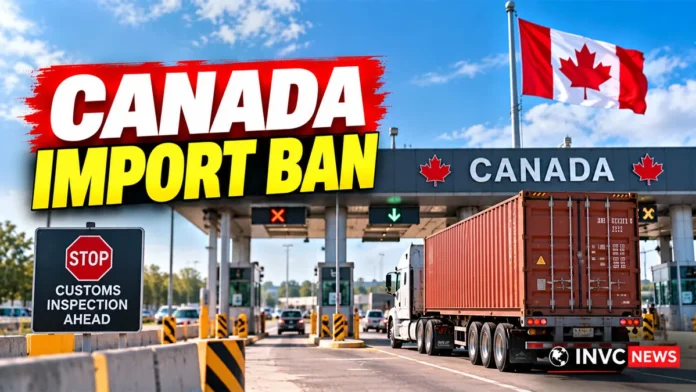
WASHINGTON, United States | October 1, 2026 — The U.S. ban on Canadian imports has moved parts of the trade dispute from higher prices to blocked shipments. Selected alcoholic beverages, whey products and large-engine motorcycles now face import restrictions, potentially affecting American retailers, manufacturers and buyers awaiting deliveries. However, the details matter: the measure targets specific product classifications, and some alcohol restrictions depend on packaging. The nearly $1 billion headline describes estimated past trade covered by the ban—not a confirmed loss or a prohibition on everything Canada sells to Americans.
INVC NEWS | BEYOND THE HEADLINE
What happened. Why it matters. What comes next.
THE 60-SECOND BRIEF
- The restrictions took effect at 12:01 a.m. Eastern Time on September 29, 2026.
- They cover selected Canadian alcoholic beverages, whey products, other listed goods and motorcycles in a specified engine category.
- American Action Forum trade policy director Jacob Jensen estimates the affected imports at $967 million, using 2025 trade figures.
- Alcohol accounts for approximately 87% of that estimate.
- Product classification, packaging and import timing determine how the restrictions apply.
What Has Changed at the Border?
U.S. Customs and Border Protection has instructed officials to reject new imports of covered Canadian products from the effective date.
That changes the commercial calculation. A tariff increases the cost of an eligible shipment; an import prohibition prevents a covered shipment from entering.
Businesses therefore cannot assume that paying the earlier tariff will allow them to continue importing a newly prohibited product.
However, Customs guidance preserves specified treatment for goods imported before the deadline. Qualifying merchandise already in bonded warehouses or foreign-trade zones may enter domestic commerce subject to the applicable 50% duty.
Which Products Does the Ban Cover?
The restrictions follow detailed customs classifications rather than broad descriptions such as “Canadian dairy” or “Canadian motorcycles.”
| Product group | What the official guidance identifies |
| Alcoholic beverages | Selected classifications, with packaging or other scope conditions where specified |
| Whey products | Whey protein concentrates and several modified, fluid and dried whey categories |
| Other listed goods | Specified molasses categories and non-alcoholic beer |
| Motorcycles | The listed classification for motorcycles and related cycles with reciprocating internal-combustion piston engines above 800 cc |
This distinction matters for buyers and importers. A product’s Canadian origin alone does not establish whether this particular prohibition covers it.
Why Packaging Matters for Canadian Alcohol
Customs says that alcohol entries marked “Packaged” in the relevant annex cover bottles, cans, boxes, kegs and similar containers intended for direct consumption.
Alcohol outside an applicable scope condition avoids that import exclusion, although the relevant 50% tariff can still apply.
Consequently, different shipping and processing arrangements can produce different outcomes for products associated with the same country.
For American shoppers, an immediate disappearance of every Canadian alcohol brand would therefore overstate what the measure does.
What Motorcycle Buyers Should Know
BRP confirmed that its Canadian-built Can-Am Spyder and Canyon three-wheel motorcycles fall under the restrictions, according to the Associated Press.
The company said it had already completed most production and shipments for the current season, limiting the immediate impact.
For prospective buyers, dealer inventory and future replenishment are separate questions. Existing availability does not establish whether dealers can obtain additional Canadian-built units under the new rules.
The customs classification also means readers should avoid treating the measure as a prohibition on every Canadian vehicle.
What the Nearly $1 Billion Figure Means
Jensen’s $967 million estimate measures the value of imports covered by the restrictions using 2025 data.
It does not establish how much business companies will lose in 2026. Actual effects depend on earlier tariffs, shipment volumes, existing inventory and companies’ ability to change distribution arrangements.
Alcohol’s approximately 87% share helps explain why beverage producers feature prominently in the dispute. Nevertheless, a smaller trade category can still face substantial disruption at the company level.
Why Smaller Producers Face a Harder Adjustment
Reuters reported that smaller Canadian alcohol producers face difficulties replacing U.S. sales with customers at home.
Provincial regulations and access to retail shelves complicate sales across Canada. Some larger producers may have more flexibility to shift bottling or distribution, while smaller distilleries often bottle locally.
That makes the problem broader than finding another buyer. Producers may also need a workable route into another market.
What Washington and Ottawa Say
The White House invokes Section 338 of the Tariff Act of 1930, arguing that Canada has maintained discriminatory treatment of American commerce. It presents the restrictions as a response to Canadian retaliation and barriers affecting U.S. producers.
Canada rejects that justification. A spokesperson for Canada-U.S. Trade Minister Dominic LeBlanc told the Associated Press that Ottawa would prioritize supporting affected Canadians and diversifying its international partnerships.
What Happens Next?
Buyers should watch delivery commitments and availability. Importers need to check the exact classification and scope of each product against Customs guidance.
The broader issue is whether negotiations restore access or companies reorganize supply chains around the restrictions. Until then, the practical impact will depend on the individual product—not simply the nearly $1 billion headline.











[…] News & Views – “Canadian Alcohol and Motorcycles Face U.S. Import Ban—What Buyers Need to Know” (Oct 1, […]
Comments are closed.