
NEW DELHI, INDIA | AUGUST 25, 2026 —
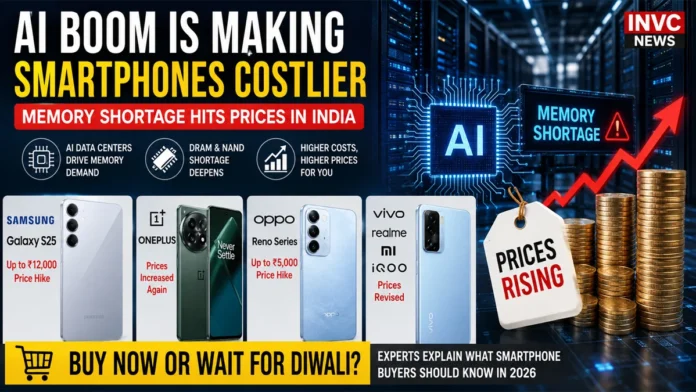
Smartphone prices in India are climbing again, and the reason goes far beyond ordinary inflation. The global artificial-intelligence boom is consuming enormous quantities of high-performance memory, tightening supplies of DRAM and NAND chips also used in phones, laptops and other consumer electronics.
The pressure is now visible on retail price tags.
Samsung has raised the price of select Galaxy S25 variants in India by as much as ₹12,000, while OnePlus and OPPO have implemented another round of increases across multiple models. Vivo, Realme, Xiaomi, iQOO and other brands have also revised prices during 2026 as component costs remain elevated.
For buyers, that creates a practical question ahead of India’s festive shopping season:
Should you buy a smartphone now—or wait and hope Diwali discounts beat the price hikes?
Samsung Galaxy S25 Gets Up to ₹12,000 Costlier
Samsung’s latest Galaxy S25 revision shows how sharp the pressure has become.
The 12GB + 256GB Galaxy S25 is now listed at ₹84,999, up from ₹80,999.
The bigger increase is on the 12GB + 512GB model, which has moved from ₹92,999 to ₹1,03,999—an increase of about ₹11,000 based on the reported old and new prices, while some market coverage has described the revision as up to roughly ₹12,000.
The 12GB + 128GB version remains at ₹74,999.
Samsung is not alone.
OnePlus has reportedly raised prices multiple times since late 2025, while OPPO’s latest round includes increases of as much as ₹5,000 on select Reno-series models.
Why Is AI Making Phones More Expensive?
The link runs through memory chips.
AI servers require huge quantities of specialized memory, including high-bandwidth memory, or HBM. Memory manufacturers are therefore directing more production capacity toward lucrative AI infrastructure.
That leaves tighter supplies of conventional DRAM and NAND used in:
smartphones → laptops → tablets → SSDs → gaming devices.
IDC says AI infrastructure demand is competing directly with consumer-device manufacturers for limited memory-production capacity. It expects shortages to remain a significant problem through 2026 and potentially into 2027.
Also Read – : Reliance Meta AI Data Center: Jamnagar to Host Major AI Infrastructure Project
That creates an unusual side effect of the AI boom:
The same global investment making AI more powerful can also make your next smartphone more expensive.
India’s Smartphone Market Is Already Slowing
Higher prices are arriving at a difficult time for manufacturers.
India’s smartphone shipments fell 11.1% year over year in the April-June quarter, to about 33.2 million units, according to IDC data reported this month.
Shipments for the first half of 2026 were down 7.9%.
Globally, IDC now forecasts smartphone shipments to fall 13.9% in 2026, potentially the steepest annual decline on record, while average selling prices rise.
Budget buyers may feel the squeeze most because memory represents a larger proportion of the total manufacturing cost of cheaper phones.
Could Phones Come With Less RAM and Storage?
Possibly.
IDC says manufacturers facing expensive memory have several choices:
raise prices, reduce margins, or lower specifications.
That could mean some devices that might previously have launched with 12GB RAM and 256GB storage instead arriving with 8GB and 128GB at similar price points.
In other words, consumers could face not only higher prices but also weaker specifications for the same money.
Also Read – : India, US Deepen Semiconductor and AI Partnership on Chips and Supply Chains
India-China Supply Chains Add Another Dimension
The impact is also being felt differently across manufacturers.
Chinese smartphone brands remain heavily exposed to India’s price-sensitive mass market, where even a ₹1,000-₹3,000 increase can influence buying decisions.
Samsung and Apple, by contrast, have greater scale, stronger premium positioning and longer-term supplier relationships, giving them more flexibility when component prices rise.
That is one reason 2026 could accelerate consolidation in India’s smartphone market.
India is simultaneously trying to expand domestic semiconductor and electronics production and reduce vulnerabilities created by concentrated Asian supply chains.
Also Read – : India’s New FDI Rules Bring Fresh Focus to China-Linked Investment and Manufacturing
Should You Buy a Phone Now or Wait for Diwali?
For buyers who need a phone immediately, waiting solely for a dramatic base-price reduction may be risky.
Memory costs remain elevated, and more price revisions are possible.
However, buyers targeting premium models may still benefit from festive-season:
- Bank discounts
- Exchange bonuses
- No-cost EMI
- Credit-card offers
- Retailer inventory clearance
The key is to compare the final checkout price, not just the advertised discount.
A phone advertised as “₹10,000 off” during Diwali may not actually be cheaper if its base price was increased beforehand.
Bottom Line
The AI boom is creating an unexpected consumer-tech problem.
As data centers absorb more memory capacity, smartphone manufacturers are facing higher DRAM and NAND costs—and Indian consumers are increasingly paying the difference.
Samsung, OnePlus, OPPO and several other brands have already revised prices.
For buyers, the smartest strategy now is simple:
Track the actual selling price today and compare it with the final festive-sale price—not the size of the discount banner.
AI may be transforming computing.
It may also be making your next smartphone considerably more expensive.











Comments are closed.