By Team INVC | INVC NEWS
Published: October 9, 2026 | 06:04 PM IST
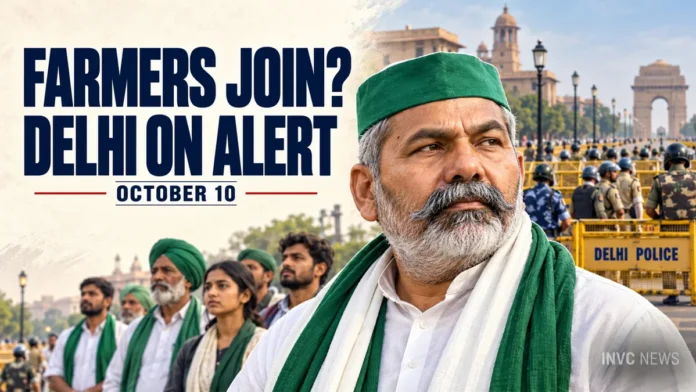
NEW DELHI, India | October 9, 2026 — The political stakes around Saturday’s planned protest in New Delhi have risen sharply after farmer leader Rakesh Tikait’s Bharatiya Kisan Union extended support to the Cockroach Janta Party’s October 10 mobilisation, potentially widening the gathering beyond its original youth base.
At the same time, Delhi Police has dramatically tightened security across the capital.
More than 20,000 police and paramilitary personnel have been deployed ahead of the planned demonstration, according to police officials, while authorities have made clear that permission has not been granted for a protest at Jantar Mantar.
The combination of farmer support, youth mobilisation and an unusually large security deployment has turned October 10 into a major law-and-order and political test for the national capital.
Tikait Support Could Change the Scale of the Protest
The Bharatiya Kisan Union has publicly extended support to the planned CJP protest.
CJP representatives said Tikait had appealed to farmers and supporters to reach Delhi for the mobilisation.
Supporters who are unable to travel to the capital have also been encouraged to raise their concerns locally and submit memoranda in their respective districts.
CJP leader Abhijeet Dipke publicly thanked Tikait for backing the protest, describing the mobilisation as part of a wider campaign around democracy and voting rights.
The immediate question now is how many farmers will actually travel to Delhi on Saturday.
Support from a prominent farmer leader does not automatically establish the size of the turnout, and authorities have not released any independently verified estimate of how many farmers are expected to arrive.
20,000-Plus Security Personnel Deployed Across Delhi
Delhi Police has significantly strengthened security arrangements ahead of October 10.
A senior police officer has said that more than 20,000 police and paramilitary personnel are being deployed across the city to prevent any breach of peace and maintain traffic and public order.
Additional central forces have also been brought in.
Security preparations are particularly intense around the New Delhi district, where Jantar Mantar is located.
Authorities have also increased surveillance and barricading at several locations as they prepare for possible attempts by groups to move toward restricted areas.
The deployment reflects police concerns that large groups could converge on Central Delhi from different directions.
No Permission for Jantar Mantar Protest
Delhi Police has said it has not granted permission for the October 10 protest at Jantar Mantar.
Police officials have appealed to people not to participate in unauthorized gatherings and have asked the public to follow law-and-order restrictions.
Authorities have cited multiple factors behind the decision, including the timing of the application, concerns over traffic disruption and previous alleged violations during demonstrations.
CJP, however, has challenged the restrictions.
Dipke has said the protest will proceed and has argued that peaceful assembly is a democratic right.
That sets up a direct confrontation between the organizers’ stated intention to demonstrate and the police position that the proposed gathering lacks authorization.
What Is the CJP Protest About?
The CJP-led demonstration is centered on demands related to electoral processes and the functioning of the Election Commission.
The organizers have been campaigning against the Special Intensive Revision exercise and have raised allegations about deletion of names from voter rolls.
They have also demanded accountability from Chief Election Commissioner Gyanesh Kumar.
The Election Commission has defended the revision process and has maintained that voters who are wrongly excluded can use prescribed procedures to seek restoration of their names.
Because of the political sensitivity of the issue, claims made by both protesters and political groups require careful attribution rather than being presented as established findings.
Farmers Could Give the Protest a Wider Political Base
Tikait’s support matters because farmer organizations have a demonstrated ability to mobilize large groups and sustain protests over extended periods.
BKU’s involvement could also broaden the protest narrative beyond students and young activists.
However, it remains unclear how extensively farmer groups will mobilize for Saturday’s demonstration.
The difference between an endorsement and a large physical turnout is significant.
That is why the most important development to watch on October 10 will be whether farmer groups arrive in substantial numbers or largely express solidarity from outside Delhi.
Abhijeet Dipke Says Protest Will Go Ahead
Despite the denial of permission, Dipke has said the planned protest will continue.
He has also criticized restrictions affecting transport and movement in the capital.
CJP has alleged that supporters in different states have faced police notices, detentions and other preventive action ahead of the protest.
Those claims have not all been independently verified.
Delhi Police, on the other hand, says its measures are aimed at maintaining law and order and ensuring the movement of ordinary residents and commuters.
Rail and Metro Disruptions Raise the Stakes
The security measures are already affecting travel.
Rail authorities have announced numerous cancellations and schedule changes involving services linked to New Delhi and Hazrat Nizamuddin.
A railway list shared with INVC NEWS contains 66 cancellation entries, including Magadh Express, Tejas Rajdhani, Sampoorna Kranti, Shatabdi and several other long-distance and regional services.
Two Mumbai-origin services in the same railway list have also been rescheduled by five hours.
Railways has separately indicated that operations at several other major Delhi stations are expected to remain normal, although passengers have been advised to verify individual train status before traveling.
Transport disruption means the impact of the protest is already extending beyond participants to ordinary commuters.
Why October 10 Matters
Saturday’s events could become a significant test of three competing forces.
The first is the protesters’ ability to mobilize supporters despite restrictions.
The second is the extent to which farmer organizations join the campaign.
The third is the ability of Delhi Police to maintain security and traffic movement without escalating tensions.
If the gathering remains peaceful and limited, the day could pass primarily as a political demonstration.
If significantly larger groups attempt to move toward restricted areas, authorities could face a much more complex crowd-management challenge.
What Should Delhi Residents Do?
People traveling through Central Delhi on October 10 should expect delays, security checks and possible route restrictions.
Commuters should verify railway and Metro status before starting their journey and avoid relying on unconfirmed social-media messages.
Delhi Police has also urged residents to avoid rumors and follow official instructions.
Those who are not participating in the demonstration may want to avoid unnecessary travel through heavily secured parts of New Delhi until restrictions ease.
Why You Should Read This Story
This is no longer just a routine political protest.
Tikait’s backing introduces the possibility of farmer participation, while the deployment of more than 20,000 security personnel shows how seriously authorities are treating the situation.
The outcome could affect commuters, students, farmers, political groups and residents across Delhi.
Why This Story Is Worth Sharing
Many people may only hear that a protest is planned.
But the real impact extends much further—train cancellations, possible Metro restrictions, road barricades, heavy security and the prospect of a broader farmer-youth mobilisation.
Sharing accurate, verified information can help people distinguish confirmed developments from rumors and make safer travel decisions.
The Bottom Line
Rakesh Tikait’s support has raised the political profile of the CJP’s October 10 mobilisation.
Delhi Police, meanwhile, has responded with a deployment of more than 20,000 police and paramilitary personnel and has reiterated that the proposed Jantar Mantar protest has not been authorized.
The key question now is not merely whether the protest takes place.
It is who turns up, in what numbers, and whether the mobilisation remains peaceful amid one of the capital’s heaviest security deployments in recent months.