By Team INVC | INVC NEWS
INVC NEWS | BEYOND THE HEADLINE
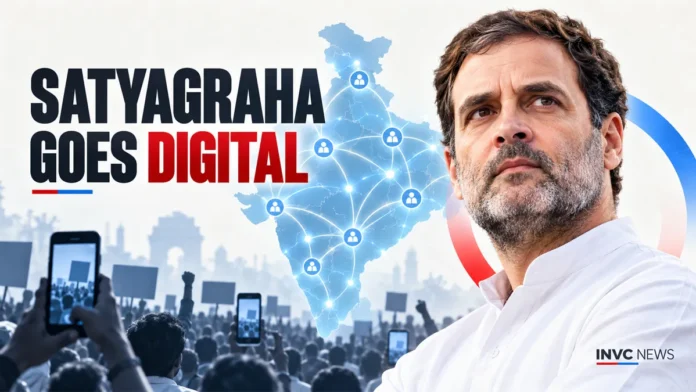
NEW DELHI, India | October 4, 2026 — A local campaign can struggle to attract attention beyond its district. The Rahul Gandhi Satyagraha platform aims to change that by bringing issue-based protests onto a shared digital map. Gandhi launched the initiative on October 3 and invited people to register their movements. For students, farmers and rights groups, the immediate question is practical: can greater visibility lead to meaningful support? The announcement explains how Gandhi wants people to participate. Its effectiveness, however, will depend on what follows each submission.
THE 60-SECOND BRIEF
- Rahul Gandhi launched the Satyagraha digital initiative on Saturday, October 3.
- He invited people to submit information about their campaigns through a website form.
- The initiative seeks to connect people who campaign on similar issues.
- Gandhi pledged to explore support through Parliament, public advocacy and correspondence.
- Registration expresses a request for support; the announcement does not guarantee a resolution.
What Happened
Gandhi, the Congress leader and Leader of the Opposition in the Lok Sabha, introduced Satyagraha through a social media announcement and an accompanying video.
He described a range of campaigns involving land, education, examinations, women’s rights, and Dalit and OBC rights. He said people often pursue these demands separately and proposed bringing their accounts together.
The launch followed Gandhi Jayanti by one day. Congress also published an official announcement dated October 3.
Rather than asking participants merely to endorse a political message, Gandhi invited them to describe their own movements. He said his team would explore how it could assist.
Why It Matters
The initiative gives readers a specific development to assess: an opposition leader wants to create a common point of contact for different public campaigns.
For a student group, that could mean finding others who face comparable examination grievances. Similarly, a land-rights campaign could seek visibility beyond its immediate community.
Those possibilities explain the platform’s appeal. Yet visibility alone cannot establish whether an allegation is accurate or persuade an authority to change a decision.
The key distinction is between documenting a grievance and resolving it. A useful follow-up should show what organizers submitted, how the team responded and whether the relevant authority took action.
How Participation Is Supposed to Work
Gandhi asked people to visit the Satyagraha website, fill out a form and enroll their movements.
According to his explanation, the initiative would bring accounts together on a map and help participants identify people pursuing similar causes. He also said his team would get in touch to explore support.
However, the launch statements reviewed for this report do not establish a guaranteed response deadline or a standard outcome for every submission.
Participants should therefore judge the initiative through its follow-through: acknowledgment, contact, specific assistance and a clear explanation of the next step.
What Each Side Says
Gandhi presented the initiative as part of his responsibility as Leader of the Opposition. He argued that people fighting injustice need stronger connections and support.
He also alleged that authorities suppress truth. That remains his political characterization; the launch itself does not establish the merits of individual complaints.
The launch material reviewed for this report does not include a specific government or BJP response to the platform. Any later response should address the initiative directly rather than rely on unrelated political exchanges.
For individual disputes, the relevant department, institution or other party should also have an opportunity to answer the allegations.
Numbers That Matter
The most important confirmed date is October 3, 2026, when Gandhi announced the initiative.
Early dashboard figures also offer a limited snapshot. Moneycontrol reported on October 3 that the website displayed 421 submissions, including 83 concerning education access, 66 concerning corruption and 45 concerning farmer issues.
Those figures reflect that report’s observation time. They do not represent a verified October 4 total.
Moreover, submission counts cannot measure how many complaints have supporting evidence, how many people each campaign represents or how many disputes the initiative has helped resolve.
The Bigger Picture
INVC NEWS’s assessment is that Satyagraha’s significance will depend on whether it turns public submissions into sustained engagement.
A common map may help people discover related campaigns. Nevertheless, different disputes require different responses. An examination complaint, a land disagreement and a demand for better healthcare each involve distinct evidence and decision-makers.
Consequently, a national platform will need to preserve those details as it connects participants. Its credibility will grow through specific, documented cases rather than submission totals alone.
What Happens Next
The next useful developments will involve examples of follow-up: whom the team contacted, what support it offered and how authorities responded.
Readers should also watch for clearer information about complaint review, participant data and progress tracking. These details would help people understand what happens after they complete the form.
Until then, the launch establishes Gandhi’s stated intention to connect campaigns. It leaves the scale and effectiveness of the promised assistance open.
INVC NEWS Bottom Line
Satyagraha offers a proposed route from a local grievance to wider political attention. Its real test begins after registration: whether participants receive concrete support and whether that support helps move their demands toward a response.